Mirror Review
November 13, 2025
The longest US government shutdown in American history, lasting 43 days, officially ended on November 12, 2025.
Congress passed a funding bill late Wednesday after an intense standoff that froze major federal services, delayed paychecks, and shook confidence across agencies and markets.
The US Government Shutdown Vote in the House of Representatives cleared the chamber by a narrow margin, allowing the government to reopen and workers to return.
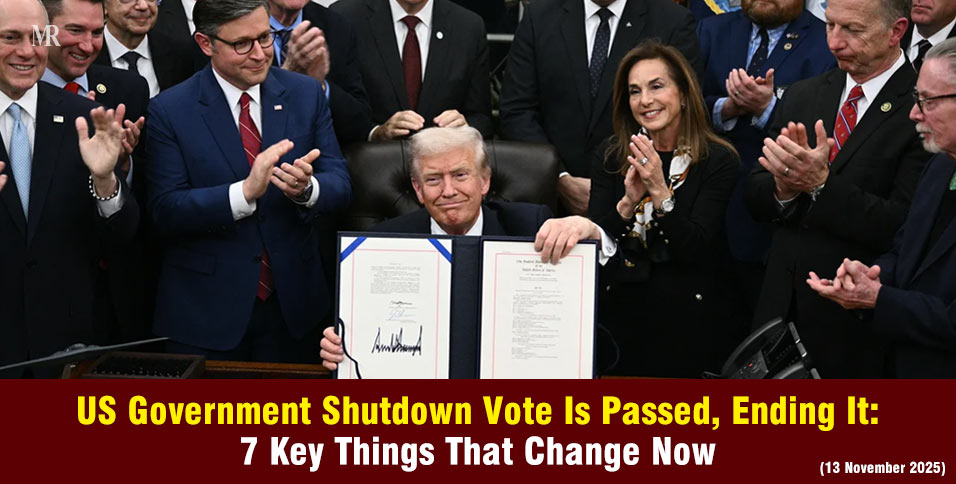
Shortly afterward, President Trump signed the bill, finalizing what had become a record-breaking impasse.
While operations will now resume, this moment marks more of a reset than a resolution.
7 Things That Change After The US Government Shutdown Vote
1. Federal Agencies Reopen, But Only Temporarily
The bill immediately restores funding, allowing agencies like the IRS, FAA, and EPA to restart halted operations.
However, because this is a continuing resolution, most funding only lasts until January 30, 2026, meaning another congress vote on shutdown could be necessary early next year.
This reopening provides short-term stability but also sets up another political showdown if no long-term budget deal is reached.
2. Federal Workers Receive Back Pay
Around 670,000 federal employees who were furloughed or working without pay will now receive back pay under existing law. Workers from the TSA, FAA, and national parks are among those returning.
Example: FAA employees in Atlanta reported being “weeks behind on critical inspection work.” With operations restarting, the government faces a significant backlog to clear.
3. Social Assistance Programs Restored
The SNAP food assistance program, WIC, and unemployment offices that were frozen during the shutdown are now funded.
The Department of Agriculture confirmed that SNAP benefits will resume within 24 hours, ensuring millions of families receive aid.
But this fix is temporary. If Congress fails to agree on a full-year spending plan, these programs could again be at risk.
4. Air Travel, Visas, and Permits Resume
The FAA and Transportation Security Administration (TSA) return to normal operations after the US Shutdown impacts airlines, improving air travel reliability. The State Department can also resume issuing passports and visas, while national parks reopen across the country.
Example: During the shutdown, Yosemite and Grand Canyon saw closures that cost nearby communities millions in tourism revenue. Those parks will now fully reopen, though cleanup and restoration are ongoing.
5. Political Fallout: Winners and Losers
The government shutdown house vote revealed deep divides within both parties.
- Mike Johnson managed to push through a deal despite opposition from hardliners in his own party, earning cautious praise for “getting the job done.”
- Democrats, including Adam Gray, who voted to end the shutdown, risk backlash from progressives but gained bipartisan credibility.
- President Trump’s government shutdown response shifted from confrontation to conciliation, positioning him as the deal-closer ahead of the 2026 budget debate.
Political analysts suggest that both parties will use this episode as leverage for next year’s campaign narratives, with Republicans framing it as fiscal discipline restored, and Democrats as governance rescued.
6. Unresolved Issues: Health-Care Subsidies Still Stuck
The Affordable Care Act premium tax credits, which Democrats had demanded to extend, were excluded from the final bill. The White House said there would be a separate vote in December.
Sen. Tim Kaine noted, “We’ve ensured funding for families who rely on SNAP and essential programs, but the ACA issue is still on the table. This is far from over.”
This unresolved fight guarantees that healthcare remains a flashpoint in the next vote on government shutdown debates.
7. Economic Impact: Recovery Begins, But Not All Losses Are Reversible
The 43-day shutdown cost the U.S. economy billions in lost productivity and delayed contracts. Analysts estimate a loss of about 0.3% in quarterly GDP due to suspended operations and unpaid workers.
Small businesses dependent on federal clients, such as contractors and suppliers, face the toughest road back.
Example: Defense contractors in Virginia reported “weeks of lost production” that may not be recoverable even with back pay.
Economist Lydia Baines told Reuters, “It’s like restarting a stalled engine. The system restarts, but it doesn’t immediately hit full speed.”
The House Vote: How the Shutdown Was Ended
The House shutdown vote that brought an end to the crisis passed 222–209, just a few votes above the majority threshold required.
- How many votes to pass a bill in the House: A simple majority of at least 218 votes is needed to pass.
- How many votes were needed to end shutdown: In this case, 222 votes ended the 43-day halt.
Speaker Mike Johnson, who faced pressure from both sides, called it “a necessary compromise to restore order.”
The Continuing Appropriations and Other Extensions Act, 2026 funds most government agencies until January 30, 2026, while others, like agriculture and veterans’ programs, are funded through the full fiscal year.
The Congress vote today saw six Democrats breaking ranks to support the Republican-sponsored measure. They were:
- Adam Gray (California)
- Henry Cuellar (Texas)
- Jared Golden (Maine)
- Don Davis (North Carolina)
- Marie Gluesenkamp Perez (Washington)
- Tom Suozzi (New York).
California’s Adam Gray, a moderate Democrat, explained his vote by saying, “This wasn’t about politics; this was about paychecks and stability.”
Representative Thomas Massie (R-Ky.), who had been vocal against previous spending deals, also backed the government shutdown vote, saying, “We can’t afford to paralyze federal operations just to score points. Americans expect solutions, not standoffs.”
The Senate approved the bill 65–33, and President Trump signed it hours later, declaring, “We can never let this happen again. This is not how America should function.”
With the House bill passed and signed by the president, the longest US government shutdown officially ends, at least for now.
Conclusion
The US Government Shutdown Vote brought the country’s longest shutdown to a close, but only partially.
Agencies reopen, paychecks return, and aid flows again, yet the bill’s short-term nature leaves a storm cloud on the horizon.
With President Trump’s signature ending the standoff, and Mike Johnson’s House leadership barely holding together competing factions, the U.S. government has bought itself time, but not stability.
The next congress vote on shutdown in early 2026 could again test how effectively Washington can govern without grinding the country to a halt.
For now, America breathes a sigh of relief. But the underlying divisions that caused the shutdown remain unresolved, making this a pause, not peace.