Mirror Review
October 31, 2025
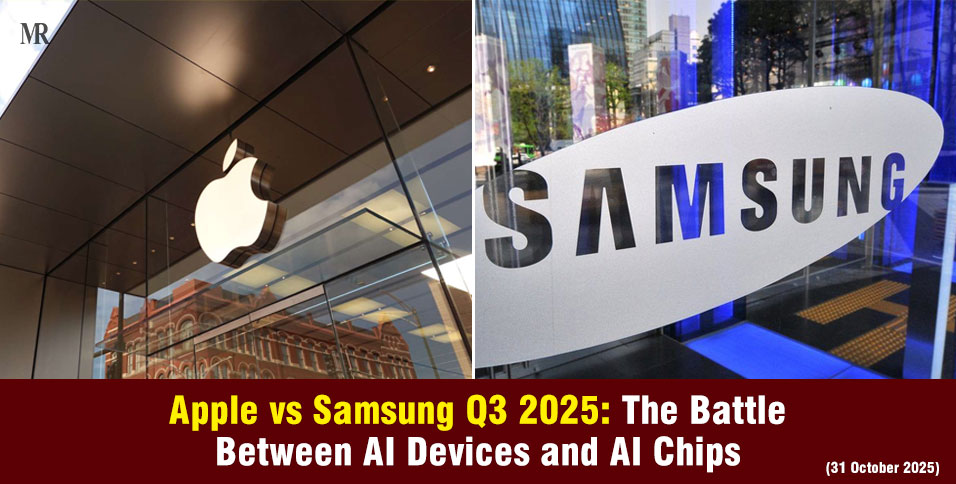
The Apple vs Samsung rivalry entered a new phase after both companies reported their Q3 2025 earnings last week.
Apple posted $102.5 billion in revenue, up from $94.9 billion last year, powered by stronger iPhone, Mac, and Services demand.
Samsung, meanwhile, reported KRW 86.1 trillion (~ $64B) in revenue and a sharp jump in operating profit to KRW 12.2 trillion (~ $9.2B), thanks to record-high sales of AI memory chips like HBM3E.
This is the foundation of the evolving AI devices vs AI chips battle: one where Apple grows through devices and services, while Samsung surges on chips and infrastructure.
1. Apple’s AI Device Strategy Is Turning Into Real Revenue
Apple’s Q3 2025 looked exactly like a company benefiting from an AI-driven upgrade cycle.
Key Apple Q3 2025 Numbers
- Total revenue: $102.46B
- iPhone revenue: $49.0B (up YoY)
- Mac revenue: $8.7B
- Services: $28.75B, a record high
- Net income: $27.46B
- EPS: $1.85
The biggest driver was the AI-centric iPhone lineup powered by the new M-series neural engines. Apple’s approach is clear: Build AI features directly into devices, and lock the value into Services.
Why Apple’s device-led model works
- The iPhone is still the world’s most profitable consumer product.
- AI upgrades (camera intelligence, on-device GenAI, real-time translation, personal automation) encourage faster replacement cycles.
- Apple’s Services engine adds recurring revenue per user from subscriptions, iCloud+, App Store, and AI-powered features.
This quarter shows that Apple isn’t trying to dominate AI hardware; it’s trying to dominate AI experiences. And experiences create stickiness.
As Apple CEO Tim Cook said in the earnings call, “The best AI is the one you don’t feel — it just works.”
This line reflects Apple’s long-term strategy: AI as a seamless layer inside its ecosystem, not a standalone feature.
2. Samsung’s AI Chip Power Is Becoming Its Main Growth Engine
Where Apple rises through devices, Samsung rises through factories.
Samsung’s Q3 2025 was the company’s strongest in years because the world is hungry for the one thing Samsung leads globally: AI memory and foundry technology.
Key Samsung Q3 2025 Numbers
- Revenue: KRW 86.1T (~ $65B)
- Operating profit: KRW 12.2T (~ $9.2B) — up 159% QoQ
- DS (chips) revenue: KRW 33.1T (~ $25B)
- Memory revenue: KRW 26.7T (~ $20B) — record high
The real driver: AI infrastructure spending
Samsung’s memory unit expanded HBM3E shipments as cloud companies rushed to secure supply for AI data centers.
Key highlights from the earnings release:
- HBM3E demand surged with AI model training expansion.
- Samsung began mass production of 2nm GAA chips, a major milestone in foundry leadership.
- Fab utilization improved as one-time costs fell.
Samsung technologies are rapidly becoming the base layer supplier for the AI world, from memory to logic chips to displays.
Moreover, Samsung’s growth engine has clearly shifted from smartphones to semiconductors.
This shows one clear trend in the Apple vs Samsung battle: Samsung is winning the supply chain side of the AI revolution.
3. A Shift in the Apple Vs Samsung Rivalry: Two Different Lanes of AI Growth
Instead of fighting for the same prize, the two giants now dominate different parts of the AI value chain. This is what makes Q3 2025 a turning point.
Apple controls the AI front-end
This includes:
- AI smartphones
- AI PCs (M-series Macs)
- Wearables
- Services revenue
- App ecosystem and developer platform
Apple’s AI plays are consumer-facing.
Samsung controls the AI back-end
This includes:
- HBM3E and upcoming HBM4 memory
- 2nm GAA node manufacturing
- AI server memory
- Foundry producing chips for multiple global clients
Samsung’s AI plays are infrastructure-facing.
Why this matters
Consumers will associate AI with Apple’s product experience, but the infrastructure that powers the AI boom will largely carry Samsung’s imprint.
It’s a split that mirrors historical patterns:
- In the 2000s, Intel built the chips, and Microsoft built the experience.
- In the 2020s, Samsung builds the AI hardware, and Apple builds the AI experience.
This two-lane model explains why both companies can grow at the same time without eroding each other.
4. The Market Impact: Apple Stock vs Samsung Stock
Investors reacted differently to both earnings. For Apple Inc., shares rose modestly: after the Apple Q4 2025 results, Apple stock climbed roughly +0.57% during regular trading and a further +0.99% after hours, reaching about US$272.38. Meanwhile, Samsung Electronics Co., Ltd. shares jumped by over 5% immediately after its Q3 2025 earnings release, reaching a 52-week high.
Apple stock sentiment
Apple benefits from:
- Predictable Services revenue
- Strong device margins
- Reduced reliance on China
- Stable buybacks
Apple’s rising Services margins show the company’s shift into a recurring-revenue machine, which Wall Street loves.
Samsung stock sentiment
Samsung benefits from:
- The AI memory supercycle
- Higher chip ASPs
- Improved foundry utilization
- Early 2nm leadership
Samsung is historically cyclical, but AI infrastructure spending is making DS margins more stable.
What Comes Next
With both companies now on separate AI tracks, here are the most realistic forecasts based on current momentum.
| Prediction | Likelihood | Why |
| Apple’s Services revenue surpasses US$30 billion in the next quarter | High | Services already at ~US$28.75B and device upgrades + AI features bolster tailwinds. |
| Samsung’s HBM4 chips go into full production and further boost margins | Medium-High | They are shipping samples now and expect demand to exceed supply. |
| Apple boosts its AI acquisitions/investments in 2026 | Medium | Cook noted internal AI work and hinted at M&A or partnerships. |
| Samsung faces chip supply constraints for mobile devices due to prioritising AI memory | Medium | Executive commentary suggests memory demand may squeeze mobile/PC chip supply. |
Conclusion: Apple Vs Samsung — Two Paths, One AI Future
This quarter made one thing clear: Apple vs Samsung is no longer a head-on fight. It’s a two-lane AI race where both are winning different parts.
Apple leads the AI device and services lane, translating consumer demand into record revenue and a stronger ecosystem.
Samsung leads the AI chip and infrastructure lane, becoming the key supplier powering the global AI boom.
- Apple is becoming the AI experience leader.
- Samsung is becoming the AI hardware foundation.
And in the AI era, the companies that control the experience and the infrastructure can both thrive, just in very different ways.