Mirror Review
October 24, 2025
Intel Q3 2025 results marked one of the biggest corporate turnarounds in recent tech history.
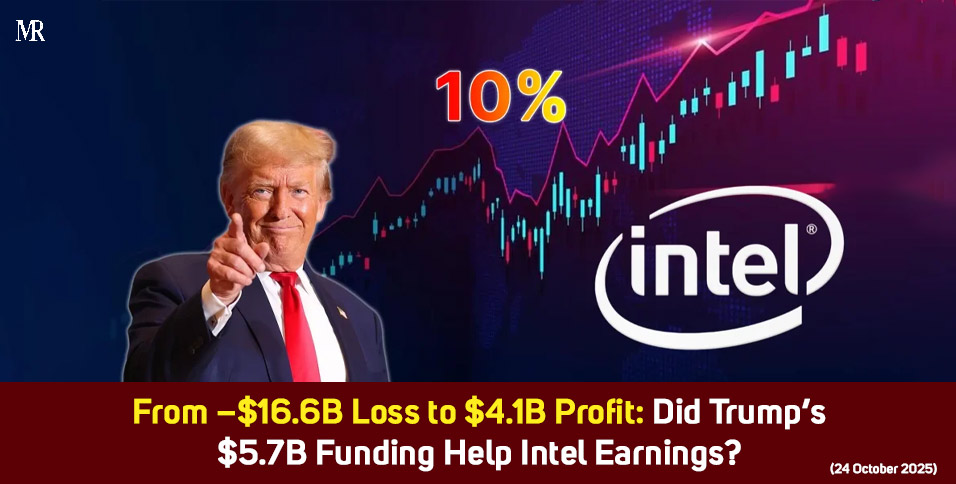
The chipmaker reported $13.7 billion in revenue, up 3% year-over-year, and a net profit of $4.1 billion, reversing a $16.6 billion loss from the same quarter last year.
The company’s gross margin surged from 15% to 38.2%, while operating margin flipped from a 68% loss to a 5% gain.
This is the fourth consecutive quarter of improved execution after Intel’s rocky years of falling behind AMD and NVIDIA.
CEO Lip-Bu Tan credited “improved execution and steady progress,” adding that AI-driven demand is “creating attractive opportunities across our portfolio.”
But what made the Intel earnings comeback possible?
Trump’s Historic $8.9B Bet on Intel
In August 2025, the Trump Administration converted earlier CHIPS Act grants into a 9.9% equity stake, buying 433.3 million Intel shares at $20.47 each. Of that, $5.7 billion was paid during Q3, directly benefiting Intel’s cash flow and balance sheet.
Commerce Secretary Howard Lutnick called it a “strategic investment in America’s semiconductor future,” while Tan described it as a “defining moment for U.S. tech leadership.”
The U.S. government Intel stake is passive with no board representation. But it sends a clear message: Intel is central to America’s plan to onshore chip production and reduce dependence on Taiwan.
Alongside government funding, NVIDIA invested $5 billion, and SoftBank added $2 billion to Intel’s stock, demonstrating broader industry confidence.
Combined, these moves gave Intel both cash and credibility to push forward with high-stakes chipmaking plans.
Intel’s AI and Foundry Bets Are Paying Off
- While Intel still trails in AI GPUs, its traditional x86 processors are back in demand as cloud providers and data centers expand their hybrid infrastructures, which mix CPUs and AI accelerators.
- Its Client Computing Group (PC and laptop chips) grew 5% to $8.5 billion, while Data Center and AI (DCAI) slipped slightly by 1% to $4.1 billion.
- Intel’s foundry business, which fabricates chips for itself and others, recorded $4.2 billion in revenue, down 2% YoY.
- Moreover, its Arizona Fab 52 is now fully operational, producing Intel 18A wafers, the most advanced logic wafers made on U.S. soil.
These milestones, along with partnerships with Microsoft, Dell, HP, and AWS, mark Intel’s slow but steady progress toward self-reliant manufacturing.
Was the Government Money the Turning Point for Intel?
It’s hard to ignore the timing: Intel’s turnaround coincides almost perfectly with the influx of federal money and AI-focused collaborations.
The company admitted it took “meaningful steps to strengthen the balance sheet” through accelerated government funding and private investments.
Furthermore, CFO David Zinsner noted that “demand is outpacing supply, a trend we expect to persist into 2026.”
That statement hints that Intel’s comeback isn’t just monetary luck — it’s structural.
The funding allowed Intel to speed up production, cut losses, and rebuild investor confidence after years of underperformance.
However, Intel also cautioned that its accounting for U.S. government transactions is under SEC consultation due to the complexity of treating government equity stakes. This is a reminder that its profit numbers could still be revised.
Intel’s Future: Still a Work in Progress
Despite the strong Intel Earnings, the company still has a lot of work to do to regain market share.
It’s yet to secure major foundry customers, and its Q4 forecast suggests a modest slowdown, with revenue expected between $12.8B and $13.8B and GAAP EPS possibly turning negative again at –$0.14.
Yet, the Intel stock price has surged nearly 90% since Trump’s investment, trading around $38, signaling renewed faith from Wall Street.
Analysts say Intel’s comeback could reshape the semiconductor landscape, especially if it manages to prove its 18A process is competitive with TSMC.
As one market watcher put it, “Intel may not be leading the AI race yet, but it’s back in the game — and this time, Washington’s betting on it.”
Bottom Line: Intel’s Comeback Is as Political as It Is Technical
Intel Q3 results prove that government backing can revive even a struggling tech titan — but it’s not just about money.
The funding, combined with AI-driven demand and strategic partnerships, gave Intel a shot to regain credibility.
If this growth continues, these Intel Earnings can prove that national policy and chipmaking can work profitably.
In short: Trump’s $5.7B bet may have helped Intel bounce back, but whether it sustains that momentum will depend on execution, not politics.