Mirror Review
September 18, 2025
Bluefors, a leading maker of ultra-low temperature cooling systems for quantum computers, has signed a Helium-3 lunar mining agreement with space resource company Interlune.
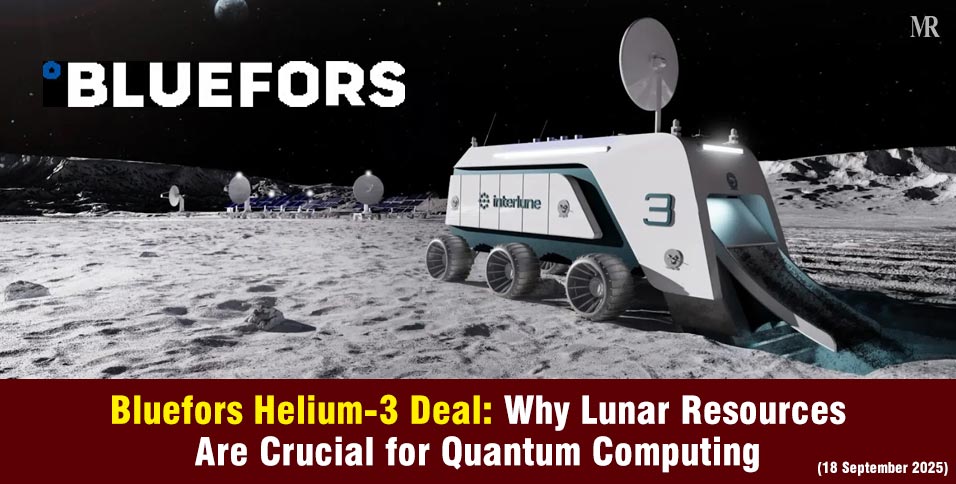
Starting in 2028, Interlune will supply Bluefors with up to 10,000 liters of Helium-3 per year, harvested from the Moon.
The Bluefors Helium-3 deal marks one of the first commercial deals to mine space resources for a critical technology on Earth. It ensures a stable future supply chain for quantum computing.
1. Earth’s Helium-3 Supply is Running Out
Helium-3 is a rare isotope vital to cryogenic cooling.
On Earth, we only get it as a byproduct of tritium decay from decommissioned nuclear weapons.
As stockpiles shrink, supplies are drying up, costs are soaring, and volatility is rising.
For companies like Bluefors, which provide the cooling backbone of quantum computers, this poses a major risk.
Gary Lai, Co-founder and CTO of Interlune, underscored the urgency: “Future quantum systems will demand more Helium-3 than is available on planet Earth.”
2. Quantum Computers Depend on It
Quantum computers need qubits cooled to near absolute zero to work
Bluefors’ dilution refrigerators use a mix of Helium-3 and Helium-4 to reach these extreme temperatures.
Without reliable Helium-3, scaling up quantum systems to commercial levels would stall.
3. The Moon Holds Vast Reserves
Unlike Earth, the Moon has no magnetic shield to block the solar wind.
Over billions of years, this bombardment has deposited huge amounts of Helium-3 into the lunar regolith, possibly over a million metric tons.
Interlune’s mission is to extract it and ship it back, and this deal provides the first clear demand signal for lunar mining.
4. Securing the Quantum Supply Chain
By locking in long-term Helium-3 access, Bluefors is protecting not just its own operations but also the wider quantum ecosystem that depends on its cryogenic systems.
CEO Rob Blaauwgeers framed the move as building “cooling technologies that will unlock the potential of quantum computing even further.”
He further stated: “Interlune will provide the huge amounts of Helium-3 that the quantum industry needs in the coming years to drive innovation, commercialization, and progress forward.”
5. Kickstarting the Space Resource Economy
This deal makes lunar mining more than science fiction.
It connects a pressing Earth-based need, quantum computing, with an off-world solution.
Success could trigger a broader space economy, where mining the Moon and other celestial bodies supports industries back on Earth.
The Bluefors–Interlune Helium-3 deal is a major step that links quantum technology and space resources, creating a future for both.
Opportunities and Risks Of Lunar Mining
The implications of this Bluefors Helium-3 deal are massive, but challenges remain, and not all experts are convinced:
- Technical risks: Mining and transporting Helium-3 from the Moon requires technologies not yet proven at scale.
Scientists like Florian Vidal caution that the challenge is immense: “Helium-3 holds promise for both quantum technologies and clean nuclear fusion, but its concentration in lunar soil is extremely low. Extracting useful quantities would require moving enormous volumes of regolith.”
- Cost barriers: Launching payloads from Earth to the Moon and back remains expensive, though falling launch costs may help.
Oxford physicist Frank Close offered another skeptical view: “The idea that Helium-3 is the magic bullet for clean energy is misleading. The technical hurdles are immense, and the cost of getting it back from the Moon may outweigh the benefits.”
- Environmental impact: Lunar mining could disrupt scientific studies of the Moon’s surface and raise ethical questions about space exploitation.
Astrophysicist Martin Elvis warned: “Mining the Moon’s scientifically valuable regions could irreparably damage our ability to study the early solar system and the universe. Once disturbed, these records are gone forever.”
- Regulatory hurdles: International space law on resource ownership is still not clearly defined, raising potential geopolitical disputes.
Still, the opportunities are hard to ignore. A stable Helium-3 supply could supercharge quantum computing, which in turn could accelerate AI development, pharmaceutical innovation, clean energy design, and national security applications.
A New Era for Quantum and Space
The Bluefors–Interlune Helium-3 deal is more than a resource contract.
It’s a bridge between two frontier industries of quantum computing and space mining that could reshape global technology and economics.
But it also raises a serious question:
Should humanity exploit celestial bodies for short-term gain, or protect them as shared heritage?
The answer may define how we approach not just the Moon, but Mars, asteroids, and beyond.
If the Bluefors Helium-3 deal pays off, future generations may look back at 2025 as the year lunar resources became essential to Earth’s most advanced technologies and the moment we crossed a mark into a truly space-driven economy.