Mirror Review
September 12, 2025
U.S. President Donald Trump recently requested that the European Union impose the same 100% tariff on India and China.
The real question now isn’t if these tariffs will come, but when.
While the EU has already pushed back, the timing of Trump’s move now depends on trade talks, political bargaining, and Trump’s broader strategy against what he calls “unfair trade.”
As one Brussels diplomat told the Financial Times, “The EU does not make policy at the request of Washington.”
That rejection doesn’t end Trump’s plan, but it does slow things down.
Without EU alignment on the Trump tariff on India, America will likely go on alone, and the start date will be shaped as much by politics as by economics.
When Were the Tariffs Announced?
- Late August 2025 – Trump floated the idea of 100% tariffs, accusing India and China of “taking advantage of American workers.”
- September 6, 2025 – By executive order, he added a 25% duty on Indian imports linked to Russian oil, effective September 27.
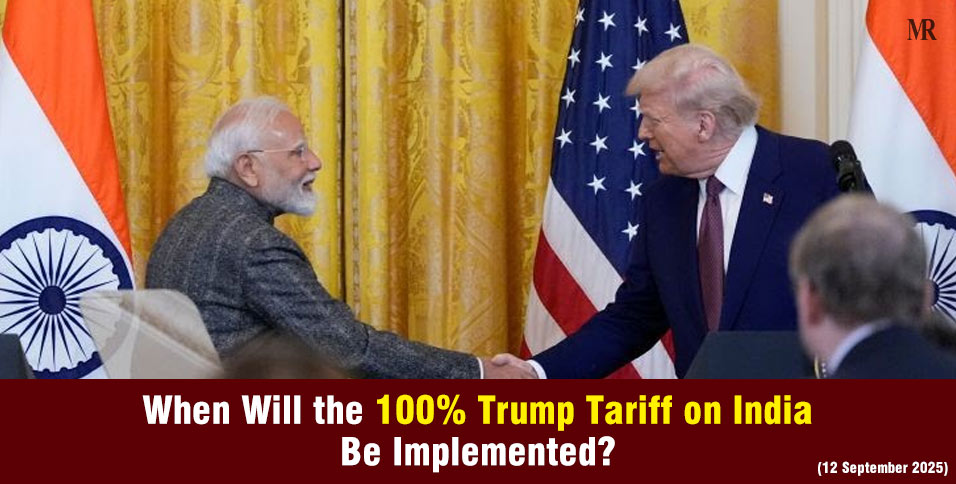
- September 10, 2025 – During talks with Prime Minister Narendra Modi, the 100% tariff threat dominated discussions.
- September 11, 2025 – Trump urged the EU to impose the same tariff, reviving his 2018 trade-war rhetoric.
India now faces 50% tariffs (a 25% base plus the new 25%). The question is whether Trump will double it to 100%.
What Do Spokespersons Say?
- U.S. Trade Representative’s office has been tight-lipped, only confirming that “all options are on the table” regarding Indian imports.
- Indian officials have publicly warned that retaliatory tariffs would follow. “India will not sit idle if our exports are unfairly targeted,” Commerce Minister Piyush Goyal said in New Delhi.
Moreover, the EU’s refusal is critical as it weakens Trump’s leverage and slows the timetable.
So, When Could The 100% Tariffs Be Implemented?
The U.S. process for new tariffs involves publishing notices, allowing comment periods, and setting official start dates. Historically, this takes 30–60 days.
Because the U.S. already has 50% tariffs in place, raising them to 100% would require another formal order, trade notifications, and possibly a court ruling if challenged.
- Earliest possible window: Late November–December 2025, if the administration moves fast.
- More likely window: Q1 2026, if negotiations drag or Trump saves the announcement for maximum political impact during the primaries.
Are Negotiations Still Ongoing?
Yes. A lot of things are still being worked out:
- The U.S. wants India to reduce or stop purchases of Russian oil. That is central to the tariff threat.
- On India’s side, areas like agriculture and energy are sensitive. India is pushing to protect its interests. India has also made clear it won’t stop buying Russian oil, despite higher costs from U.S. tariffs. That means even if a deal is possible, it might come with exceptions.
- Also, while the U.S. wants partners like the EU to align, the EU has already signaled reluctance. That puts more pressure on U.S. domestic policy and legal authority.
Prime Minister Narendra Modi has described the recent talks as “positive,” saying both sides are “working to wrap up the discussions at the earliest.”
How Are Tariffs Pushing India and China Closer?
One of the biggest unintended consequences of Trump’s tariff threat is the way it is nudging India and China closer together.
- On September 5, 2025, Chinese Foreign Minister Wang Yi met his Indian counterpart S. Jaishankar in Beijing, where both sides issued a joint statement saying they would “strengthen economic coordination amid external pressures.”
- Trade data shows India–China bilateral trade hit $141 billion in 2024, and early 2025 figures suggest the pace is holding steady despite border tensions.
- In a press briefing on September 8, 2025, Chinese Foreign Ministry spokesperson Lin Jian said: “Beijing welcomes closer cooperation with India in the face of unilateral trade measures from third countries.”
- An Indian official, speaking to Livemint, added that India is “not seeking alignment but will expand trade with all partners when opportunities arise.”
U.S. officials are watching this carefully.
A former State Department adviser told Bloomberg: “The U.S. doesn’t want to wake up and see Asia’s two largest economies forming a deeper economic front. That would dilute Washington’s leverage not only on trade, but also on security issues in the Indo-Pacific.”
This India–China factor complicates Trump’s timing.
Every delay in tariff implementation increases the chance of closer coordination between New Delhi and Beijing. This is an outcome the US wants to avoid.
Predictions On What Happens Later?
- Short-term delay: With the EU out of the picture, implementation is unlikely before late 2025. The more probable window is Q1 2026.
- Symbolic rollout: Trump may target a small set of Indian exports first such as textiles or auto parts, before expanding tariffs.
- Election timing: Expect a high-profile announcement closer to the Republican primaries, maximizing political drama.
- Retaliation risk: India could impose duties on U.S. farm goods, hurting American exporters in states that matter during elections.
- Global ripple: If tariffs expand, supply chains for pharmaceuticals, IT services, and even rare earths could be disrupted.
Has Trump Already Implemented Tariffs on Others?
Yes, but not yet in this second term.
In his first presidency (2017–2021), Trump imposed more than $370 billion worth of tariffs on China, steel tariffs on allies, and targeted European goods.
That history makes his current threats credible.
As of now (September 2025), no 100% tariff has been formally enacted on India or China.
But the legal groundwork is underway, and business lobbies in Washington expect moves within months.
Final Word
The 100% Trump tariff on India isn’t here yet, but it’s no longer just campaign talk.
Based on history, negotiations, and political incentives, the most likely implementation window is late 2025 to early 2026, unless India concedes on trade demands earlier.
What makes this round different is Europe’s refusal to play along, China’s improving relations with India, and the India-Russia bond.
That leaves Trump with fewer allies, more risks of retaliation, and a narrower timeline to act.
So the real question isn’t if the tariff will come, it’s how, when, and at what cost.