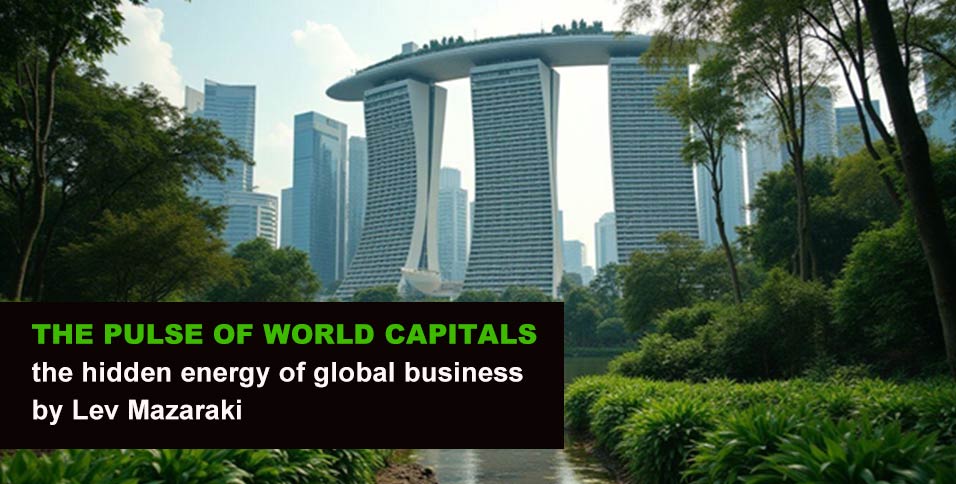
World capitals are often perceived through the lens of tourist attractions – they are judged by the beauty of their historic centres and the height of their famous skyscrapers. However, behind this glossy facade lies another, far more powerful mechanism: the world of business, which defines global economic flows. It is this side, hidden from most eyes, that I, Lev Mazaraki, strive to document. I want to share my vision of how architecture, the rhythm of the streets, and people shape the unique business character of each metropolis.
This series of photographs is a visual exploration of the behind-the-scenes life of New York, Tokyo, London, and Singapore. It is an attempt to capture their true pulse, which beats in steel structures, is reflected in glass facades, and resounds in the steps of millions of people who create the world economy.
New york: steel might and unceasing drive
New York is rightly considered the epitome of global capitalism. It is a city whose reputation is built on ambition and an unshakeable faith in progress. Its business energy is physically palpable; it literally permeates the Manhattan air, turning it into an arena for the boldest financial and creative endeavours.
Visually, this power is embodied in the canyons of glass and concrete. The skyscrapers here are monuments to corporate power and indomitable will. The streets become arteries through which the city’s ‘blood’ flows in a continuous stream: yellow cabs, rushing financiers, and couriers. In my experience, nowhere else does architecture so clearly convey the idea of dominance and constant upward movement. This city is living proof that competition can be a creative force.
But behind this steel shell lies the human factor. The rhythm of life here is governed by the concept of the «New York minute» where every second counts. The faces of the people show not just haste, but utmost concentration and a focus on results. It is this unceasing individual drive of every participant in the process that creates the collective energy that makes New York the undisputed financial centre of the world.
Tokyo: a futuristic vision and strict discipline
Tokyo is a unique phenomenon – a metropolis where the technological future has already arrived, but instead of replacing, has organically merged with centuries-old cultural codes. The business world here operates according to the laws of precision, efficiency, and collective responsibility, which radically distinguishes it from Western models.
Tokyo’s organisation is visible in everything: from the impeccably clean streets and precise lines of its futuristic architecture to the perfectly tuned public transport system. The Marunouchi business district is a model of how an urban environment can foster maximum productivity. There is no room for chaos here; every element, from navigation to the layout of buildings, is subject to strict logic and functionality.
In contrast to New York’s individualism, one feels the strength of the collective in Tokyo. The concentration and restraint in people’s behaviour speak of a deep respect for the common cause. This culture, based on discipline and attention to detail, allows for the creation of world-class innovations. Business here is like the coordinated work of a huge mechanism, where everyone’s contribution is important.
London: traditions and financial innovation
London is a city of contrasts, a historic crossroads where the age-old traditions of the British aristocracy meet the bold ambitions of the global financial avant-garde. It serves as a bridge between the old and the new world, between established rules and revolutionary technologies in finance.
This dualism is particularly noticeable in the architecture. The ultra-modern skyscrapers of the City of London, such as the «Gherkin» or the «Shard» stand alongside historic bank buildings and clubs where major deals have been made for centuries. A walk through these streets is a journey through time, where one can watch financial innovation literally sprouting through the layers of history.
London’s business culture is also dualistic. On the one hand, traditions are still strong here: a strict dress code, the importance of reputation, and the informal networks born within the walls of ancient universities. On the other, it is one of the most dynamic and open markets for innovation, a global hub for fintech and start-ups. It is this ability to combine conservatism with progressiveness that allows London to maintain its status as one of the key players on the global stage.
Singapore: a green oasis and a high-tech breakthrough
Singapore is an example of how a small island can be transformed into one of the world’s most influential business and technology hubs in just a few decades. It is a city-state built on the principles of strategic planning, innovation, and harmony with nature, which makes its business environment truly unique.
Singapore’s architecture is striking in its boldness and eco-friendliness. The famous “Supertrees” in the Gardens by the Bay and skyscrapers integrated with vertical gardens are part of a well-thought-out “city in a garden” concept. Here, every square metre is used with maximum efficiency, proving that urbanisation and nature need not conflict but can complement each other, creating a comfortable and productive environment.
Singapore’s success as a business centre is largely due to its openness to the world and its focus on human capital. It is a melting pot of cultures, attracting the best minds from all over Asia and other continents. Stability, security, and government support for innovation have created the ideal conditions for doing business. Singapore demonstrates a model of development based not on brute force, but on intellect, strategy, and the ability to look to the future.
A shared energy on a global scale
All these cities are united by an invisible yet tangible energy – the energy of global business. Through architecture and the flow of people, I try to show the driving force that shapes the world economy. This is a visual investigation into how people, ideas, and infrastructure create the complex and interconnected system that shapes the face of our world.