Mirror Review
August 28, 2025
Summary:
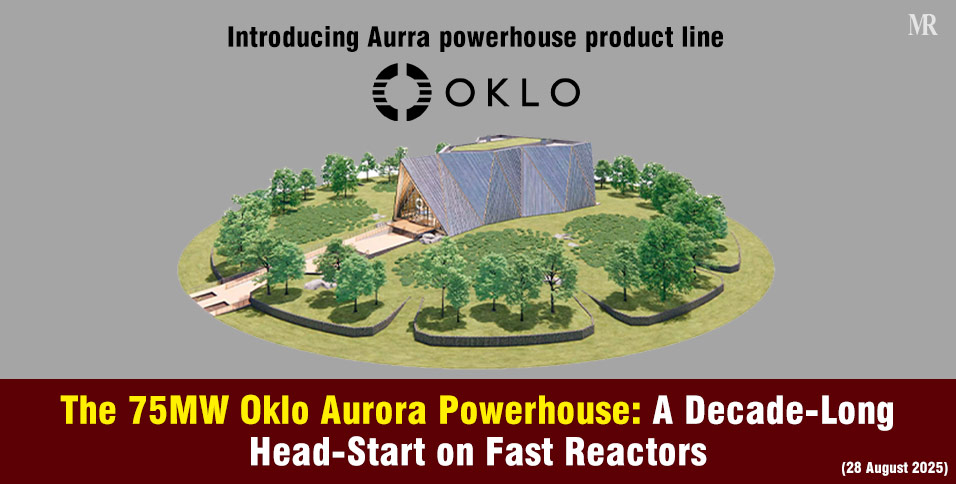
- Oklo is advancing its 75MW Aurora Powerhouse, a fast reactor that runs on recycled nuclear waste and is designed to be refueled only once a decade.
- The company has secured DOE support, regulatory traction, and EPC partners like Kiewit, targeting its first deployment by 2027.
- Recent collaborations with Vertiv, ABB, and Atomic Alchemy expand Oklo’s reach into cooling solutions for AI data centers and radioisotope production.
“Why should the future of AI data centers and clean power depend on a design tested back in 1964?”
That’s the bet behind the Oklo Aurora Powerhouse, a 75MW fast reactor now moving toward a 2027 launch.
Unlike other next-gen nuclear startups, Oklo leans on decades-old research at Idaho’s Experimental Breeder Reactor-II (EBR-II), where inherent safety and fuel recycling were proven long before today’s energy crunch.
A Reactor Built on History
Oklo’s Aurora Powerhouse isn’t starting from scratch.
Its design descends from the EBR-II fast reactor, which ran safely for 30 years and demonstrated passive shutdown even under extreme tests.
This lineage means Oklo is not only innovating, but also restoring proven technology with a modern twist.
- EBR-II Power Output: 20MW
- Aurora Powerhouse: 75MW (scalable, modular design)
- Fuel: Recycled nuclear waste from EBR-II, supplied by Idaho National Laboratory
This foundation gives Oklo a decade-long head-start compared to competitors still working through first principles.
Why 75MW Oklo Aurora Powerhouse Matters Now
AI data centers, defense bases, and heavy industries are chasing reliable, 24/7 clean energy.
Solar and wind can’t fully meet these demands, and large nuclear plants take decades to build.
Oklo’s Aurora, small enough to sit on a few acres, but powerful enough to run mission-critical sites, fills this gap.
- Refueling Cycle: Once every 10 years
- Footprint: A few acres, modular build
- Uptime Target: 90%+ capacity factor (matching commercial nuclear plants)
That makes the Aurora a natural fit for data center operators seeking stability amid rising AI-driven electricity demand.
Oklo’s USP: First-Mover Advantage
Oklo has consistently been “first” in key milestones:
- First advanced reactor site-use permit (DOE, 2019)
- First access to recycled nuclear fuel (INL award)
- First advanced reactor license application (submitted to NRC)
This track record is rare in the nuclear field, where delays and regulatory hurdles are common.
Partnering with Kiewit for construction and Vertiv for cooling, Oklo is building an ecosystem around the Aurora instead of a standalone product.
Expanding Beyond Electricity
Oklo’s strategy isn’t just about power:
- Heat Co-Generation: Supplying industrial processes
- Isotopes: Acquisition of Atomic Alchemy opens revenue in medical and defense isotopes
- Defense Deals: Selected to provide clean power to Eielson Air Force Base in Alaska
This diversification makes Oklo less dependent on a single revenue stream and strengthens its appeal to federal customers.
What to Expect Next
The real test lies in execution.
If Oklo brings its first Aurora online by 2027, it could unlock a new nuclear era that’s smaller, safer, and faster to deploy.
But fuel supply chains, regulatory approval, and financing remain hurdles.
Still, the Oklo Aurora Powerhouse offers a rare mix of history and innovation.
It’s not just another startup pitching nuclear power. It’s a company betting that a proven fast reactor design can solve 21st-century energy challenges.
Conclusion
The 75MW Oklo Aurora Powerhouse shows why starting early matters.
By blending fast reactor history with modern energy needs, Oklo has built a decade-long head-start that could put it years ahead of competitors in the race for reliable AI-ready power.