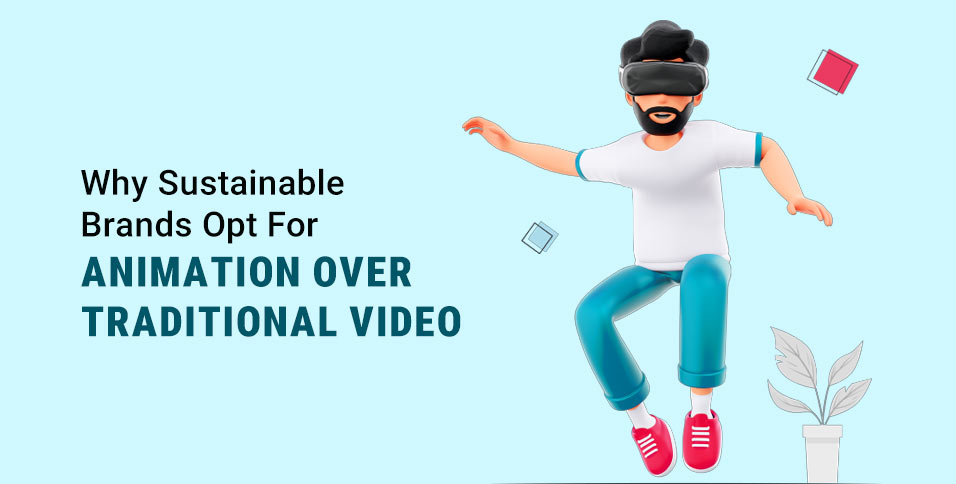
For socially conscious brands, marketing is all about making an impact while keeping things clear within budget. That’s why many choose animated content because it often lowers production emissions and simplifies reuse.
Animation gives teams control over every visual element without complex shoots or travel. Short animated clips are perfect for showing a product’s life cycle, highlighting recycled materials, or mapping out supply chain improvements.
It’s simply and visually the best way to tell a sustainability story step-by-step, and that kind of clarity builds trust with customers and stakeholders. Whether done through 2D or 3D, both animation styles give brands a chance to connect with their audience while creating less waste and more creative freedom.
Keep reading to learn how 2D and 3D animation support sustainability. We also compare formats used in 2d animation services and 3d animation services and offer practical steps for brands that want results and lower environmental impact.
Why Animation Makes Sense for Sustainable Brands
Animation reduces many production needs that add cost and environmental impact. Live action requires sets, crew travel, equipment, locations, and sometimes product shipping. Animation reduces or removes most of those needs.
Studios create visuals from files and render them digitally. Teams can reuse assets across videos, which extends the value from each production. Reuse reduces the need for repeated shoots. That lowers travel and transport emissions and saves money.
Animation also supports accurate sustainability claims. You can show material flows, recycled content, and circular design in a clear visual sequence. Brands avoid vague statements and present proof in a simple, visual way. This supports credibility and meets EEAT guidelines for trustworthy content.
How 2D Animation Helps Sustainable Storytelling
2d animation services offer a clean and efficient way to explain sustainability topics. The flat, graphic style simplifies complex systems. Brands can show steps in a supply chain, explain responsible sourcing, or display certification details.
Designers work with vector assets that scale without quality loss. That means the same files work across social posts, ads, and presentations. Teams produce new clips by rearranging existing assets rather than starting from scratch.
2d animation services also cost less on average than complex 3d projects. Lower cost lets brands create more content and keep messaging consistent. Frequent updates help maintain transparency over time, which matters for long-term sustainability communication.
How 3d Animation Adepth and Realism
3d animation services bring realism to product storytelling. Brands use 3d to showcase materials, textures, and assembly processes. A realistic 3d render can highlight recycled components, fit and finish, and how a product breaks down for recycling.
3d visuals work well for high-value or technical products where details matter. Industries like furniture, consumer electronics, and automotive benefit from 3d product spins and exploded views. These visuals help buyers understand construction choices and recyclable parts.
Even though 3d animation services may need more computing power, studios can optimize workflows to reduce render times and energy use. Techniques like reusing models, using efficient lighting setups, and batching renders help contain both cost and environmental impact.
Comparing the Environmental Impact of Animation and Live Action
Animation avoids many resource-heavy activities common to live production. No location rentals, no catering, no on-site electricity for lights, and no transport for large crews. These savings matter when brands aim to lower their carbon footprint and energy use.
Live shoots may still fit sustainability goals when teams minimize travel and work with local crews. But animation usually offers a clearer path to low-impact production, especially for recurring content.
Here is a simple comparison table to help decide
| Factor | Animation production | Live action production |
| Travel needs | Low | High |
| Set and props | Digital assets | Physical sets and props |
| Reuse potential | High | Low to medium |
| Controllable emissions | High | Low |
| Typical cost variability | Low to medium | Medium to high |
This table gives a practical view. Use it alongside your campaign goals and budget to choose the right form.
Practical Animation Use Cases for Sustainable Brands
Here is how sustainable brands can use short form animations to explain their message clearly and impactfully:
- Explain product materials with simple graphics using 2d animation services. Show what percentage of a product uses recycled content in a single fast clip.
- Demonstrate a repair or disassembly process using 3d animation services. A clear exploded view guides customers and repair partners.
- Map the lifecycle of a product using animated infographics. Combine 2d motion graphics with short 3d clips for key details.
- Create transparent sustainability reports with animated summaries. Short clips increase uptake and understanding compared to long PDF reports.
- Showcase circular design by animating how a returned product reenters manufacturing. Visual stories help stakeholders see the full process.
Cost Time, And Workflow Considerations While Using Animation
Animation can save money long term when you plan for reuse. Build a library of assets and templates. Reuse characters, icons, and models across campaigns.
For 2d animation services, plan for faster turnarounds. Teams often produce several short pieces per week once assets exist. That supports ongoing campaigns and frequent updates.
Meanwhile, in 3d animation services, allocate time for modeling, texturing, lighting, and rendering. Reusing models cuts time on future projects. Ask studios about render farm optimization and energy-efficient practices.
Work with creative teams to set clear deliverables. A tight brief reduces revisions and shortens timelines. When you specify format requirements for social platforms, you avoid rework and wasted render time.
Best Practices to Keep Animated Content Sustainable
Plan reuse from the start by creating modular assets. This reduces the need to rebuild scenes for each new video.
Optimize file formats and resolution for each channel. Do not render higher resolution than the platform needs. Lower file sizes reduce energy used during uploads and downloads.
Use incremental iterations instead of full remakes. Small changes to an existing animation cost less and consume fewer resources.
Ask your studio about their hosting and render processes. Some studios use cloud providers with renewable energy commitments. Choosing that route lowers the lifecycle emissions of production.
Prefer remote collaboration and review sessions. Avoid in-person sign-offs that force travel.
How to Measure Impact and Track Results
Track both content performance and production footprint. On the performance side, monitor view count, watch time, engagement rate, and shares. These metrics show whether the content educates or inspires action.
On the sustainability side track, the resources you avoid. Log reduced travel day,s fewer shipping events, and lower on-site days. Use these figures in reports to stakeholders and customers.
Combine both sets of data to make better decisions. If a style drives strong engagement and has a low production footprint, prioritize it for future work.
How to Choose Between 2D and 3D for Your Campaign
Think of 2d animation services as a fast and flexible option for ongoing education and social content. Use it for explainer clips, policy summaries, and quick updates.
Treat 3d animation services as a choice for products where detail influences purchase decisions. Use it for launching technical demos and premium storytelling.
Sometimes a hybrid approach works best. Start with 2d animation services for broad messaging and add 3d animation services for product deep dives. This combines scale and detail while keeping the overall impact low.
Checklist for Brands Starting with Animation
- Define the main message and call to action. Keep the clip focused on one outcome.
- Choose a format that matches the message. Use 2d animation services for clarity and speed. Use 3d animation services for realism and detail.
- Ask for reusable files and templates. Insist on source assets for future edits.
- Request a sustainability brief from your vendor. Ask how they minimize travel energy use and how they reuse assets.
- Set performance metrics and a review schedule. Check analytics and production logs monthly.
Closing Thoughts
Sustainable brands that choose animation gain a practical path to clearer communication and lower production impact. Animation supports sustainable storytelling by making complex ideas easier to grasp and easier to share.
Both 2d animation services and 3d animation services play useful roles. Choose based on message details, budget, and reuse potential. Plan for asset reuse, track both performance and footprint, and keep production lean.
Animation offers a way to show sustainability rather than just saying it. When brands show the steps they take in clear visuals, they build trust and create content that lasts.