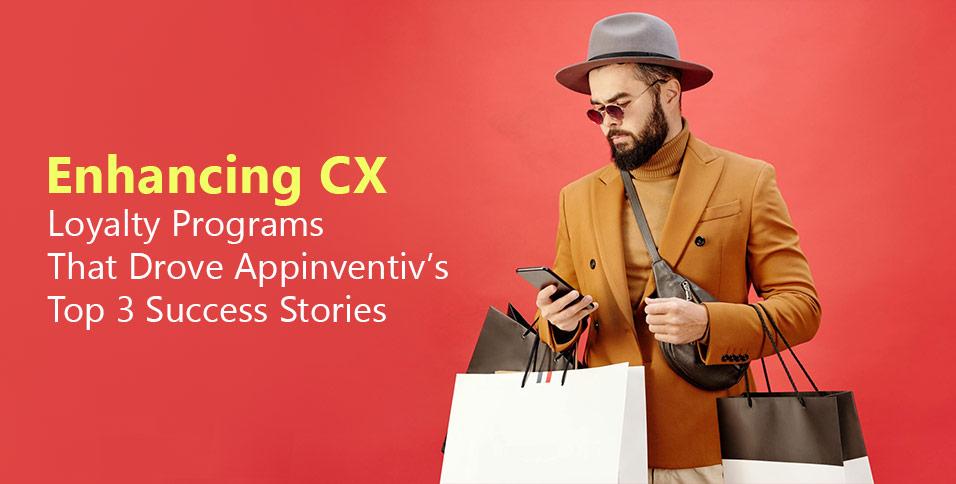
In a world where the user can change brand in an instant, quality Customer Experience (CX) attention is more than ever before – a competitive advantage – it is already a requirement. Customers today expect not only a consistent product, but also a customized approach and real value for their loyalty. This is where loyalty programs come to the forefront as a strategic tool to retain and engage with audiences. At Appinventiv success stories, we do not see loyalty programs as an add-on to mobile marketing, but an extension of a holistic digital ecosystem. They are an extension of the product that is supported by real-time data, integrated into mobile platforms and built on behavioral analytics. Not only does it enhance CX, but it also gives sustainable business results – from boosting the LTV to an organically growing user base.
In this article, we shall illustrate three actual instances where loyalty schemes have emerged as the formula for success. Whether it’s e-commerce, digital healthcare, or travel services, you’ll learn how effective reward tiers mechanics, gamification, and precise personalization can transform the entire course of user engagement.
Technologies that drive successful loyalty programs
We at Appinventiv believe that successful loyalty programs start with a deep understanding of the client and end with precise, technology-supported execution. We have seen over the past several years how the right combination of data, personalization, and UX can not only retain customers but also form a deep emotional connection with the brand.
1. Behavior analysis and segmentation
There is no loyalty analytics that is successful without data collection and analysis. We implement analytical systems which:
- track behavioral patterns (purchases, application usage, reaction to actions);
- create dynamic client segments;
- establish the rules for automatic triggering of personalized sentences.
We actively employ tools like Firebase Analytics, Mixpanel and our own ML models for user clustering by activity.
2. Personalization on the API level
Simple discounts do work. But true loyalty makes a personal approach. We design the software in such a way that:
- backend-services generated personalized offers in real time;
- push campaigns and email automatically adapted to user preferences;
- API interfaces offered flexible interaction with external partners and CRM integration systems.
Such an approach increases the relevance of offers and increases conversion of shares up to 3-4 times compared to “general” mailings.
3. Gamification and micro-interaction
It is important to us that the utilization of the loyalty program is accompanied by positive emotions. That is why we are implementing the next features of our loyalty program:
- system of levels, scores and achievements;
- Challenges and seasonal activities;
- Visual feedback on each action (animation, progress bars, badges).
We create very responsive UI native elements with the help of React Native and Flutter, and Framer Motion and Lottie for animation in a mobile app.
Tip: take a look at this page from food delivery application development company to learn more about case study insights.
4. Mobility and cross-platform
The user wants his loyalty program to function “everywhere and simultaneously”. We offer:
- frictionless integration of web and mobile channels;
- data synchronization in real time through Firebase/GraphQL/WebSockets;
- offline access to the most important parts of the program (e.g., collected points or discount QR-codes).
We want to make sure that the customer experience is good no matter what device or interaction channel is used.
Three Appinventiv success stories: how a well-designed loyalty program revolutionizes CX
Over the past two years, we at Appinventiv have seen how carefully designed loyalty programs can not only retain customers but also revolutionize the customer experience (CX) at all touchpoints. Here are three examples where our solutions have brought business sustainable growth through loyalty and user engagement.
Case 1: RetailBoost — how we increased repeat purchases by 30% in the omnichannel retailer
Context:
A large retail chain came to us with the task of increasing customer engagement and increasing LTV. The problem was the poor reactivity of users in the app and the lack of personalization.
Solution:
We designed and implemented a mobile loyalty program founded on real-time analytics and dynamic recommendations. The program included:
- Flexible scoring system;
- Personalized push notifications based on user behavior metrics;
- AI module to personalize discounts and promotions according to shopping history.
Result:
4 months after launch:
- re-purchases increased by 30%,
- average session length in the annex increased by 45%,
- Number of users abandoning has decreased by 19%.
Case 2: HealthFirst — improving treatment adherence with digital motivation
Context:
Our client — a web patient health management platform — required a solution to improve compliance in users, especially in long-term treatment courses.
Solution:
We introduced a motivation and loyalty program where patients were rewarded for compliance with the prescribed regime (reception reminders, completing a health diary, etc.).
Solution features:
- Gamed interface with achievement level system;
- API integration with activity tracking devices (wearables);
- Secure medical data processing according to HIPAA.
Result:
- Compliance with prescribed treatment increased by 25%;
- Daily activity rate of users increased by 38%;
- positive user feedback on the «feeling of care» in the app.
Case 3: TravelMate — as gamification and scoring system have revived interest in travel
Context:
The travel service has faced a sharp decline after the pandemic. The mission is to bring back users and to stimulate the frequency of bookings.
Solution:
We proposed to launch a gamified loyalty program with a focus on behavior in-app rewards. The program included:
- Points system for bookings, reviews, and referrals;
- RPG-style visual progress controller;
- Seasonal challenges and special screens for «frequent travelers».
Result:
- 40% increase of active users in 6 months;
- Increase in the number of bookings per user by 28%;
- increase in UGC content (reviews, photos, videos) by more than 60%.
Conclusion
In each of the three examples, we used detailed analysis of user behavior and built solutions as a part of the client’s business model. Loyalty programs work only when they:
- Supported by data,
- naturally integrated into the user flow,
- and provide real value to both sides.
We will discuss which aspects of these solutions have been most important for their success and scalability in the next chapter.
Core elements of effective loyalty programs
There is no one-size-fits-all recipe for creating loyalty programs for digital goods. However, based on observing how users act, the engagement metrics and results of A/B testing, there are some key elements which time and again deliver the result. We have incorporated these elements in our offerings to clients at Appinventiv below as what truly works in practice.
1. Personalization through data
The user of today assumes that the service “knows” it – right from product choice to activity schedule. ML-driven offers built on behavioral analysis and personalization exhibit higher CTR and customer retention.
We leverage a data-based dynamic recommendation system in real time – this allows us to display relevant bonuses or rewards at the moment when the user is most likely to act.
Technologies in the middle: user segmentation (RFM, clustering), behavioral triggers, AI/ML-personalization engines.
2. Gamification and behavioral mechanics
The imitation mechanisms – scores, levels, badges, cheeks – dramatically increase engagement. They work on the same idea as game mechanisms: to produce a feeling of accomplishment and motivation.
In one of our cases (TravelMate), a gamesized loyalty program with socialization components (achievements, leaderboard) increased the repeat action frequency by 40%.
The key elements: visual growth, clock-like time-based indications, activity motivation, task push-notifications.
3. Integration with a mobile platform
The mobile app is the main channel of interaction with the loyalty program. The program must be “embedded” into the user flow: from registration action to purchases and repeated actions.
We integrate loyalty modules into mobile applications such that the user will not switch between channels – all: activity, charges, points exchange takes place in one screen.
UX-focus: intuitive navigation, native animations, offline access to program status, smooth authorization.
4. Transparency and trust
The program rules have to be clear: how to earn points, how to use them when they become obsolete. We try our best to ensure that the reward system doesn’t create additional questions for the user – everything is explained clearly and calculations are made available in the user account.
Methodology: GUI, in-app FAQ, state and update notifications, action history logic.
5. Flexibility and scalability
Business users’ goals and behavior change over time. That is why the loyalty system should have a flexible architecture – the capability to define new scenarios, the ability to run A/B tests and fast integration with other systems (CRM, ERP, analytics).
In our solutions, we use microservice technique and API-first architecture, which makes it simpler to scale and adapt to new channels and segments.
A successful loyalty program is not merely a list of rewards. It’s a technology-tuned mechanism, ingrained in the digital product ecosystem. Considering real user needs, business goals and platform capabilities, such programs become a part of the growth and retention strategy.
Global trends in loyalty programs
In the midst of intense competition and increasingly fast-rising user expectations, companies are rethinking their conventional approach to launching loyalty programs. The current trends are characterized by the intersection of technology, individualization, and the digital landscape. In what follows, we highlight the most influential areas that drive the future of loyalty programs in 2025.
1. Subscription models: loyalty as a service (LaaS)
One-off discounts come in second to subscription schemes, in which the consumer receives ongoing value. Subscription opens doors to promotions, priority service or premium functionalities within the mobile app.
Illustration: Amazon Prime isn’t bonus-based but value-based – delivery, content, services, creating emotional attachment with the brand.
What is most important for IT demands: Signature models require a well-designed subscription architecture, retention metrics and a scalable flexible billing system.
2. User behavior and AI-based personalization
The «one client, one proposal» mechanic is no longer relevant. Companies wish to use behavioral analysis, machine learning and segmentation for dynamic offsetting.
Tools and methods:
- AI models trained on transactional data.
- Real-time customization of bonuses and messages in the application.
- A/B testing of personalized proposals.
For development: Demands CDP (Customer Data Platform) integrations, custom recommendation algorithms and event-driven analytics.
3. Gamification: engaging, but first and foremost, motivating
The user behavior is shaped by the game mechanics: levels, rewards, challenges. Particularly effective in mobile applications where loyalty can be measured not only in transactions, but even in time spent in the interface.
Successful practices:
- Rewards for daily activity.
- Competitions among the users.
- Visual progress-bars and «missions».
Recommendations for implementation: Use the SDK or create a custom engine to reward you. Special care — UX: visual cues and animation must be easy, but not forgettable.
4. Integration with Web3 and digital assets
While Web3 is yet in its infancy, there are already some companies that are already testing NFT as parts of loyalty programs: special avatars, entry to closed content, ownership of digital objects associated with the brand.
Cases:
- Starbucks Odyssey utilizes NFT to enhance its loyalty program.
- Nike, Adidas are partner with digital collection that will find a place as part of the apps.
Technical requirements: We need to accommodate blockchain infrastructure, wallets, smart contracts and UX nurturing during user onboarding for Web3-setting.
5. Omnichannel and ecosystem approach
Now consumers interact with brand across several touchpoints — app, web, offline, social media. New loyalty scheme must be platformed and cross-app.
Principles:
- Centralized client data repository.
- Synched bonus write-offs and fees across all the channels.
- Single customer view with analytics and interaction history.
Technologically: API-first architecture must be developed, microservice methodology must be employed, and integration with external CRM/ERP systems.
Loyalty is not a stack of coupons, but experience within the system. The future of loyalty schemes — for smart automation, deep personalization and transparent integration into the digital life of the user. For IT teams, it is not just about creating beautiful interfaces, but with data, adaptive architectures and scalable backend solutions.
Conclusion: How to create a loyalty program that really works
1. Leverage user behavior, not assumptions
Customers generate massive digital footprints: what they buy, when, on which platform, how often and in what context. The loyalty program needs to be created based on this data — not only to tailor the offer, but also to deliver actual value to the customer at the right moment.
2. Integration into the mobile ecosystem — mandatory
And now, the client requires a loyalty program to become “embedded” in their everyday online lives. It means – a mobile app with simple UX, push notifications, digital maps, contactless rewards, personalized recommendations at a click. We recommend an architecture for such solutions with scaling and integration into third-party platforms (CRM, BI-systems, payment systems).
3. Launch game mechanics — it works
The game is not just a trend, but an effective way to engage. The mission, levels, collars, and rewards encourage users to come back and interact with the product more typically. We’ve seen how simple mechanics built into loyalty programs increase engagement by 25 to 40 percent.
4. Test, measure, improve
The loyalty program is not «put and forgotten». It is a continuous process of A/ B testing, monitoring of indicators and adjustments on the basis of feedback. It is especially crucial to track such metrics as retention ratio, LTV, engagement, conversion into re-purchases. Automating these processes with ML models can be your competitive advantage.