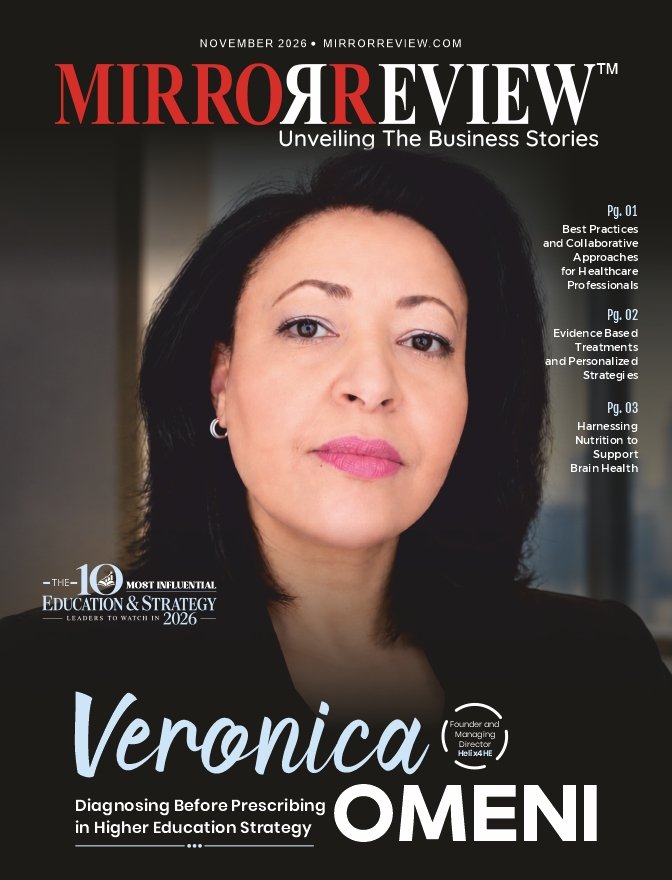
Rankings, reputation, research, teaching quality, employability and internationalisation are the working vocabulary of modern higher education. Too often, though, universities pursue each of them as a separate exercise, handled on its own terms and judged by its own measures.
Veronica Omeni, Founder and Managing Director of Helix4HE, has built her work around challenging that habit. Her view is direct: “They are deeply connected.” Her career has taken her from human resources and information technology to leading teams and advising governments, and it has left her with a firm belief that institutions improve when they understand themselves honestly.
A Career Built Across Cultures
Her path did not begin in a lecture hall. Veronica’s first roles were in human resources and information technology, positions that taught her about organisations, technical literacy and how technology changes work. She then moved into professional training and teaching, and progressed into senior roles in adult education and higher education.
Travelling from a young age and later living and working internationally showed her how people approach the same challenge through very different cultural lenses. Her belief in the value of different cultural perspectives, combined with her experience leading institutions internationally and her doctoral research into educational technology and AI, continues to guide her professional approach.
The reach of that experience is considerable. With more than 30 years of international experience, Veronica has worked across more than 300 universities and business schools worldwide, alongside senior roles in educational leadership. Over two decades, she has worked with European institutions and ministries, including initiatives that supported civil servants as countries prepared for European Union accession.
More recently, her work has included national higher education performance strategy with governments in different regions. These experiences gave her insight into how policy choices shape the realities of institutions, their staff, and the learners they serve.
The Case for Independent Advice
She founded Helix4HE to provide independent, impartial and evidence-based advice, free from the commercial interests of ranking publishers and the pursuit of league table positions as ends in themselves. Her approach places university rankings within the broader context of institutional strategy, academic priorities and the realities of higher education.
The advisory practice combines an understanding of how educational institutions function internally with knowledge of the external forces shaping them, including the principles and processes behind university rankings. Its aim is to help universities and business schools improve performance, build credible international relationships and strengthen their reputations. The strategies are shaped to each institution’s mission and context, not purely in pursuit of a metric.
Veronica hopes to encourage educational institutions to pursue greater ambitions while contributing to stronger, more effective educational ecosystems.
What Helix4HE Actually Does
The breadth of Helix4HE’s services reflects its integrated approach to institutional development. Its advisory work encompasses institutional strategy, university rankings and benchmarking, research visibility, internationalisation and global engagement, governance and quality assurance, employability, academic development, partnerships and AI-enabled transformation. By considering how these interconnected areas contribute to an institution’s wider strategic priorities, Helix4HE supports coherent, sustainable improvement rather than isolated initiatives or short-term gains.
Understanding Before Action
When Veronica describes how she brings strategy, rankings, internationalisation, employability and revenue-generating partnerships into one growth plan, she begins with context. She looks at the institution’s mission, academic strengths, financial reality, stakeholder expectations, and the political, economic and cultural setting in which it operates.
She then speaks openly with colleagues across the organisation and tries to take internal politics out of the diagnosis. She is candid about why this matters. Institutions sometimes become so invested in their own narrative that constructive challenge is discouraged.
Drawing on her medical family background, she frames the process in clinical terms: “Coming from a medical family, I see strategy rather like clinical diagnosis: you must examine the symptoms honestly before prescribing a remedy,” she says.
Once the picture is honest, the work can turn constructive. Curriculum, graduate outcomes, partnerships, research and rankings can be aligned in a roadmap with clear ownership and review. For Veronica, the deeper purpose is institutional self-knowledge: understanding weaknesses as clearly as strengths so that the institution can move forward.
Principles for Leading Through Change
Veronica’s leadership rests on three commitments: understand the organisation before offering solutions, tell the truth about the evidence, and involve the people who must deliver change. She values financial sustainability, but she warns that organisations begin to decline when they lose sight of their staff and the people they serve.
She believes in humanity, honesty and accountability. Effective leadership, in her view, means recognising when a plan or process needs changing rather than defending it out of pride. Education serves people, not the other way round.
Those principles were tested at scale. Veronica has led teams of up to 500 staff across multiple regions, and the experience taught her that high standards and humane leadership are compatible. In her experience, teams perform at their best when goals are well defined, professional expertise is valued, and people feel both supported and respected.
International teams, she notes, call for particular sensitivity to different communication styles and cultural expectations. She has little patience for micromanagement, power politics or leadership built around ego and fear, which she regards as markers of poor and insecure leadership.
She aims to give colleagues room to speak honestly, take ownership and enjoy their work, while recognising their shared achievements. “That is how strong organisations and lasting teams are built,” she says.
When Two Cultures Became One
Asked to recall a moment when her leadership was truly tested, Veronica points to a merger. An organisation for which she held national-level responsibilities joined with another whose culture was very different. On paper, the combination looked sensible, but contrasting expectations created real challenges.
She inherited teams from both organisations while facing financial and delivery pressures. Her priority was to understand the people and cultures involved, establish shared expectations and build trust. She did not assume that a new structure would automatically create a unified workforce.
The episode left her with a lesson she carries into higher education. Even the strongest financial case will falter if leaders underestimate organisational culture and the goodwill of the people required to deliver change.
Technology in Service of Purpose
On AI, EdTech and digital learning, Veronica is clear about the order of things. “Technology should serve people and educational purpose, not the other way around,” she says. Before investing in AI, institutions should define the problem and assess their capacity to deliver change, because sophisticated systems are of little value if staff cannot be trained to use them effectively.
Helix4HE’s approach includes digital and AI literacy, staff development, assessment, accessibility, data governance and implementation roadmaps. Her doctoral research keeps her engaged with both the opportunities and the limitations of EdTech. The measure of success, in her view, is learning quality and student outcomes, not simply the number of tools adopted.
Collaboration Beyond Logos
Universities, businesses, government, and civil society often work in separate silos, despite facing challenges that none can solve alone. Veronica sees triple- and quadruple-helix collaboration as a way to connect research with economic development, public services, workforce skills, and community priorities.
She is firm that this takes more than good intentions. “Collaboration needs more than logos and meetings,” she says. Partners must agree on what problem they are addressing, how responsibilities and benefits are shared, and how outcomes will be measured.
Civil society, in her words, should be an active contributor, not an afterthought. When those conditions are met, the benefits can extend far beyond any single institution.
A Career in Numbers
Veronica is careful with the figures she shares, and she is explicit about their scope. They describe her broader career, not Helix4HE client totals. Earlier responsibilities included training or supporting over 1,000 civil servants, and overseeing teaching provision and curriculum development reaching approximately 80,000 learners across multiple learning centres. Those teaching teams worked across more than 30 languages.
Her work has spanned the UK, Europe, Asia, Africa, the Americas and other regions. During her long career, she has worked with around 20 national governments on educational initiatives, and some of that work has included collaboration with EU institutions.
The Road Ahead
Looking forward, Veronica expects higher education to become more flexible without compromising intellectual rigour. AI, lifelong learning and changing employment patterns are creating demand for shorter, stackable study and new approaches to teaching.
She is equally alert to the costs. Technology also brings information overload, changing attention patterns and pressures on wellbeing for both learners and teaching staff. “We have unprecedented access to knowledge but struggle to distinguish evidence from misinformation,” she observes, and she believes education must help people navigate that complexity.
She expects universities to become more inclusive, more responsive to skills gaps and more deliberate about balancing digital innovation with human connection, critical thinking and effective support. She also calls for a shift in perspective. “We also need to become less Anglo-centric in our approach to global education,” she says. “One model does not fit all, and we should become better at tapping into our collective global knowledge.”
Begin at Home
Her advice to education leaders is to look beyond familiar institutions, countries, and assumptions. She encourages them to approach international partners as equals and to learn from unfamiliar education systems.
Yet she insists the journey starts closer to home. Universities sometimes seek partnerships thousands of miles away while departments in neighbouring buildings barely collaborate. Strong international engagement, she explains, depends on shared institutional knowledge and a culture of internal cooperation.
Her counsel is to listen to staff and students, face uncomfortable evidence, and build relationships that create value on both sides. For Veronica, the future of higher education depends on institutions that understand their own purpose, learn from the wider world, and place people at the centre of meaningful progress.
Quotes

Read more : The 10 Most Influential Education & Strategy Leaders to Watch in 2026