A school bus is not, on the surface, where a company gets built. It is a lumbering, yellow, faintly ridiculous object, built for stopping at every corner, not for going anywhere in particular. But somewhere on the back roads of America, in the strange, suspended months when the whole world stopped moving, a teenager was living inside one, cutting his own path while everyone else waited for normal to come back. That teenager is now the Chief Executive Officer of Cult Content, and the story of how he got from that bus to this title says a great deal about the kind of entrepreneur social commerce tends to produce: resourceful, a little unconventional, and unwilling to wait for permission.
Tommy Lynch did not arrive at TikTok Shop by way of a business degree or a corporate training program. He arrived by way of pallets, print-on-demand shirts, and a stubborn instinct to build things himself, whatever the obstacles. It is a background that reads less like a resume and more like a series of small, scrappy experiments, each one teaching him something the last one hadn’t. By the time he founded Cult Content, he had already amassed 50 million views for product brands and understood that the platform rewards something less tangible than clever videos or clever ads. It rewards belonging.
A Bus, a Pallet, and a Beginning
Every founder has an origin story, but few of them start with power tools and a stack of discarded shipping pallets. Tommy’s did. At fourteen years old, he began pulling apart pallets and turning the wood into tables, shelves, and other furniture, which he sold at an outdoor market in Washington, DC. That market stall, unglamorous as it may have looked, was also his first online store, an early indication of his entrepreneurial instinct.
Then came Covid, arriving during his junior year of high school, upending the world’s plans along with his own. Most people his age were adjusting to a life lived through screens. He bought a school bus.
He converted it into a mobile home and founded Adventure Bus Rental LLC, but he was too young to obtain the CDL and insurance required to operate the business. Rather than shelve the idea entirely, he simply changed the terms. He moved into the bus himself and set off across the country, running a print-on-demand Etsy store from the road and beginning, almost as a byproduct of survival, to make content professionally.
It is worth pausing on that detail, because it explains something about how Tommy thinks. Faced with a legal wall he could not climb, he did not abandon the bus. He lived in it instead, and built something else on top of the wreckage of the original plan. That willingness to adapt when circumstances changed would become an important part of his entrepreneurial journey.
The Origin of Cult Content
By the time Tommy started Cult Content, he was no longer a kid experimenting with an Etsy shop. He had spent years inside the content world and had come to understand something central to his approach: TikTok Shop was not just about making videos or running ads. It was about building a dedicated community around a brand or agency.
The inspiration came from a program called “The Collective,” now known as “Your First Dollar,” a free community where creators could find opportunity without paying for the privilege. He wanted to build something in that same spirit, a place anyone could join without cost, where people could find purpose, unlock their potential, and connect with others who took the work as seriously as they did.
The name itself carries a wink. “The tongue-in-cheek name was inspired by the fact that everyone in the industry seems to want their own cult,” he explains, “the brands want a cult of creators, and the creators want a cult of viewers.” But behind the joke sits something more sincere. There is, in his telling, a spiritual thread running through Cult Content, an invitation to members to chase their goals on TikTok Shop while also identifying and aligning with something larger than a sales target: their higher purpose.
Principles for an Industry That Never Sits Still
Social commerce is a field defined by its own instability. For Tommy, that constant change makes having a stable foundation particularly important.
“Change is a constant in this industry, and in order to survive it, you must be rooted in something that does not change, something that is eternal,” he says. It is a philosophy he practices literally, not just rhetorically. During his team’s Monday and Friday calls, he ends each meeting with an inspirational quote, drawn from the Bible, the Bhagavad Gita, the Tao Te Ching, or whatever book or movie happens to be occupying his attention that week.
He sees his job as twofold: to help his team forecast where the industry is headed, and to help them become the change themselves rather than simply react to it. Being grounded in wisdom, he believes, is what allows a team to hold steady through the turbulence, the wins and the losses alike, without losing sight of what actually matters.
What Cult Content Builds, Piece by Piece
Strip away the philosophy and the spiritual framing, and Cult Content is, at its core, a full-service TikTok Shop management agency, one built to carry a brand from its earliest setup through its ongoing growth.
The work begins at the foundation: registration, onboarding, shop setup, product listing management, and promotional strategy, the unglamorous scaffolding that has to be right before anything else can work. From there, Cult Content runs its clients’ ads and manages their paid media directly.
The affiliate side of the business is where the Tommy’s creator community starts to earn its keep. The agency reaches out to creators on behalf of its brand clients and draws on a community of more than 700 affiliates to produce content at scale. Incentives are organized, and creators are led through weekly calls, one set for each brand the agency represents, keeping the relationship active rather than transactional.
The Myths Nobody Wants to Hear
Ask Tommy about the economics of TikTok Shop and the tone shifts. There is a gentleness to how he talks about creators and community, but when the subject turns to money, he becomes blunt, almost protective of the people who might otherwise walk in with false expectations.
“The vast majority of brands on TikTok Shop are not profitable,” he says. The platform has the reputation of a gold rush, but in his experience, the brands that win the biggest are often the ones capable of losing the biggest. He recalls a recent conversation with another figure in the industry about one of the largest brands operating on TikTok Shop, a brand that, by his account, loses over one million dollars a month on the platform.
The reason, he explains, is the sheer weight of costs stacked on top of one another: cost of goods sold, shipping, promotions, coupons, affiliate commissions, TikTok’s own referral fee, agency fees, sampling, affiliate bonuses, and merchant fees. By the time all of that is subtracted, there is rarely much left. Tommy is candid about the pressure he feels to sell a rosier version of this story. “Everyone wants me to sell them a false dream where they will be making 500k profit after a few months,” he says. “The reality is very different.”
His advice to brands considering the platform is less about optimism and more about preparation: know your unit economics before you start, and know exactly how much you can afford to lose, and for how long. He frames TikTok Shop not as a guaranteed profit center but as a top-of-funnel awareness channel, one that can break even or even turn a profit, but that delivers its real value when treated as a marketing investment, the kind that lifts performance across a brand’s other channels.
Content as the Heart of the Brand
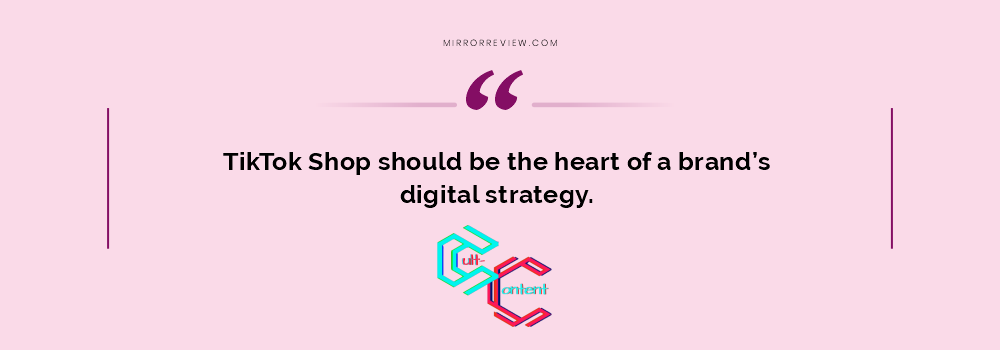
If the economics chapter of Tommy’s philosophy is sobering, the content chapter is where his enthusiasm returns. He believes TikTok Shop, done right, should sit at the very center of a brand’s digital strategy, not as one channel among many but as the engine that feeds all the others.
The agencies that do this well, Cult Content among them, help a brand build a genuine community, one capable of producing what he describes as potentially tens of thousands of videos a month. That volume of content does not have to stay on TikTok. With a creator’s permission, the same videos can be repurposed across Instagram, Facebook, YouTube, and other platforms, multiplying their value well beyond their original home.
What strikes Tommy most, though, is what creators themselves respond to. Again and again, he hears the same sentiment: creators appreciate and respect brands that understand content from the inside. When a founder is willing to pick up a camera and make videos about their own product, going through the same struggles the creators face, it means something. It teaches the community what kind of content actually works, and it strengthens the bond between brand and creator in a way that a marketing brief never could.
Finding the Right Voices
Authenticity and performance are often treated as opposites in marketing, one measured in feeling, the other in numbers. Tommy does not see it that way. “Authentic engagement and measurable commercial results go hand in hand on TikTok Shop,” he says. The videos that perform best, in his experience, are the ones that do not feel like shop content at all, the ones where a creator is speaking from real experience and real authority rather than reading from a script built to sell.
To find those voices, Cult Content leans on AI-enabled tooling, specifically a platform called Reacher, which holds a database of more than three million TikTok Shop affiliates. The tool allows the agency to search by GMV, or gross merchandise value, but also by natural language, the kind of plain, specific query a human might actually type, like “moms with curly hair.” That search capability is paired with the agency’s creators community, which Tommy and his team draw on directly to match the right voice to the right brand.
A Test That Revealed What He Actually Believes
Every leader has a moment that tests whether their stated values survive contact with a real, inconvenient situation. For Tommy, that moment came when a brand he was working with decided it did not want to pay what it owed its affiliates.
His first instinct, he admits, was to let it go, to accept the situation and move on. But the memory of his own years as a creator pulled him back, the times brands had chosen not to pay him. He recognized the position the affected creators were in, because he had once stood in it himself. So he organized a call with the creators involved and led an effort to recover the money the brand owed them.
“I learned how important it is to fight for creators,” he says. “It’s easy to say that you’ll do it, but when it comes time to actually show up for them, you’ll want to pretend that it’s not your problem.” It is a small story, but a revealing one, the kind that says more about a leader’s actual priorities than any mission statement could.
The Numbers Behind the Name
For all his talk of community and higher purpose, Tommy does not shy away from results, and the results are not modest. He has taken four brands from next to no sales on TikTok Shop to five figures a month. Across his career, he has directly helped more than 100 brands navigate the platform.
His own resume carries weight as well. He has been part of an eight-figure-per-year team, and he spent a month and a half with Reacher as it went through Y Combinator.
Where Social Commerce Goes From Here
Tommy’s outlook for the future of the industry is measured, not breathless. He does not expect artificial intelligence to replace the human element of the business so much as absorb the parts of it that were never human to begin with. AI, in his view, will primarily take over the non-human elements: the systems, the SOPs, the mechanics of the machine, things like task management, product pages, and ad operations.
What will not be automated, he believes, is community. “Top creator agencies aren’t necessarily built on what they teach creators,” he says. “They are built on the community. They’re built on people wanting to be a part of them.” As social selling continues to expand beyond TikTok into YouTube and Meta, he expects omnichannel strategy to shift from a nice-to-have into a genuine necessity for any brand hoping to stay competitive.
Advice for the Road Ahead
Asked what he would tell a brand preparing to step into social commerce for the first time, Tommy’s answer circles back to the same discipline that runs through everything else he has built. Be prepared to spend more than you expect, and spend only when the dollars have clear ROI. Be patient. See through the noise.
And then, the line that seems to summarize the entire philosophy behind Cult Content, the community, the creators, the careful economics lessons, all of it: Invest in people, not platforms.
It is a fitting note to end on for someone whose career began not with a platform at all, but with a stack of discarded pallets and a school bus with nowhere in particular to be, and who built, out of both, something that people actually wanted to belong to.
Quotes