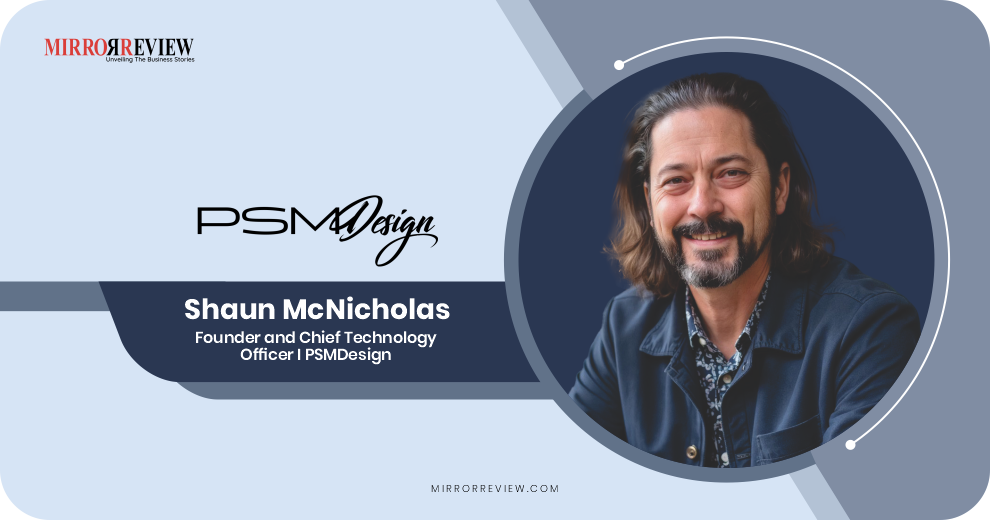
Technology leadership rarely announces itself with drama. More often, it accumulates, one crashed server and one repaired system at a time, until three decades later, a person looks back and realizes they have built something they did not originally set out to build. That is the shape of the career belonging to Shaun McNicholas, Founder and Chief Technology Officer of PSMDesign, whose journey from IT Director to CIO to CTO has produced not just a company, but a philosophy about what technology is actually for, and a broader vision for the future of business intelligence, automation, and executive decision-making.
Three Foundations, One Philosophy
Long before boardrooms, infrastructure diagrams, and executive technology strategy, Shaun trained as an illustrator and designer. It is an unusual starting point for a man who would spend the next thirty years inside server rooms and enterprise systems, but he has always described himself as “the product of paradox,” a person pulled equally toward technical precision and creative restlessness.
That duality never resolved itself into one identity. Instead, it became the foundation of his approach to technology and leadership.
Even as he rose through IT Director positions and into CIO and CTO roles across a range of organizations, he carried the instincts of a designer alongside the discipline of an engineer. The two, he has said, were never in conflict. Precision told him how systems should work. Intuition told him what actually served the humans depending on those systems. That combination would later define the architecture and experience of IteraOS: a unified operating environment built with technical rigor at its core, but organized around how executives and teams actually evaluate risk, consume information, and make decisions under pressure.
Leadership Beyond Technology
There is a third thread running through Shaun’s story, one that rarely appears on a conventional CTO’s resume: over forty years as a serious student of Scripture and nearly as many years spent responsible for technology leadership inside the churches he served. Rather than serving as a side note to his corporate career, this foundational commitment provided the moral architecture for everything he builds.
Decades of biblical study, reinforced by years of serving in technology leadership within the churches he called home, shaped his conviction that technology exists to serve people rather than itself. That conviction continues to govern his engineering principles today. Technology is never just about efficiency. It is always about human flourishing.
Good architecture, in his view, is not measured only by speed, scalability, or feature count, though all of those matter enormously. Good architecture serves people. It creates room for what matters most. It does not replace judgment. It protects oversight, supports accountability, and makes it easier for leaders to act with confidence because the right context is available at the right time. In Shaun’s view, technology does not create trust by replacing human judgment. It creates trust by strengthening it.
The Year Everything Converged
In 2025, these separate threads, including the design instincts, the systems expertise, and the spiritual conviction, came together at a moment that was anything but comfortable. Shaun lost his primary source of income. Faced with genuine uncertainty, he made a decision that would define the next phase of his work: rather than drift, he would build something that unified everything he had learned.
That decision ultimately became IteraOS, an intelligent operating environment he first built as a personal operating system: a single place where his own information, projects, schedules, and tools could finally exist together. The goal was to bring together his biblical study, his design work, his technology projects, his family commitments, his financial life, and his creative ambitions within a single, unified view.
What he discovered while building it surprised him. When a single person finally has access to the complete context of their own life, and when AI agents can see that full picture rather than fragments of it, something shifts. The speed at which meaningful work becomes possible increases dramatically. Clarity about what actually matters stops being abstract and becomes unmistakable.
While IteraOS was first proven in Shaun’s own working environment, it was never conceived as merely a personal solution. From the beginning, it was built as a test case for a broader architectural thesis: that executive and management intelligence improves dramatically when communications, operational data, financial signals, documents, workflows, and AI assistance can function inside one secure, context-aware system.
Shaun has explored this foundational philosophy, where biblical principles of stewardship and service inform technical design and human-centered innovation, extensively through his writing on Arts in the Kingdom. There, he expands on the ideas that continue to shape his approach to leadership, technology, and human flourishing.
Why Fragmentation, Not Weak Technology, Is the Real Failure
Shaun’s diagnosis of why automation and digital transformation initiatives fail is direct: the problem is rarely weak technology. The problem is a fragmented operating context.
Organizations routinely rent access to a growing stack of disconnected tools. Revenue signals live in one system, customer relationships in another, financial records somewhere else, internal knowledge inside disconnected documents, and key operational decisions are scattered across inboxes, spreadsheets, and meetings. In that environment, no single tool ever sees the whole picture.
The result is costly in two directions. Human teams grow exhausted simply managing the gaps and reconciling systems that were never designed to work together. AI agents, meanwhile, are brilliant at narrow tasks but starved for context, lacking enough breadth, depth, and governance of information to operate reliably across real business conditions.
This is not theoretical for him. Across thirty years in production environments, he has lived through servers crashing and networks failing. He has spent entire weekends repairing architecture he had gotten wrong the first time. He has dealt with hard drive failures, missing backups, and tape restores that stretched across days while entire businesses waited helplessly for their information to return.
Those experiences produced a hardened set of architectural questions he now asks of every system: Is it scalable across the organization? Is it secure and private by design? Is it flexible enough to support how an organization actually operates? And does it provide enough contextual depth to produce accurate, trustworthy outcomes without drifting off subject?
From Personal Question to Company Mission
PSMDesign, the company Shaun founded, was built to turn that diagnosis into an actionable business offering. For him, the true goal of enterprise architecture is to keep the necessary capabilities while reducing dependence on disjointed software.
For him, the real challenge in AI adoption has never been whether organizations are willing to experiment with new tools. It is whether they can adopt those tools in a way that preserves oversight, respects risk, and actually improves how the business operates. After watching decades of enterprise initiatives collapse into expensive shelfware or brittle automation, he set out to build a firm that helps organizations navigate the difficult middle ground between doing nothing and automating blindly.
Rather than adding another application to an already crowded software stack, IteraOS was architected as the intelligent operating layer that connects existing systems into a single, context-aware environment. PSMDesign operates as the strategic and implementation layer around this philosophy, helping organizations eliminate the friction of tab-switching and siloed data by deploying a single, cohesive environment.
The goal was never to build another application. It was to build a frictionless decision environment where leaders could see more clearly, decide more confidently, and automate more responsibly.
What IteraOS Changes for Organizations
To understand IteraOS, it helps to step away from the traditional way enterprise software is evaluated. When an organization looks at a new digital initiative, the standard impulse is to ask what features it adds to the list. Shaun built IteraOS around a fundamentally different question: how do we eliminate the operational latency of jumping between ten different systems to execute a single strategic decision?
IteraOS does not ask an organization to rip out its working tools or abandon established workflows. Instead, it serves as the unifying operating layer that allows existing systems to function as one coordinated intelligence network. It bridges the gaps between data silos, bringing immediate context to everyday business operations.
Only after understanding this architectural foundation do the specific capabilities make sense. Because IteraOS operates as a unified environment rather than a standalone tool, it naturally brings cohesion to the core domains of an enterprise:
- Connected Relationships and Operations: Instead of isolating contacts, communications, and deal pipelines inside a siloed CRM, the platform weaves relationship history directly into daily execution and client workflows.
- Human-Governed Automation: The operating layer uses approval-gated automations that accelerate routine execution while ensuring human signatures govern high-stakes decisions, preventing unchecked scripts from executing blind actions.
- Accessible Organizational Knowledge: By utilizing retrieval-augmented document libraries across the entire enterprise context, institutional memory becomes instantly searchable and actionable without forcing teams to hunt through disconnected archives.
- Unified Financial Visibility: Transaction reconciliation and budget modeling are connected directly to operational data, allowing executive leadership to evaluate strategic initiatives against real-time financial signals.
- Context-Aware AI Assistance: Employees no longer need to juggle separate subscriptions and tabs for ChatGPT, Claude, and Gemini. The platform embeds multi-modal AI access directly into the secure workflow, providing context-aware intelligence without data leakage.
The common denominator across these areas is not novelty; it is disciplined integration. Shaun built PSMDesign specifically to help organizations avoid the AI hype trap by focusing on systems that reduce manual effort, improve visibility, strengthen governance, and create measurable operational leverage.
Iterative Intelligence, Explained in Four Stages
At the center of Shaun’s professional philosophy sits a framework he calls Iterative Intelligence, a structured progression for integrating AI into business operations without sacrificing human judgment.
Augmentation comes first, where AI offers suggestions and recommendations, but humans retain full decision authority. Refinement follows, as feedback from those human decisions trains the system to improve the quality, relevance, and reliability of those suggestions over time. Only after that comes Automation, reserved strictly for tightly bound, high-confidence, low-risk tasks. The final stage is Insight, where the system begins surfacing patterns, relationships, and strategic opportunities that teams, working alone, could never have detected manually.
He designed this progression deliberately, ensuring that machines remain tools in service of human judgment rather than becoming a replacement for it. In practice, it governs how PSMDesign implements business systems: AI first supports decision-making, then improves through supervised feedback, then automates only where the controls are strong enough, and finally contributes to strategic visibility. The objective is not automation for its own sake; it is a controlled path toward better executive intelligence.
The Mistakes Organizations Keep Making
Over time, Shaun has identified three recurring failures that undermine enterprise automation efforts.
The first is treating automation as an all-or-nothing proposition, as though every task must be either fully manual or fully automated. In reality, roughly eighty percent of the value lies in the supervised middle ground, where systems can accelerate work without removing human oversight from consequential decisions.
The second mistake is pursuing speed without governance. Organizations routinely rush toward deployment before building the controls, approval structures, and transparency needed to prevent preventable errors. The result is not just technical failure, but the erosion of trust.
The third is neglecting change management. Even technically sound systems fail when the people expected to use them are not brought into the process early enough to understand, trust, and adopt them.
He addresses all three through a disciplined operating approach: approval-gated automation where critical decisions require a human signature before execution, transparent AI recommendations where systems explain why they recommended something rather than merely what to do, and continuous feedback loops that improve performance over time. His tools are designed for skill elevation rather than deskilling, freeing people from repetitive work so they can focus on strategy, relationships, and executive judgment.
Balancing Innovation, Scale, and Governance
As a strategist, Shaun manages the tension between innovation, scalability, and ethics through a practical operating discipline. He practices principled experimentation: building minimum viable systems, testing them in real conditions, and measuring real-world impact before scaling broadly. He insists on data governance from day one, treating security, privacy, compliance, and auditability as foundational architectural requirements rather than afterthoughts bolted on later. And he prioritizes stakeholder alignment early, ensuring that technical systems actually reflect the values, workflows, and risk tolerance of the organizations expected to rely on them.
This approach is especially important in AI-enabled systems, where the temptation to move quickly can outpace the structures needed to make that speed safe. For him, security, privacy, auditability, and accountability are not secondary concerns. They are foundational requirements of any platform intended to support real business decisions.
The Test That Defined His Leadership
One of the clearest demonstrations of Shaun’s philosophy came during an automation deployment that initially faced significant resistance from middle management. Rather than mandate compliance or force adoption, he changed his strategy entirely. He identified two early-adopter departments, gave them ninety days of dedicated support, and let performance become the argument.
The results validated the approach. With the right systems and oversight structures in place, a small team was able to successfully oversee the operations of an entire university’s continuing education department, serving several hundred instructors, several thousand annual students, and several million dollars in annual revenue. The participating teams reported measurable time savings and improved job satisfaction. Watching those results become visible, skeptical departments began requesting the same tools voluntarily.
The lesson he draws from that experience has become a cornerstone of his consulting practice: change leadership succeeds through proof, trust, and peer credibility rather than mandates.
A Career Measured in Outcomes
Across more than two decades of platform and infrastructure development, Shaun’s track record reads less like a résumé and more like a series of systems that learned to work smarter over time. The through-line is consistent: he doesn’t just build technology that stores information; he builds systems that surface insight and improve through use.
As CTO of a retail intelligence platform, he oversaw a global engineering organization and an approximately $7.5 million annual technology budget, unifying fragmented Wi-Fi, BLE, POS, loyalty, and marketing data into a single behavioral intelligence system. The result was closed-loop attribution in physical retail, connecting digital campaigns to in-store visits and purchase outcomes for the first time, and turning marketing decisions from “we believe this is working” into “we can measure exactly what’s driving results.”
For a healthcare manufacturing and distribution company, he re-architected an underperforming CRM, not by replacing it, but by transforming it into an operational intelligence layer across sales, support, and customer engagement. The outcome was structural: roughly a 20% increase in revenue and a 50% reduction in support staff requirements. The business stopped scaling through headcount and started scaling through systems.
Earlier in his career, leading a professional services firm before AI had a name, he built a custom CRM on a Java-based architecture and layered in intelligent search and classification using early implementations of Apache Lucene. The system indexed vast volumes of structured and unstructured data and surfaced connections between clients, conversations, and opportunities, functionally an early form of the machine-learning-assisted search intelligence common today.
At a higher-education technology provider, he modernized a rigid monolith into a scalable, multi-site architecture on modern .NET MVC frameworks, delivering roughly a 45% improvement in platform performance, a 10%+ year-over-year lift in conversion, and meaningful gains in SEO visibility. And across a high-volume outdoor e-commerce network with millions of parts and thousands of vehicle variations, he rebuilt search and catalog navigation with Apache Solr and Lucene while migrating legacy infrastructure to the cloud, cutting catalog processing and build time by roughly 50%.
Different industries, different eras, one pattern: systems that adapt to how people actually work and improve continuously through real-world feedback. It is the same principle he now defines as Iterative Intelligence, and the foundation on which IteraOS is built.
Through PSMDesign, he has translated that experience into a broader mission: helping mid-market and enterprise organizations adopt AI and automation in ways that are practical, governed, and operationally meaningful. In parallel, he has established himself as a sought-after speaker and strategist on AI adoption, human-machine collaboration, and digital transformation.
Where Shaun Believes This Is Heading
Looking toward the future, Shaun sees three major shifts defining the conversation around business automation.
First, organizations will move beyond the false choice of “AI or human” and invest instead in systems built around “AI and human” collaboration. The real competitive advantage will come not from replacing people, but from giving them better context, better tools, and better decision support.
Second, explainability will become non-negotiable. Regulators, customers, and internal stakeholders alike will increasingly demand systems that can account for why decisions were recommended, approved, or executed. Black-box speed without governance will lose ground to interpretable, accountable intelligence.
Third, the companies that ultimately win will be the ones that treat automation as an iterative operating discipline rather than a single, one-time deployment. The strongest organizations will build integrated environments where workflows, data, AI support, and human oversight continuously refine one another over time.
His advice to leaders navigating that uncertainty is characteristically direct: start small where the business pain is real, build with governance from the beginning, and let humans remain in control of the decisions that matter.
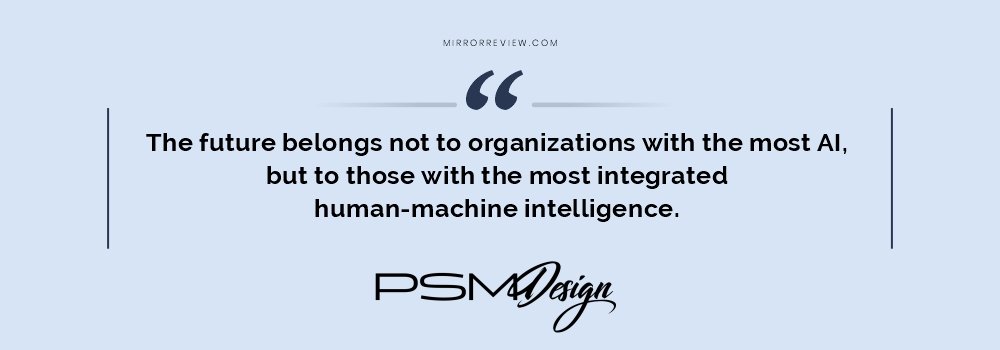
For Shaun McNicholas, that has never been a slogan. It has been the operating principle behind a career spent watching systems fail, rebuilding them under pressure, and ultimately arriving at a simple, hard-won conclusion: the future does not belong to whoever deploys the most artificial intelligence. It belongs to whoever integrates machine intelligence with human judgment, business context, and accountable decision-making.
Quotes
Read more : AI, Automation & Human-Centered Technology Leaders to Watch in 2026