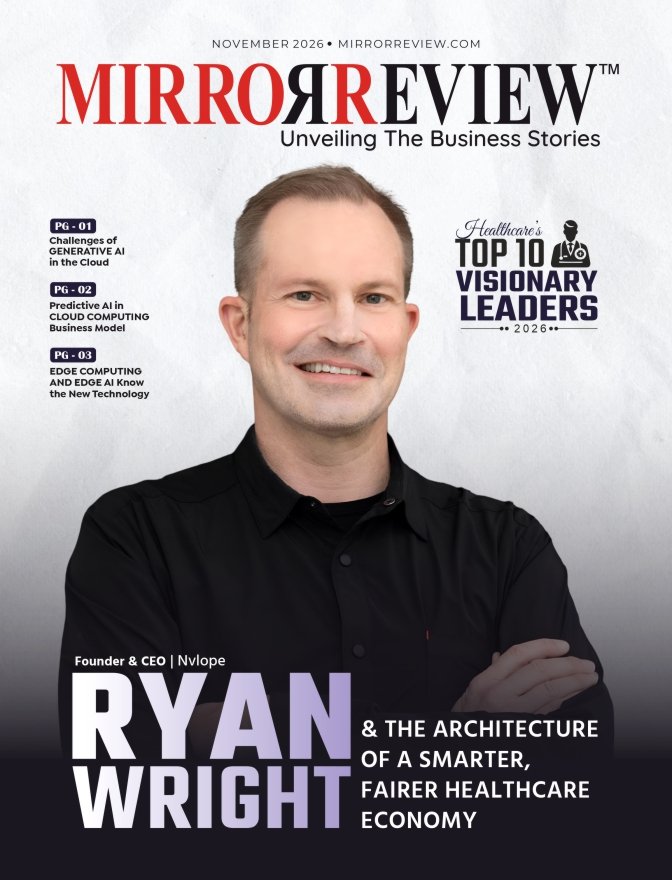
There is a particular skill you develop in hospitality if you are paying close enough attention. You learn to read a room before it speaks. You learn to anticipate what someone needs before they have found the words for it. And above everything, you learn that the entire experience, every single moment of it, lives or dies on one question: Does the person in front of you feel seen?
Ryan Wright spent years in upscale food service mastering exactly that. He was not a doctor. He was not a financier. He had no formal background in the systems he would eventually set out to dismantle. What he had was something arguably rarer: the trained instinct to recognize when a human being was being overlooked. He believed, with real confidence, that he could carry that instinct into healthcare. That a patient deserved the same quality of attention as a guest.
Healthcare, he would soon learn, had other ideas.
The Night in New York That Changed Everything
The first Messari Mainnet conference brought Ryan to New York, and it left him disheartened. The blockchain world he had hoped to find was crowded with misdirected energy and hype dressed as vision. An industry tolerating conduct that should have embarrassed it.
But he had made a plan while in New York, a meeting that had nothing to do with the conference floor. He was set to meet Tory Cenaj, an editor working at the intersection of medicine and emerging technology, to discuss an Ambassador position.
That conversation turned out to be the best part of the trip.
“By morning, I had a clear vision of what my career could be, and what the world could look like if this infrastructure were built correctly.”
There was also something personal waiting to be named. His mother was the first registered vascular ultrasound technologist in the state of Missouri. Medical imaging had surrounded his entire life. He had just needed someone to help him see it.
Building the Connective Tissue
What followed that morning of clarity was years of deliberate, unglamorous work.
Ryan became the Midwest Ambassador for Blockchain in Healthcare Today, the world’s first peer-reviewed journal dedicated to distributed ledger technology in medicine. The role demanded everything: podcasts, university outreach, public speaking, writing as a subject matter expert, and building what he describes as “the connective tissue of an emerging field.”
What those years gave him was not just knowledge. It was certainty.
Certainty that physicians, cryptographers, data scientists, and policymakers shared the same conviction: healthcare data architecture was fundamentally broken. And the tools to fix it already existed.
Nvlope emerged from that community. The name is not incidental. Your medical information, the logic goes, should be sealed, addressed, and opened only with your authorization. Instead, today it is scattered across institutions that don’t communicate, monetized by brokers you never consented to, and harvested into AI models trained on your life, without your knowledge or compensation.
Ryan intends to invert that structure entirely.
The First Proof
Nvlope’s earliest act was radiology.
Ryan developed a system to tokenize diagnostic imaging assets at the point of creation, giving the patient a provenance-tracked, sovereign claim to their own scan before it ever touched an institutional repository. The work caught the attention of AI MINDSystems, a team already building toward something far larger. The acquisition that followed was, in Ryan’s words, a natural convergence: what he had developed as a mechanism, they had the vision and infrastructure to scale into a market.
The distinction Ryan draws about how Nvlope operates is precise and deliberate.
“We tokenize diagnostic assets at the edge. We don’t move information unless we have to.”
This is simultaneously a privacy principle and a green cloud commitment. Rather than extracting data into centralized repositories, Nvlope issues intellectual property rights to diagnostic assets where they already live. Existing health systems operate under modern DePIN business models, becoming validators and, ultimately, benefactors of federated computing.
The problem this model addresses is not abstract. Healthcare suffers from three compounding failures. First, fragmentation: records exist everywhere and nowhere at once. Second, security: centralized data repositories become catastrophic breach targets. The Change Healthcare incident alone exposed 192 million records and cost over $1.5 billion. Third, and perhaps most quietly devastating, a compensation failure: the people generating the most clinically valuable data receive nothing in return.
What Your Data Is Actually Worth
This is where Ryan’s thinking turns philosophically precise, and a little radical.
Alongside the team at AI MINDSystems and pioneers like Heather Flannery, who founded Consensys Health and serves as CEO of AI MINDSystems Impact, he has helped build toward something called Universally-accessible Data Income, or UDI.
The premise is simple, and the implications are enormous. Human beings produce extraordinary signals: clinical, behavioral, and diagnostic. The dominant AI narrative treats that signal as a resource to harvest. “What it consistently misses,” Ryan says, “is the human at the center of the equation.”
His framework redefines the relationship entirely. That signal is labor. It is earned. And it should carry forward-looking rights, what the team calls IP Participation Rights, or IPPRs, an invention of AIMS. Prospective data, consented and provenance-tracked from origin, becomes guaranteed, regulatory-grade data. Phase 2 clinical trials become more efficacious when regulatory technology is embedded in the platform from the start. Every stakeholder is derisked simultaneously, and the people who need remuneration most are finally receiving it.
“That’s capitalism working for genuine good,” Ryan says. He says it without irony.
The Technical Challenges Are Solved. The Institutional Ones Are Not.
Ryan is not naive about where the real friction lives.
The regulatory frameworks governing healthcare exist for excellent reasons. The hard work, as he describes it, is designing infrastructure that augments those frameworks rather than disrupting them. Building trust with clinicians before asking them to change workflows. Making compliance easier, not harder.
“The most important innovations in healthcare are relational before they are technological.”
That belief runs through every partnership Ryan keeps. Melvin Greer, Chief AI Officer at AIMS and a foundational figure in AI and systems architecture from his years at Intel, shapes how the team thinks about scale. Dr. Atif Khan from Memorial Sloan Kettering bridges the clinical and technical worlds with rare fluency. Alex Cahana’s thinking on value-based care has shaped Ryan’s own more than Cahana probably knows. And Daniel Uribe, the inventor of BioNFTs, recognized the significance of Ryan’s work on tokenized DICOM files, seeing diagnostic digital assets as a new type of orthogonal asset for the real-world asset market.
These aren’t networking relationships. They are proof that this future is being built by people who care deeply about getting it right.
The Market Is Already Moving
The institutional posture is shifting. Clinicians who were skeptical two years ago are now asking pointed implementation questions. Progress on portable medical imaging tokenization and the regulatory framework for data forwards, instruments that let clinical operators purchase exactly the data they need with quality guarantees embedded from the start, marks a quiet but significant turn.
That momentum is now translating into tangible financial backing. The team is currently advancing through the final diligence stages for a potential institutional investment in the $3 to $5 million range, a milestone that will officially close their initial seed round. The opportunity has already received unanimous support in principle from a prominent institutional investor deeply rooted in digital asset infrastructure and traditional financial markets. Securing this backing represents meaningful institutional validation, effectively proving out the model while opening the door for follow-on strategic participation. Just as importantly, it positions the venture to open its next funding round to new investors with a clear, validated trajectory for exceptional returns.
Missouri’s passage of HB 594, making it the nation’s first zero capital gains jurisdiction for individuals, creates what Ryan sees as a rare alignment of policy and economic timing. The goal is not simply a product. It is a market structure for what he believes is the 21st century’s most valuable asset class: verified human signal. Not just hosting the hardware of the AI era, but capturing the exchange that prices what happens inside it.
Beyond the office, Ryan reads widely through history and ancient literature, writes hard science fiction, and follows the news and markets with the attention of someone who understands the two are inseparable. As President of Stand With Crypto Missouri, he travels the country, reintroducing blockchain as a response to the anxieties that artificial intelligence has stirred in ordinary people.
The Image That Started Everything
Ryan returns, in the end, to his mother.
The first registered vascular ultrasound technologist in the state of Missouri. A woman who put a probe on someone’s chest and produced a picture that could save a life.
That image belonged to the patient. The skill belonged to her.
“Somewhere along the way, we built systems that forgot both of those things.”
He is building infrastructure to remember them.
Quote
Also Read: Healthcare’s Top 10 Visionary Leaders: 2026