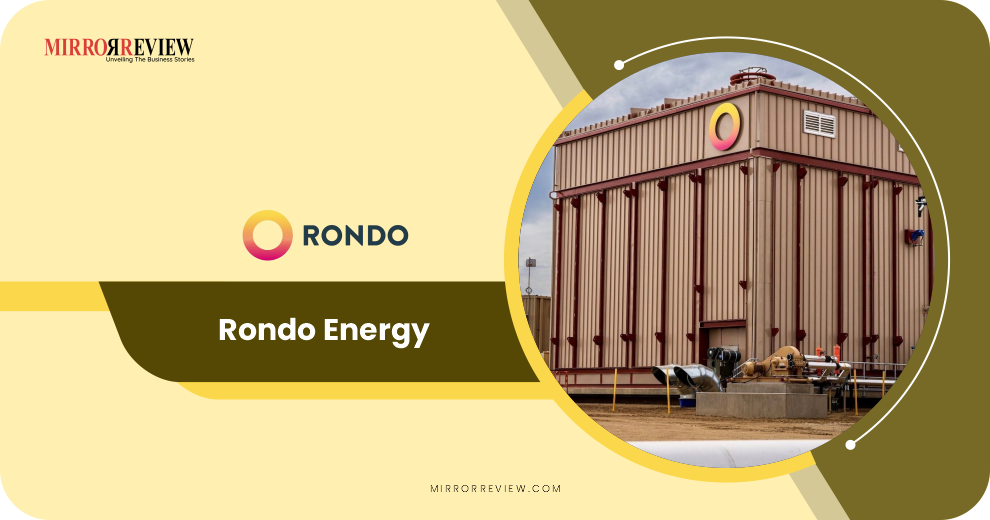
Steel mills have used brick to hold heat for centuries. It is not a glamorous material, and it is not meant to be. Rondo Energy has adapted this established principle for a new purpose: storing electricity from intermittent wind and solar generation as heat, then supplying that heat continuously to industrial facilities.
The Rondo Heat Battery is built around a straightforward commercial proposition: lower operating costs and emissions by turning electricity into a dependable source of industrial heat. The company says its technology is available for deployment at industrial scale today. Rondo is headquartered in California, with a global team across North America, Europe, and Australia.
How a Brick Becomes a Battery
The mechanics are elegant. The battery charges six to eight hours a day with intermittent electricity from local wind and solar, or from the grid. Electric heating elements convert that electricity into heat, which radiant energy transfers to refractory bricks heated to between 1,100 and 1,500°C. The bricks retain the stored heat for hours or days, with Rondo reporting thermal losses of less than one percent per day.
Throughout operation, the system releases stored thermal energy as a steady stream of high-temperature air, supplying the heat required for industrial processes and steam production. Rondo advertises efficiency of more than 98% from electricity input to heat or steam output. Its 100-megawatt-hour commercial installation at Holmes Western has reported round-trip efficiency above 97%. These are distinct performance measures, and the results of an individual installation should not be confused with the company’s broader product specifications.
The company describes the system as capable of unlimited operating cycles and a service life exceeding 40 years. A single unit can be sized to rated outputs from 2 megawatts thermal to over 100 megawatts thermal. Rondo’s design is non-pressurized and uses no hazardous chemicals, gases, or liquids. The company says its architecture avoids the fire and explosion risks associated with conventional combustible fuels. Because the system heats through electrical resistance rather than combustion, it produces no direct nitrogen oxides, sulfur oxides, or particulate matter during operation. Designed to work alongside established industrial infrastructure, Rondo’s technology aims to help manufacturers transition away from fossil-fuel-based heating without having to redesign their entire production systems.
Why Heat Matters
The target is large. Rondo has noted that industry uses more energy than any other part of the world economy, and that most of it is used as heat. The company estimates that industrial heat accounts for roughly one-quarter of global energy consumption and a similar proportion of global carbon dioxide emissions. It has long been seen as difficult to decarbonize because of cost, continuity, and temperature.
John O’Donnell, Rondo’s Founder and Chief Innovation Officer, who was CEO when he made the observation in 2023, framed the opportunity in blunt terms. “Decarbonizing industrial heat is a trillion-dollar market requiring far more storage than the electric grid.”
From Pilot to Scale
Rondo’s reported commercial pipeline includes projects representing more than 400 megawatt-hours of storage capacity, while its partnerships extend to a further 3 gigawatt-hours of potential deployments. Its company website lists 11 commercial developments, including eight Rondo Heat Battery deployments, more than $160 million in funding, and four partnerships across five industries: food and beverage, cement, fuel, chemicals, and textiles. Its industry pages go further, identifying potential applications in aluminum, mining, steel, pharmaceuticals, paper and pulp, and other sectors.
The company’s investors read like a cross-section of heavy industry and climate finance. They include Breakthrough Energy, Microsoft’s Climate Innovation Fund, Rio Tinto, Energy Impact Partners, SCG, Titan Cement Group, Aramco Ventures, and SABIC. In October 2025, Rondo announced commercial operation of a 100-megawatt-hour heat battery at Holmes Western in California. The system supplies continuous industrial steam using electricity generated by an on-site solar array, making it the world’s largest industrial heat battery in commercial operation, according to the company.
The manufacturing story reaches back to June 26, 2023, when Rondo and Siam Cement Group announced plans to expand Rondo Heat Battery production capacity at SCG’s facility to 90 gigawatt-hours per year. The companies described the planned capacity as larger than any battery manufacturing facility then operating worldwide. At the time of the announcement, production capacity of 2.4 gigawatt-hours per year was already online. The partners projected that the planned expansion, if fully realized and deployed as intended, could enable annual carbon dioxide reductions of 12 million tonnes. One of the technology’s early commercial applications was an ethanol production facility in California, where a Rondo Heat Battery was already operating at the time.
Six Promises in Plain Language
Rondo summarizes its case in six words, and each comes with specifics. It calls the heat battery profitable, citing its claim of low-cost energy storage, the avoidance of a green premium, and reduced exposure to energy price volatility. It calls it sustainable, with continuous low-carbon heat and the potential to eliminate Scope 1 and Scope 2 emissions when powered by appropriately sourced low-carbon electricity. It says the system is flexible, with fast deployment, modular construction, and scalable capacity. It is safe, proven, and future-proof, drawing on established refractory-brick technology and a design intended to charge when renewable electricity is available rather than requiring constant power input.
Rondo has also received U.S. Department of Energy funding for work on high-temperature industrial heat storage, including research into advanced heating elements intended to improve storage capacity and charging performance.
A Groundbreaking in Brunsbüttel
A new milestone followed on January 19, 2026, when Rondo and Covestro formally marked the start of construction on their planned thermal-storage installation at Covestro’s Brunsbüttel facility in Germany. The 100-megawatt-hour battery is scheduled to go into operation by the end of 2026, charging when low-price renewable electricity is abundant and delivering continuous high-temperature steam to on-site production. It is expected to produce ten percent of the steam the site needs and save up to 13,000 tonnes of carbon dioxide emissions per year. Breakthrough Energy Catalyst and the European Investment Bank support the project, subject to funding conditions.
Covestro recorded EUR 14.2 billion in revenue during fiscal year 2024 and operated 46 production sites worldwide at the end of that year. Across its manufacturing operations, steam represents a significant energy requirement; at Brunsbüttel, natural gas remains the source used to generate it.
Eric Trusiewicz, Rondo’s CEO, sees a pairing of two problems. “This project shows how two of Europe’s central challenges can be solved together.” Covestro’s CTO, Dr. Thorsten Dreier, was equally direct about why his company is involved. “The heat battery is such an idea: a new technology that enables us to take another step forward on our path to a sustainable future.”
The state’s Minister for Energy Transition, Tobias Goldschmidt, called the energy transition “Schleswig-Holstein’s project of our time.”
The Leadership Behind the Brick
Rondo’s leadership team pairs founders with operators: Eric Trusiewicz as Chief Executive Officer, John O’Donnell as Founder and Chief Innovation Officer, Pete von Behrens as Founder and Chief Technology Officer, Karim Ibrik as Chief Operating Officer, and Tony Meneghetti as Chief Financial Officer.
Rondo’s proposition is deceptively simple: turn electricity available for only part of the day into process heat that factories need around the clock. Its progress suggests that one of the most consequential tools for industrial decarbonization may not require exotic materials or an entirely new manufacturing ecosystem. Sometimes, the next step forward begins with familiar bricks, engineered to hold the sun’s energy until the production line needs it.
Read more : Leading Companies to Watch in 2026