
There is a specific kind of silence that terrifies a modern business leader. It is not the quiet of a focused office or the hush of a boardroom before a decision. It is the silence of a server room that has stopped humming. It is the blank stare of a thousand monitors that have simultaneously gone dark. In that moment, the abstract concepts of revenue, reputation, and workflow evaporate, replaced by a singular, crushing reality: the system is down. And in the digital age, when the system is down, the heartbeat of the organization stops.
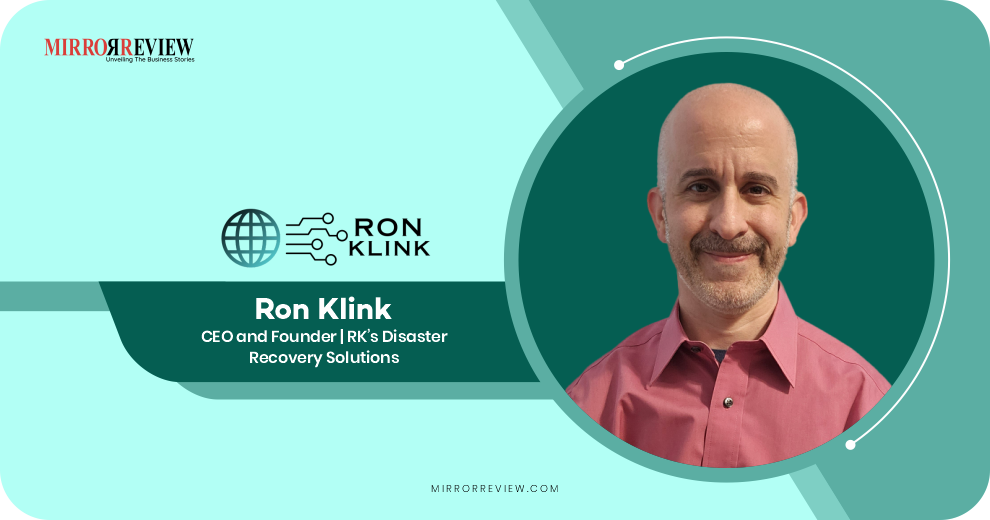
For more than thirty years, Ron Klink has lived in the space between that terrifying silence and the relief of the reboot. He is an IT Infrastructure Specialist, a title that feels too clinical for the work he actually does. He is a guardian of continuity. He is the man who looks at the chaotic, unpredictable nature of the world….. from hurricanes to cyber-attacks, from pandemics to power outages….. and builds the structures that allow a business to survive them.
As the CEO andFounder of RK’s Disaster Recovery Solutions, Ron is not just selling software or server space. He is selling survival. He is selling the peace of mind that comes from knowing that when the worst happens, the lights will come back on. But to understand Ron’s approach to technology, you have to look away from the screens and look at the man himself. You have to look at the discipline of a competitive bodybuilder, the mindset of a man who has spent decades learning that strength is not something you are born with. It is something you build, repetition by repetition, through resistance, through pain, and through the refusal to break under pressure.
From the Mainframe to the Cloud
Ron’s journey into the engine room of the economy began with a spark of inspiration from a high school teacher who saw the future before it arrived. That teacher pointed him toward technology, and Ron never looked back. He entered the industry three decades ago, a geological epoch in tech years. He started his career in the high-stakes, high-pressure environment of the financial district in New York City.
This was the era when mainframes were kings. They were massive, whirring monoliths that occupied entire rooms, the physical brains of the financial world. Working in NYC finance taught Ron the most important lesson of his career: downtime is not an inconvenience; it is a catastrophe. In the financial district, a minute of silence costs millions. It was a baptism by fire, an environment where precision was the baseline and failure was not an option.
As the decades passed, the monoliths gave way to servers, and servers gave way to the cloud. The hardware shrank, but the complexity grew. Ron adapted. “As technology changed so did I,” he reflects. He moved with the tides of innovation, mastering virtualization, network redundancy, and data replication. He became a lifelong learner, a proud member of the IAMCP (International Association of Microsoft Channel Partners) and the IEEE (Institute of Electrical and Electronics Engineers). He stayed ahead of the curve not because it was trendy, but because in his line of work, if you fall behind, you leave your clients vulnerable.
The Gap in the Shield
The origin story of RK’s Disaster Recovery Solutions is not found in a moment of triumph, but in a series of observations about vulnerability. As Ron watched the world change, he noticed a disturbing trend. The threats were getting bigger….. climate change was producing more violent weather, the digital landscape was spawning more sophisticated cyber-attacks, and the global pandemic of COVID-19 had shattered the illusion of stability.
Yet, despite these escalating threats, businesses were not keeping up. Ron saw a profound disconnect. Large enterprises might have had their bunkers, but small and medium-sized businesses were walking a tightrope without a net. “I saw that there was a disconnect with businesses in regards to disaster preparedness,” he says. He saw companies that had no readiness plan, organizations that would be down for days, weeks, or even longer after an unforeseen event.
This realization was his call to action. He founded his company to fill this cavernous ravine in the market. He wanted to bring the high-level, rigorous protection of the financial district to the businesses that form the backbone of the economy. He wanted to ensure that a hurricane or a hacker didn’t mean the end of the road for a family business or a growing mid-sized firm.
Restoring the Business, Not Just the System
In the world of IT consultancy, there is often a fixation on the machinery. Technicians worry about the servers, the cables, the code. Ron flips this dynamic on its head. “Most providers focus on restoring systems,” he explains. “At RK’s, we focus on restoring business.”
This is a subtle but profound distinction. A restored server is useless if the people can’t access it, or if the critical financial data is corrupted, or if the workflow has been shattered. Ron’s model takes a “business-first approach” to resilience. He starts by understanding the organization’s most critical priorities.
- What are the processes that keep the money flowing?
- Who are the people who need to be connected?
- What is the heartbeat of this specific company?
Only after he understands the organism does he build the life support system. His model combines rigorous risk assessment to identify vulnerabilities with bespoke strategy development. He utilizes the full arsenal of modern tech: virtualization to create flexible digital environments, cloud-native disaster recovery for rapid restoration, and automated recovery processes to minimize the most common point of failure….. human error.
Ron doesn’t just build the plan; he tests it. “We conduct rigorous testing and validation, simulating real-world scenarios to confirm readiness,” he says. It is the digital equivalent of a fire drill, but with higher stakes. He wants to be certain that the plan is effective before a disaster occurs, not during it. He aims to make resilience a competitive advantage and a strategic asset.
The Ecosystem of Resilience
Ron describes the infrastructure he builds as a “resilient IT ecosystem.” It is a living thing, composed of interconnected parts that support one another.
Risk evaluation sets the priorities, acting as the nervous system that senses danger. Virtualization and cloud-native tech provide the flexibility, the muscle that allows the company to pivot and move. Redundancy eliminates single points of failure, ensuring that if one organ fails, another takes over. And automation accelerates recovery, the adrenaline shot that brings the system back to life instantly.
“Together, these elements ensure critical operations can withstand and recover from any disruption quickly and seamlessly,” Ron asserts.
This ecosystem is supported by a network of human partnerships. Ron is quick to credit the team he leads, a group of professionals who combine deep technical expertise with a collaborative spirit. They are hardware managers, network engineers, and system architects who share his culture of trust and accountability. Externally, he collaborates closely with Microsoft partners and specialized vendors in cybersecurity and compliance. He understands that in the world of deep tech, no one survives alone. You need a tribe.
The Muscle Memory of Leadership
Ron’s approach to leadership is deeply informed by his life outside the office. He is passionate about physical fitness, a former competitive bodybuilder. This is not just a hobby; it is a philosophy made flesh.
Bodybuilding is a sport of discipline. It is about showing up every day, doing the work when no one is watching, and understanding that growth only comes from pushing against resistance. It is about consistency. “It taught me discipline, consistency, and the ability to push through challenges,” Ron says.
He applies this same mindset to his business. In the field of technology, there is no such thing as a perfect, static balance. “It changes day by day,” he admits. “Some days are calm, and others are pure chaos.” Like a bodybuilder adjusting to the weight on the bar, Ron has learned to adapt to the rhythm of the load.
This resilience was tested during an unexpected internal resource shortage at his company. It was a moment of pressure, a potential crisis. But Ron didn’t panic. He fell back on his training. He stayed calm. He communicated transparently with his team. He reorganized priorities. “That experience reinforced my belief that adaptability and clear communication are the keys to strong leadership,” he reflects. He took the weight, stabilized the core, and pushed through.
The Teacher at Heart
Despite the high-tech nature of his work, Ron’s heart remains that of a mentor. He has never forgotten the high school teacher who inspired him, and he pays that debt forward by mentoring aspiring entrepreneurs. He advises business owners not just as a service provider, but as a guide, helping them navigate the frightening waters of the digital age.
“One of my proudest achievements is mentoring aspiring entrepreneurs and helping them launch successful businesses,” he shares. He finds deep satisfaction in empowering others, in building a stronger, more resilient business community.
His vision for the future is rooted in this desire to help. He wants to strip away the feeling of powerlessness that comes with disasters. “I don’t want anyone to feel powerless when life or business takes an unexpected turn,” he says. He is driven by the goal of sharing knowledge, of providing practical strategies so that when the storm comes, the business stands strong.
The Philosophy of the Backup
Ron Klink is a man who deals in the “what ifs.” What if the power goes out? What if the data is stolen? What if the flood comes? Most people avoid these questions because they are terrifying. Ron runs toward them because he knows the answers.
He wants to inspire people to see uncertainty not as a threat, but as an opportunity to grow stronger. He wants them to understand that resilience is not just a business strategy; it is a life skill. It is the ability to take a hit and keep moving. It is the discipline to prepare for the worst so that you can achieve the best.
“Challenges will come,” he says, with the quiet confidence of a man who has lifted heavy weights and weathered heavy storms. “But they don’t have to break you; they can build you.”
In a world that feels increasingly fragile, Ron Klink is building a fortress. He is the architect of continuity, the engineer of endurance, and the leader who ensures that no matter how dark the screen gets, the story of the business continues. He serves the CIOs and the CISOs, the small business owners and the entrepreneurs, offering them the one thing money usually can’t buy: the certainty that they will survive.
Quotes
Also Read: Cyber Resilience Leaders: The Most Promising and Influential Tech Leaders to look forward to in 2026


