Every university is, at bottom, an argument. Some argue for tradition. Some argue for exclusivity. A few argue that one institution can be several things at once, and then spend decades proving it.
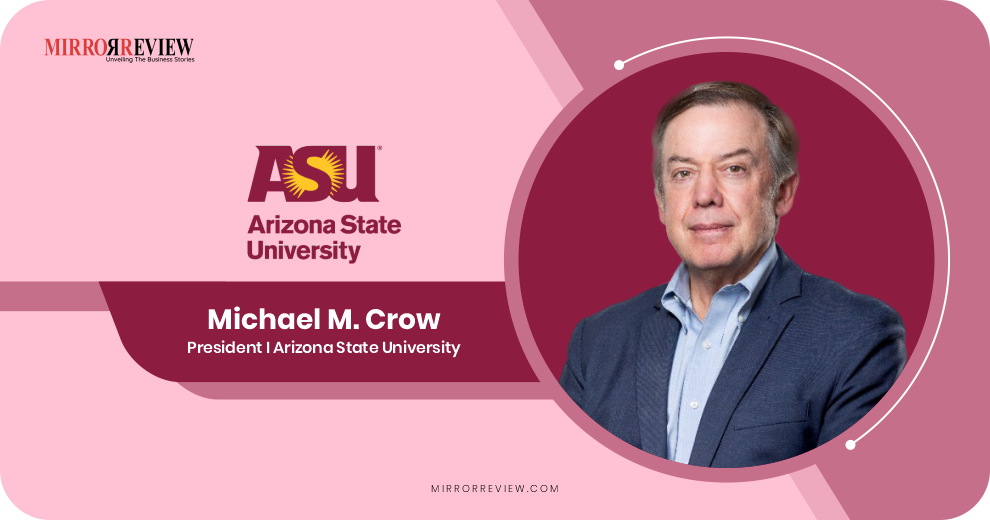
In Tempe, Arizona, that third argument has been running since July 2002. Its author is Michael M. Crow, the sixteenth president of Arizona State University (ASU), now more than 24 years into the role.
He is an educator, a knowledge enterprise architect, a science and technology policy scholar, and a higher education leader. The phrase knowledge enterprise architect is the one that lingers. It describes someone who does not simply run a university but rethinks how its academic, research, and public-service functions fit together.
The Model With a Name
The plans have a name: the “New American University.” Michael conceived this model when he moved from Columbia University to Arizona State University in 2002. It asks a university to hold three commitments at the same time.
The first is academic excellence at the highest level. The second is inclusiveness to a broad demographic. The third is maximum societal impact.
Holding all three is the hard part, and ASU’s charter translates this ambition into institutional commitments: measuring success by whom the university includes and how they succeed, advancing research and discovery of public value, and assuming responsibility for the communities it serves. Michael has guided ASU’s transformation around these principles, developing it into one of the nation’s leading public metropolitan research universities.
It is easy to say that a university can be excellent, open to many kinds of students, and useful to society. It is much harder to build the structure that makes all three true at once. That is the difference between a mission statement and a design, and his work consistently reflects this institutional approach.
The word metropolitan deserves a second look. It places the institution within the wider civic and economic life of its region, rather than apart from it, a setting that sits comfortably beside the model’s emphasis on broad inclusiveness.
What Changed in Tempe
The results are visible in ASU’s academic structure, research capacity, and student community.
Under Michael’s leadership, ASU has established more than 30 new transdisciplinary schools and launched major multidisciplinary research initiatives. Its research expenditures have increased more than eightfold since 2003, while the university has recorded growth in traditional, online, and international student enrollment, first-year student quality, retention, and ethnic and socioeconomic inclusion.
The scale of this transformation is evident in the figures: ASU’s research-related expenditures rose from $123 million in fiscal year 2002 to a record $1.03 billion in fiscal year 2024. This represents a fundamental change in the university’s research capacity, not simply an incremental increase in spending.
Read together, these developments describe a university growing in ambition, in capacity, and in the range of people it serves. The phrase transdisciplinary schools is also worth noting. It suggests a campus organized around questions that cross departmental lines, not only around the departments themselves.
Research expenditures and student diversity are different kinds of measures. In Michael’s model, they belong to the same story.
Before Arizona
Michael did not arrive in Tempe as a newcomer to institutional design. He spent more than a decade at Columbia University in New York, rising through its administration in a series of increasingly senior roles.
He joined Columbia in 1991 as Associate Vice Provost for Science and Engineering. From 1992 to 1993, he served as Vice Provost for Research; from 1993 to 1998, as Vice Provost of the University; and from 1998 to 2002, as Executive Vice Provost. He also directed Columbia’s Earth Institute during his final years at the university.
Each step widened the lens: from science and engineering, to research, to university-wide administration, and finally to the executive office.
He was also a professor of science and technology policy at Columbia from 1992 to 2002. At Columbia, he served as chief strategist of the research enterprise and its technology transfer operations, the work of moving discoveries out of the laboratory and into wider use.
The handoff is tidy. His Columbia years end in 2002, and his ASU presidency begins in July of that year. Seen from a distance, the pattern is a long apprenticeship in how research institutions work, followed by the chance to build one to his own specifications.
A Voice Beyond the Campus
His counsel has traveled well beyond university walls. Michael has advised the U.S. Departments of State, Commerce, and Energy. He has advised defense and intelligence agencies. He has advised a number of nation-states on matters of science and technology policy and the design of knowledge enterprises.
That last phrase, knowledge enterprise design, runs through his career like a thread. It is both a field of study and something close to a job description.
His work across government, national security and international advisory settings reflects a consistent interest in how societies organise research, technology and the institutions responsible for advancing knowledge. He has also served as chairman of the board of In-Q-Tel since 2006, connecting his expertise in emerging technologies with the needs of the U.S. intelligence community.
Michael is an elected fellow of the American Association for the Advancement of Science (AAAS) and the National Academy of Public Administration. He is also an elected member of the American Philosophical Society and the American Academy of Arts and Sciences.
The Writer’s Case
Michael has made his argument in print as well as in practice. Designing the New American University was co-authored with William B. Dabars and published by Johns Hopkins University Press in 2015. He is also the co-author of The Fifth Wave: The Evolution of American Higher Education, published by Johns Hopkins University Press on April 14, 2020.
Beyond those two books, he is the author or co-author of other books and articles analyzing knowledge enterprises, science and technology policy, and the design of higher education institutions and systems. His other published works include Public Values Leadership: Striving to Achieve Democratic Ideals (2021), co-authored with Barry Bozeman.
The subject stays remarkably steady across the titles. What his pages analyze, his university puts to the test. The books give the thinking a permanent address, and the campus gives it a daily one.
A Model Still in Motion
Strategy can live in a document. Michael’s strategy is tested in the daily operations of a university.
The measure of its durability lies not simply in how long it has been implemented, but in whether the institution can continue to balance academic excellence, broad access, and societal impact as circumstances change. That requires responding to evolving student needs, research priorities, public expectations, and institutional pressures without losing sight of the original purpose.
The New American University is no longer simply a design on paper. It is an operating model continually tested through decisions about whom ASU serves, what knowledge it produces, and how its work contributes to society.
For anyone seeking to understand where education and strategy meet, ASU offers a compelling case study in institutional transformation at scale. Michael remains central to its continuing evolution.
Read more : The 10 Most Influential Education & Strategy Leaders to Watch in 2026