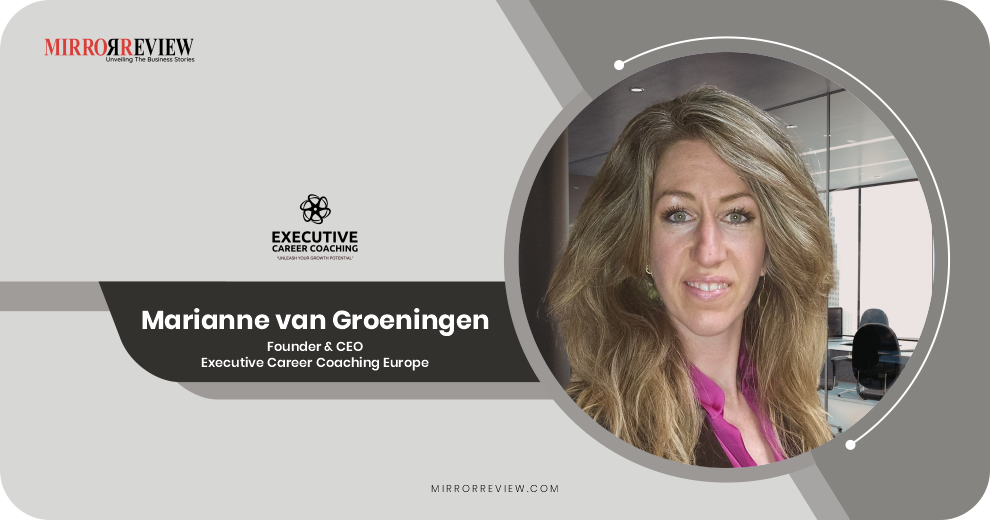
There is a particular kind of clarity that comes only from having watched something fail repeatedly, up close, with enough proximity to feel the heat of it. Not the failure of effort or ambition, but the failure of systems. Of thinking. Of leaders who were smart and capable and still could not get out of the way of the structures they had built around themselves. Marianne van Groeningen has that clarity. She has been standing in that proximity for 18 years.
She is the Founder and CEO of Executive Career Coaching Europe, ranked #1 HR Creator in the Netherlands by Favikon, and the architect of a coaching practice built across 375+ executive relationships and 20 major transformation programs across the continent. Prior to building her own practice, she served as HR Director at Schneider Electric, supporting a 170 million euro business across 10 legal entities and approximately 700 employees, joined the European HR Leadership Team at the age of 29, and led the M&A integration of Invensys in 2014. She achieved financial freedom at 34, not by sacrificing purpose, but by aligning it with strategic execution. She also co-founded 5-star Ecoresort Portobali in Northern Portugal.
She has also, across 18 years of watching how organizations absorb or resist change, developed two words she returns to often: technical debt and emotional debt. She did not read them in a textbook. She encountered them firsthand, in a company that had no idea it was drowning.
The Room That Looked Perfect
The story begins not with an insight, but with a reckoning. Marianne van Groeningen stepped into a company as HR Director that was, by every external measure, a picture of corporate health. Growing revenue. A respected brand. A leadership team that could walk into any boardroom in Europe and hold the room. Inside, it was something else entirely.
“When I stepped inside, I saw something different: a machine held together by heroic effort rather than coherent systems.”
What she found was what she now calls technical debt: processes and systems completely disconnected from each other. Every department was running on its own assumptions. Data sat in silos. Decisions were being duplicated three times over by different people who had no idea the others existed.
But the part that stayed with her was not the technical failure. It was what the technical failure was doing to the people inside the organization. She calls it emotional debt.
The best talent in that company was spending 60% of their energy compensating for broken systems. They were exhausted. They were frustrated. And they were, quietly and without ceremony, beginning to leave.
“That was the real crisis. Invisible from the boardroom. Devastating on the floor.”
The realization that crystallized for her in that moment has shaped every coaching relationship and every transformation she has led since. The role of a leader, she concluded, is not to be the smartest person in the room. It is to create the conditions in which others can do their best work. And when those conditions are broken, no amount of strategic vision will save you.
Two Disruptions, One Reckoning
Most leaders, Marianne observes, are preparing for one disruption at a time. Reality is delivering two simultaneously, and the collision between them is something that most boardrooms have not yet fully computed.
Europe’s Gig Economy is projected to reach €320 billion by 2030. At the same time, AI agents are taking on tasks that once required human judgment. These are not independent trends. They are colliding, and the collision is redesigning the entire talent architecture of modern organizations.
“We are entering a world where your workforce is not a fixed headcount. It is a dynamic ecosystem of full-time employees, specialized freelancers, and digital AI agents, all working together, all needing to be led with clarity.”
She holds two beliefs on this subject that she is candid about calling her most controversial.
The first: you can never successfully implement Agentic AI when processes, roles, and responsibilities are not clearly mapped. “AI on top of broken processes does not give you a smarter company,” she says. “It gives you faster chaos.”
The second belief she delivers in rooms full of senior leaders, watching the discomfort move across faces as she speaks it: by 2040, most companies will have more digital employees than human employees. She is not offering this as a provocation. She is offering it as a calendar.
The leaders who already understand this collision are making different decisions. They are building flexible talent frameworks that can absorb freelance expertise at speed. They are designing onboarding processes for AI agents with the same rigor once reserved for human hires. They are thinking in terms of capability portfolios rather than org charts.
Startups, she points out, are already growing twice as fast as large corporates in this environment, precisely because they can move, flex, and redeploy capability faster. The rigidity of legacy organizational structures is not a stability advantage. It is a compounding liability.
The Framework That Changes Everything
To understand what Marianne has spent 18 years building, you first have to understand the problem she believes no other framework has honestly confronted. 70% of transformations fail. Not occasionally. Consistently, across industries, across geographies, across decades of supposedly improving management science.
The reason, as she sees it, is architectural. Most frameworks focus on one dimension of change. They deliver a brilliant strategy playbook, a detailed technology roadmap, or a culture transformation program. And then they wonder why nothing sticks.
“You cannot successfully transform one dimension of an organization while leaving the others unchanged.”
She has seen this failure hundreds of times. A founder invests in a visionary strategy. But the leaders do not have the skills to execute it, and the systems are not built to support it. The vision stays on a slide deck. A CTO deploys the most sophisticated technology stack available. But the culture has not shifted, and the roles are not redesigned. Three months later, the tools are being used at 20% of their capability by leaders who never wanted them in the first place.
Her answer is the SPS Framework: three pillars that must evolve simultaneously, not one at a time. Strategy governs vision and mindset. People govern culture and skills. Systems govern technology and processes. When a leader moves one of these pillars, they must move all three. Because transformation, as she defines it, is not static, but requires holistic integration.
Her field evidence on this is precise: companies that rushed AI deployment without governance frameworks spent an average of 18 months undoing the damage. Companies that designed the process architecture first were operationally live in 6 months. The gap between those two timelines is not technical. It is, as she is quick to state, a leadership gap.
The 30% of leaders who succeed at transformation outperform the 70% who do not by a factor of 4x. Not because they are smarter. Because they are more integrated in how they think about change.
The Digital Employee Nobody Governed
When Marianne coaches founders on AI governance, she begins with a simple question. Do you have a clear job description for your AI agents? Do you know exactly which decisions they are authorized to make autonomously, which require human review, and which are off-limits entirely? In most cases, the answer is no.
“The AI has been deployed with general instructions and a vague assumption that someone is watching.”
She argues that this is precisely the same mistake leaders make with human employees when they skip onboarding and role clarity. The difference is that with AI agents, the speed and scale of the errors are dramatically higher.
The governance framework she uses distinguishes four critical layers. Task Boundaries define what the AI agent is authorized to do, and what is explicitly outside its remit. Data Privacy Protocols determine what data it can access, and who is accountable when it is accessed incorrectly. Escalation Architecture establishes when the agent should defer to a human, and which human. Performance Management defines how you measure the output of a digital employee over a 90-day horizon.
Governance for AI agents, she emphasizes, is not a technology challenge. It is a leadership challenge. Leaders who build this architecture before deployment are not slowing themselves down. They are compressing the learning curve. Because when things go wrong, and she is clear that they will, those leaders have the infrastructure to diagnose and correct at speed, rather than shut down the entire initiative and start again from nothing.
The CEO at the 2025 Web Summit in Lisbon
Among the 375 leaders Marianne has coached, one story surfaces readily when she is asked about the transformation she is most proud of.
It begins at the 2025 Web Summit in Lisbon.
She met a CEO there who had co-founded a company several years earlier with this CTO and had built something that, by any external measure, was genuinely impressive. But somewhere in the scaling process, his CTO almost quietly collapsed. His CTO had become reactive instead of proactive. He was responding to fires instead of building the architecture that would prevent them. Resulting that, the CTO is seriously considering leaving the company he had built from zero.
What emerged during that process did not surprise Marianne. The technical skill, she says, was never the issue. It was exceptional. What was missing was something harder to name: his ownership of his identity as a co-founder. Without quite noticing it, he had defaulted into the role of a very senior technician. He had stopped leading.
Over the four months that Marianne coached this CTO, she watched him make the transition from reactive to proactive. From responding to events to designing the conditions that would shape events before they happened. He stopped trying to fix every problem himself and began building the systems that allowed his team to fix them without him. Six months after they finished working together, he told her something she carries into every coaching relationship:
“I used to think my job was to be the best engineer in the room. You helped me understand that my job is to make every engineer in the room better than I am.”
The most common reason technical founders plateau at scale, she observes, is not a shortage of technical skill. It is the inability to move from being the best individual contributor in the room to being the leader who designs the system that makes everyone in the room better. The technical skill that built the company becomes the identity that limits the leader. This, she says, is the transformation she is in the business of. Not just capability. Identity.
Five Skills for the Decade Ahead
When asked which leadership skills will determine who thrives between now and 2030, Marianne does not reach for comfortable abstractions. She offers five, with the precision of someone who has seen their absence end careers.
Adaptive Leadership With Clarity. The environment will shift faster than any strategic plan can anticipate. The leaders who thrive will not be those who predicted correctly. They will be those who built a decision-making architecture that allows them to pivot with speed and transparency. Prediction, she says, is a vanishing advantage. Response capability is permanent.
AI Fluency, Not AI Dependence. There is a critical difference between a leader who governs AI as part of their workforce and one who has outsourced their thinking to it. The former builds a genuine competitive advantage. The latter is building a fragile dependency. AI, she argues, should extend human judgment. Do not replace it.
Relationship Intelligence Across Distance and Difference. As AI handles more routine interactions, the ability to create genuine human connections becomes a leader’s primary differentiator. This is not soft-skill territory. It is the most important competitive variable in organizations where work is distributed, talent is global, and trust cannot be built through physical proximity.
Continuous Learning as an Operational Habit. The half-life of knowledge is shortening rapidly. The leaders who build learning into their weekly rhythm as a non-negotiable, rather than a nice-to-have, will compound their relevance. Those who rely on past expertise will find that expertise quietly depreciating.
Ecosystem Thinking: Leading Without Control. The most significant challenges of the next decade will not be solvable within organizational boundaries. Climate transition, workforce transformation, market volatility: these require leaders who can mobilize stakeholders they do not control, build governance across organizational lines, and maintain momentum in the absence of formal authority.
She is careful to add that these five skills are not independent of one another. “The leaders who build all five together compound faster than those who develop them sequentially,” she says. Adaptive leadership without AI fluency leaves you unable to leverage the most powerful tools available. Relationship intelligence without continuous learning becomes outdated as work modes evolve. The five do not simply add. They multiply.
The Edge
When asked what she most wants the leaders she has coached to say about her ten years from now, her answer comes immediately, and it is exactly thirteen words.
“She pushed me to the edge and made sure I didn’t fall over it.”
She is not in the business of making leaders comfortable. Comfort, she says with the quiet certainty of someone who has seen it fail repeatedly, is the enemy of growth. And in this particular moment, it is also the enemy of survival. The market is too fast. The disruptions are compounding. The leaders who stay in their comfort zone will find that zone getting smaller every year until it disappears entirely.
But pushing leaders to the edge without ensuring they are safe to take the risk is not leadership development. It is recklessness. Impactful executive career coaching, as she describes it, holds both simultaneously: the radical ambition and the structure that makes the ambition achievable without destroying the leader in pursuit of it.
What makes her proudest is not the revenue her clients have grown, or the transformations they have led, or the promotions they have earned, though all of those things have happened. What makes her proudest is something quieter: the decisions leaders made that they once only allowed themselves to think about in private. The bold pivot they had been afraid to commit to. The structure they kept delaying. The identity shift from technical expert to genuine leader that they did not believe was possible for them.
“Those decisions, the ones that started as thoughts in a coaching session and became the defining moves of a career, that is what I am in the business of. No information. Not frameworks. Transformation of the kind that changes what a leader believes is possible for them.”
In a world where 70% of transformations fail before they fully begin, Marianne van Groeningen is the architect of the other 30%. And if her read of this moment is right, which her track record suggests it is, the leaders who find their way into that 30% sooner rather than later will not simply survive the age of Agentic AI. They will define it.
“The best way to predict the future is to create it.”
Connect with Marianne & Executive Career Coaching Europe
1. Marianne van Groeningen on LinkedIn:linkedin.com/in/mariannevangroeningen
2. Executive Career Coaching Europe:
- Website: executivecareercoaching.io
- LinkedIn: https://www.linkedin.com/company/executive-career-coaching-europe/
Quotes
Read More: The Leaders Who Will Survive Agentic AI Are Already Thinking Differently