
In September of 2017, inside a conference room in the Polanco district of Mexico City, a Senior team of Vice Presidents from one of the largest beverage companies in the world sat across a table from a Mexican entrepreneur carrying a drink of his own invention. It was called Go Gaba, a “Mind Drink” built around a unique combination of natural ingredients, developed to promote mental concentration and improve performance. He had already carried it into stores across Mexico and the Netherlands, and it had won him recognition from Google and from authorities in both Mexico and France.
The Coca-Cola Company expressed interest in bringing the product to a wider market. A legally binding agreement was then signed in December 2017 between the publicly listed Mexican subsidiary of The Coca-Cola Company and Jose Antonio Del Valle Torres. The meetings, held between July and December of that year, included Manuel Arroyo Prieto, the current Global Chief Marketing Officer of The Coca-Cola Company. Approximately five months after the agreement was signed, another publicly listed subsidiary, Coca-Cola Japan, began marketing its own version of the drink in Japan, under a different name, without him.
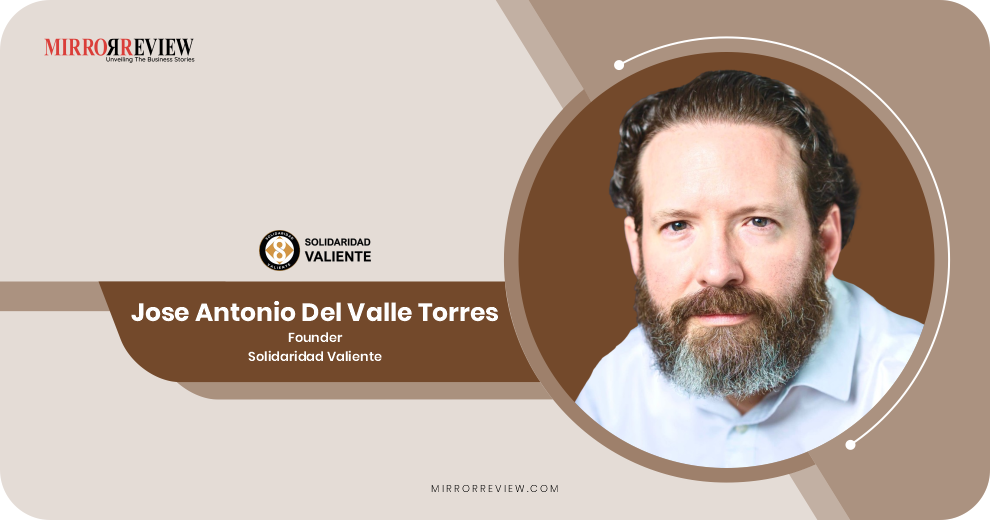
That betrayal, and everything that followed it, is the hinge on which the story of Jose Antonio now turns. He is the Founder of a social movement, Solidaridad Valiente, and serves as a strategic advisor, entrepreneur, and journalist whose professional life has run, almost improbably, along two parallel tracks: building enterprises to generate value, and defending, with everything he has, the idea that truth still matters in a world built to outlast it.
A Country of Contrasts
Jose Antonio grew up inside a set of contradictions that would eventually define his life’s work. Mexico, as he describes it, is a country “sunk in corruption throughout decades, regardless of the political party in Government”, where many people lack reliable access to quality health care, quality public education, and an effective justice system. That discomfort, he says, never left him.
He studied Business, Accounting, and Human Resources at a leading university in the field of Economics, and interned first at a private bank and later at a multinational corporation, work that steered his early career toward organizational reengineering. His last position before becoming an entrepreneur was as Chief Financial Officer for one of the most notable national initiatives in Mexico, a project spanning utilities, electricity, and telecommunications, aimed at bringing meaningful improvement to less developed communities. From there, he built his own ventures oriented around added value and innovation.
The Deal in Polanco
Go Gaba was the product of that orientation. Reporting on the dispute, including coverage by Bloomberg, Work-Bites, BRAINZ, and the Financial Times, has laid out the sequence in detail. Jose Antonio had already established Go Gaba in the Mexican and Dutch markets by the time Coca-Cola’s executives, impressed by its potential, offered to use its marketing, financial, and brand development capabilities to help scale the product. The agreement that was signed in December of 2017 set the stage for the legal dispute that followed.
In July of 2018, Jose Antonio filed two criminal complaints against the company for corporate fraud and industrial property theft. Mexico City’s Attorney General later determined that his losses from the affair totaled $345 million dollars, a figure also cited in coverage by the Financial Times. The rival product was pulled from the market almost as quickly as it appeared. International reporting on the case has identified several senior executives, including Arroyo Prieto and Selman Careaga, the President of Asia Pacific for The Coca-Cola Company, as figures of interest in the investigation, though the underlying legal proceedings in Mexico remain, by Jose Antonio’s own account, unresolved.
What the Dispute Took
Asked when his leadership was most severely tested, Jose Antonio does not hesitate. “My leadership has been dramatically and permanently tested over the last eight years as I have committed my life to find justice,” he says. “I lost everything that ever mattered to me: Country, Family and Business.”
The dispute, now nearing eight years old, has cost him more than a business relationship. Citing numerous attacks on his life, confirmed by reputable security experts, he has lived for years in self-imposed exile, moving home repeatedly to protect his life. He describes the experience as part of a Coca-Cola pattern he has watched play out in other countries as well, one where he believes theft, harassment, intimidation, corruption, and violence function as the standard cost for those who challenge their concentrated corporate power.
What the ordeal revealed to him, he has said elsewhere, is a structural imbalance: individuals are accountable before the law within the borders of a single jurisdiction, while multinational corporations may operate through entities across multiple jurisdictions, making accountability more complex. It is a lesson he did not ask for, and one that reshaped the rest of his career.
An Open Letter and a New Purpose
Solidaridad Valiente was born directly out of that reckoning. In 2021, Jose Antonio wrote an open letter to then President of Mexico Andrés Manuel López Obrador, laying out the corruption within Mexican authorities to favor Coca-Cola in his case. According to Jose Antonio, the Presidential Office responded immediately; he says, unfortunately, the corruption not only continued, but multiplied. The access to justice failure, layered on top of everything else, became the founding motivation for the organization.
“The core initiative of ‘Solidaridad Valiente’ is to remind Mexicans, and global citizens in general, of Mexico’s core values: National Identity, Freedom and Democracy,” he explains. “I strongly believe that in this way, through individual awareness, positive collective changes can be obtained.”
The premise is deliberately modest in scale and ambitious in reach: when the challenges facing a country are large, diverse, and spread across a vast population, meaningful change must start with individual impact before it can ever accumulate into something collective. Solidaridad Valiente seeks to spotlight Mexico’s human talent, tourist destinations, and gastronomy in an effort to counterbalance the corruption narrative with something he believes is just as true: that the country is, in his words, a land of extraordinary talent and creativity persistently punished by corruption and violence to reach its full potential.
The Principles Underneath
Pressed on what has guided him consistently across both the nonprofit and business sectors, Jose Antonio answers without elaboration, as though the list were self-evident: “Honesty, commitment, empathy and literacy.”
That simplicity extends to how he thinks about the tension every social impact leader eventually faces, the one between mission and sustainability. He insists the two are not in competition. Lasting social impact, in his framing, depends on building a realistic and executable equilibrium among measurable objectives, established organizational capabilities, and sustainable development. Without that balance, he suggests, good intentions collapse under their own weight.
Value Beyond the Balance Sheet
Social value and long-term organizational growth, Jose Antonio says, are never separate considerations in his work, whether he is operating as an entrepreneur or as a community development advocate. His profession, as he puts it, is entrepreneurship. His passion is serving his country, even from the distance of self-imposed exile and the permanent threat to his life.
That same philosophy shapes how he approaches partnerships. To amplify impact through collaboration with businesses, communities, and other stakeholders, he believes objectives have to be shared and aligned, at least broadly, and that shared passion for execution has to be matched with professionalism, hard work, and a commitment to results that can actually be measured. Anything less, in his estimation, produces partnerships that look good on paper and accomplish little in practice.
Lessons of an Advisor
In his role as a Strategic Advisor, helping organizations adapt and pursue sustainable success, Jose Antonio points to a single discipline above all others: constant learning, applied at the personal, organizational, and social level simultaneously. The goal, as he describes it, is to remain anchored to core values while staying genuinely open to new opportunities, a balance that is easier to state than to practice, particularly during periods of organizational pressure or uncertainty.
What Solidaridad Valiente Has Built
Asked to name the milestones that best reflect the impact of Solidaridad Valiente, Jose Antonio points not to a single event but to what he describes as a shift in awareness: a growing recognition of the significance of national identity, the identification of concrete examples of Mexican achievement worth celebrating, and a meaningful and steadily growing base of followers actively engaging with the organization’s work. It is, by design, a slower and more diffuse kind of progress than a headline number, one built person by person rather than campaign by campaign. Awareness, consciousness, and the possibility of collective change through individual transformation.
Looking Toward 2026
As for what comes next, Jose Antonio sees the greatest opportunities for entrepreneurs and nonprofit leaders emerging where a local perspective meets a global vision of growth and integration. He points specifically to communications, space, energy, and security as the fields most likely to produce the next wave of meaningful impact, sectors where local realities and global systems are becoming impossible to separate from one another.
The Question He Leaves Us With
Jose Antonio’s closing message centers on a call for the truth to prevail, in every situation, across every nation, within the global narrative. He is careful to frame this not as an abstraction but as a personal discipline: without self-introspection, and without a clear, well-established commitment to serving others, life does not fulfill its purpose.
“It’s how we spend our time that matters most,” he says. “After all, life is simply a personal experience within the interaction of time, energy and space.”
He ends, characteristically, not with a conclusion but with a question, tossed to whoever is listening: What are we going to do with that?
Quotes
Read more: Leadership, Entrepreneurship & Social Impact Leaders to Watch in 2026


