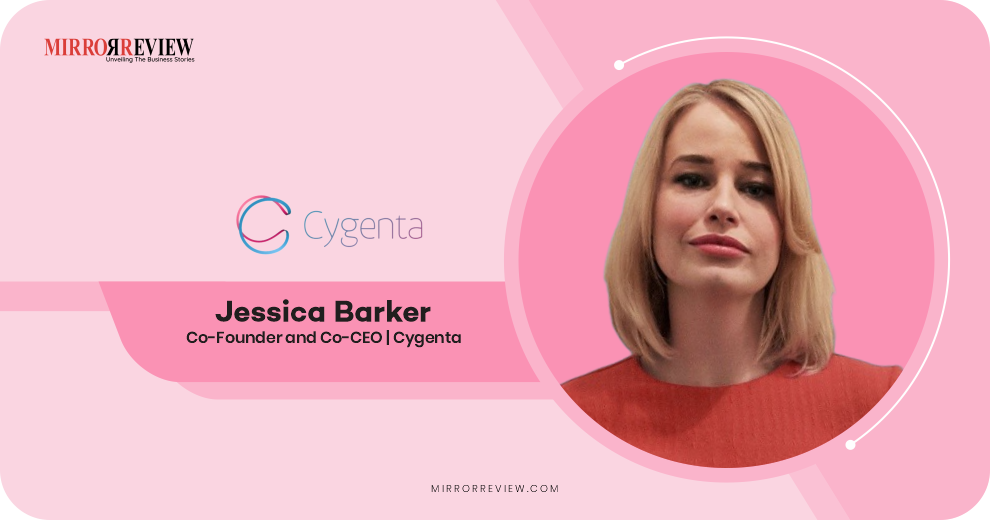
There is a story the cybersecurity industry has told itself for years, repeated so often it began to resemble doctrine: that people are the weakest link. The unpredictable variable. The source of mistakes technology must compensate for, rather than collaborate with. Jessica Barker has spent more than a decade challenging that assumption.
As the Co-Founder and Co-CEO of Cygenta, the cybersecurity business she built alongside her husband, FC, Jessica has built her career around a fundamentally different belief: that people, when properly educated, empowered, and understood, can become an organisation’s strongest line of defense.
That perspective has taken her to keynote stages across more than 25 countries, in front of audiences exceeding 50,000 people, including events hosted by NATO, the World Government Summit, and RSA San Francisco. It has made her one of the most recognized voices in cybersecurity awareness, behavioural science, and security culture, as well as a bestselling author and award-winning industry leader. But for her, the central idea has always remained the same. Security is ultimately about people.
Reframing the Human Side of Cybersecurity
Jessica’s work sits at the intersection of cybersecurity and behavioural science, two disciplines that have historically operated separately. While much of the cybersecurity industry has focused on technical controls, threat detection, and infrastructure protection, She has concentrated on the sociology and psychology behind how people actually interact with technology and risk.
“I help organisations leverage the human side of cyber to strengthen their security and empower their people,” is how she describes her mission.
The distinction matters. Her approach is not about treating employees as liabilities requiring constant correction. It is about building understanding, confidence, and decision-making capability inside organisations so security becomes part of the culture rather than merely a compliance requirement.
That philosophy has become central to modern cybersecurity conversations, but when she began championing it more than a decade ago, it was still considered a niche perspective inside a heavily technology-driven industry.
“Helping people become the strongest link in security since 2011” remains one of the clearest summaries of the work she has spent years advancing across organisations, governments, and global cybersecurity communities.
Building Cygenta Around a Different Philosophy
Cygenta was built around the idea that effective cybersecurity cannot rely solely on technical systems. Awareness, culture, behaviour, and communication must play an equally significant role.
Under Jessica’s leadership, the company has become widely recognized for its human-centered approach to cybersecurity education and awareness. Rather than relying on fear-based messaging or checkbox compliance exercises, Cygenta focuses on helping organisations build long-term security cultures grounded in understanding and trust.
That work has involved direct engagement with more than 50,000 people across over 25 countries, reflecting her belief that meaningful security awareness is built through genuine human interaction, not simply through automated training modules or policy documents.
Running a globally recognized cybersecurity company while simultaneously maintaining one of the industry’s most active speaking and publishing schedules requires an unusual combination of operational discipline and clarity of purpose. The consistency of Cygenta’s reputation over more than a decade speaks to both.
From Keynote Stages to Bestselling Books
Jessica’s influence extends far beyond advisory sessions and organisational workshops. She has delivered more than 80 keynote presentations around the world, speaking at some of the cybersecurity industry’s most influential forums, including NATO, the World Government Summit, and RSA San Francisco. Her talks consistently explore the behavioural dimensions of cybersecurity, translating complex ideas about risk, trust, culture, and human behaviour into conversations that audiences can immediately understand and apply.
Her bestselling book, Confident Cyber Security, further expanded that mission, helping readers approach cybersecurity not as an abstract technical discipline, but as a practical and deeply human challenge. She also co-authored Cybersecurity ABCs, bringing foundational cybersecurity concepts to broader audiences in a clear and accessible format.
That ability to translate cybersecurity into language ordinary people can engage with has made her a trusted media voice for outlets including the BBC, Sky News, and Wired. In a field often saturated with jargon and fear-driven narratives, she has built influence through clarity, accessibility, and empathy.
Contributing Beyond the Stage
Jessica’s impact extends into advisory and leadership roles across the cybersecurity ecosystem. She has served on numerous boards and advisory groups, often on a voluntary basis, contributing her expertise to broader industry development and policy discussions.
Her roles have included former Chair of ClubCISO, participation in the Black Hat Europe Executive Summit, and service on the UK Government Cyber Security Advisory Board (GCAB), positioning her at the intersection of industry practice, executive leadership, and public policy. Those contributions reflect a broader commitment not simply to advancing her own company or platform, but to helping shape the future direction of cybersecurity itself.
The Human Voice Cybersecurity Needed
Jessica Barker represents a different model of cybersecurity leadership: one grounded not in fear, but in understanding. At a time when organisations continue struggling with phishing attacks, insider risk, digital trust, and security culture, her insistence that people should be educated rather than blamed has become increasingly influential across the industry.
She has spent years reminding organisations that cybersecurity is not merely a technical problem waiting for a technological solution. It is also a behavioural challenge, a communication challenge, and ultimately a human challenge.
In 2026, as AI, automation, and increasingly sophisticated cyber threats continue reshaping the digital landscape, that perspective has only become more important. Because technology may secure systems. But people secure organisations.
Read More: Cybersecurity Marketing & Communications Disruptors to Watch in 2026