
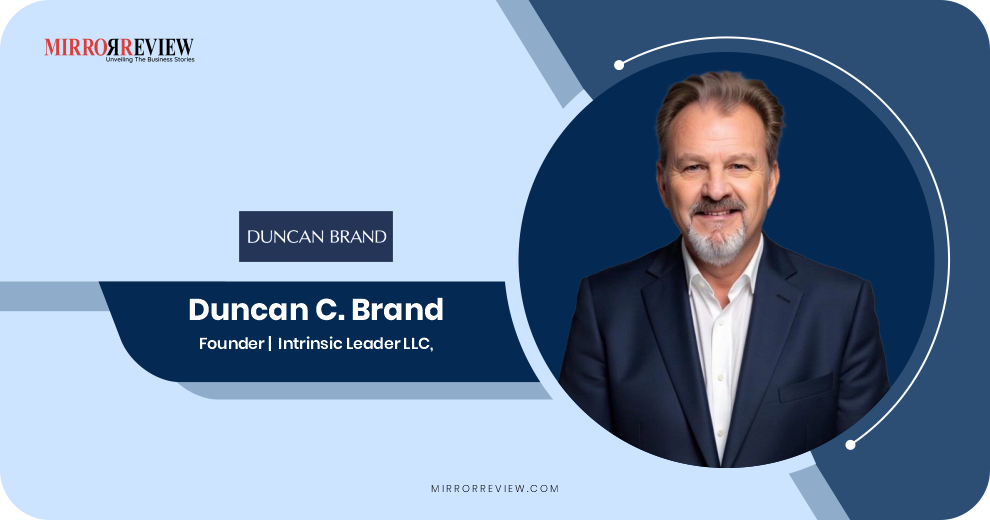
A hospital boardroom and a federal agency office rarely appear on the same page of anyone’s resume, let alone in the same paragraph of a single career. But for Duncan C. Brand, Founder of Intrinsic Leader LLC, the two rooms have always rhymed. Walk into either one, he has come to believe, and you will find the same quiet fracture: systems built for compliance, hollowing out the very people they claim to develop.
It is an observation that has taken fifteen years to sharpen, across industries as varied as healthcare, technology, aerospace, and government. And it has landed Duncan on a definition of leadership that sounds almost deceptively simple. “A future-fit organization is one whose leaders can absorb constant change without losing their people’s trust, growth, or commitment.”
That sentence, plain as it looks on paper, is the product of a long unlearning.
From Structures to Something Harder
Early in his career, Duncan believed that a future-fit organization was a matter of architecture: the right competency models, the right succession charts, the right training curricula. Get the blueprint correct, and the building will hold.
Fifteen years and several industries later, he no longer believes in blueprints alone. The fracture he has watched repeat itself, in a hospital boardroom or a federal agency, taught him something the org charts never could. Structures do not fail loudly. They fail quietly, by hollowing out capable people who keep showing up to work inside them.
It is this shift, from structural thinking to something more human and considerably harder to measure, that now defines Duncan’s mission at Intrinsic Leader: to build leadership systems that last.
A Book That Gave People Language
That mission found its clearest expression in Mind the Gap, Duncan’s book built around a philosophy he calls “People First, Employee Second.” Since its release, the response, in his own words, has been “humbling.”
Leaders have told him the book gave language to something they had felt for years but could not quite articulate: the difference between quiet compliance and genuine commitment. What surprised Duncan most, though, was not the emotional resonance. It was the financial one. Executives, he found, did not want another feel-good manifesto. They wanted a CFO-ready business case that treats people-first leadership as risk mitigation.
Middle managers responded differently, but no less powerfully. They told him the book validated instincts they had been pressured to abandon. For Duncan, that is the measure of a book doing its job, not applause, but recognition.
Twenty Countries, One Currency
Duncan has scaled leadership academies across 20 countries, and the experience has taught him a rule he now treats as gospel: frameworks travel, but expressions do not.
Trust, he says, is the universal currency of leadership. Yet how that trust gets earned varies enormously from one culture to the next, in the directness of feedback, in comfort with hierarchy, in the pace at which relationships form before business is even allowed to begin.
His answer to that variation is discipline rather than improvisation. “I never parachute in with a finished product,” Duncan says. Instead, he partners with local leaders to translate his frameworks into their own cultural context because, as he puts it, a leadership academy that ignores culture teaches compliance, not leadership.
Where Artificial Intelligence Is Allowed to Help
Ask Duncan about artificial intelligence and talent development, and he does not reach for hype. He reaches for a boundary.
At Intrinsic Leader, AI is used where it genuinely adds value: personalizing development pathways, analyzing skills gaps across an enterprise, and giving leaders safe environments in which to practice difficult conversations before having them for real. But Duncan is, in his own words, “ruthless about one boundary: AI informs, humans decide.”
The opportunity, as he frames it, is that AI can free leaders from administrative work so they can return to the deeply human work of leading. The danger is treating it as a substitute for judgment and relationships. Intrinsic Leader, he says plainly, designs for the former.
Consultant by Day, Coach by Nature
Duncan also holds an ICF executive coaching certification, a credential that runs alongside, rather than beneath, his consulting practice. He is careful to separate the two roles, even as he insists they feed each other constantly.
As a consultant, Duncan works on the system, diagnosing how hiring, succession, performance management, and development connect or fail to. As a coach, he works with the person, holding up a mirror so an executive can confront their own gaps. The ICF discipline matters here, he explains, because a coach does not hand out answers.
The two roles are inseparable in practice. “I have never seen a talent system transform without the leader at the top changing first,” Duncan says, a line that doubles as both his methodology and his warning to any organization hoping to skip that step.
What Gen Z Is Actually Asking For
On the subject of Gen Z, now a significant share of the workforce, Duncan resists the framing that so many organizations default to. Gen Z, he argues, is not inventing new demands. It is “asking out loud for what every generation quietly wanted: purpose, transparency, real growth, and to be treated as human beings rather than job functions.”
The first shift he makes with leaders is one of interpretation: stop hearing entitlement, start hearing feedback. From there, Duncan builds practical muscle. Frequent, honest conversations replace annual reviews. Visible growth pathways replace static career ladders. Authenticity replaces managerial performance.
Leaders who master this shift, Duncan notes, do not just retain Gen Z. They get better for everyone else on the team, too.
Trust Without Hallways
Hybrid and remote work, in Duncan’s assessment, did something more fundamental than change schedules. It dispelled an illusion, the assumption that proximity equals connection.
Trust, he says, can no longer be assumed through hallway visibility. It has to be deliberately designed. That shift changes succession planning in particular, because proximity bias is real, and leaders have always tended to promote the people they can see. Duncan now helps clients build systems that value outcomes over visibility, identifying talent by contribution rather than office attendance.
Development itself has moved too, out of one-off classroom events and into the flow of work, through cohort-based experiences that travel with people rather than pulling them away.
The Focus Has Narrowed, Not the Reach
Intrinsic Leader’s roots run through technology, healthcare, finance, utilities, aerospace, government, and philanthropy, and Duncan considers that cross-industry range a genuine advantage rather than a lack of specialization.
Still, something has changed deliberately. The shift, he explains, has been in focus rather than industry. Intrinsic Leader now concentrates on C-level leaders because sustainable change in talent systems has to start at the top. Alongside that focus, Duncan is seeing growing demand from two newer directions: mid-market companies building leadership infrastructure for the first time, and AI-native businesses discovering, often the hard way, that technology moves fast, but trust still moves at human speed.
The Mistake Everyone Makes First
Ask Duncan what goes wrong before organizations ever call him, and he does not hesitate. They treat leadership development as a training problem when it is actually a systems problem. They buy a program before diagnosing the gap, then wonder why nothing changes once managers return to their busy desks.
The second mistake runs deeper still, what Duncan calls the executive mindset gap: declaring people the most important asset while budgets, promotions, and metrics quietly say otherwise. “Employees believe what the systems tell them, not what the posters say,” he says. It is why every engagement at Intrinsic Leader begins the same way, with an honest reality check.
The Numbers Behind the Philosophy
Duncan’s client work has produced results he describes in concrete terms: double-digit improvements in leadership engagement, accelerated internal mobility, reduced time-to-hire, and inclusive leadership behaviors that strengthen both culture and performance across global technology, healthcare, and public-sector organizations.
But when asked what he is proudest of, Duncan does not lead with metrics. He leads with people. Having trained more than 5,000 leaders and managers worldwide, he finds particular satisfaction in watching those he developed years ago step into executive roles and build people-first cultures of their own. The release of Mind the Gap has extended his frameworks even further, well beyond the clients he could ever reach in person.
The milestones he values most, though, are quieter than any of those. Retention curves bending. Engagement recovering. Internal promotion replacing external rescue hiring.
What Comes Next
Duncan describes the next chapter of Intrinsic Leader in three words: scaling without dilution. The plan includes expanding its executive-level advisory services built around the Mind the Gap frameworks, specifically the Reality Check Audit, the Trust Battery, and the 90-day playbook, while developing ways for organizations to run these tools internally through their own certified facilitators.
He is also investing in digital tools designed to keep development inside the flow of work, alongside more speaking and workshop engagements that bring the book’s ideas directly to leadership teams. And there is a sequel underway. Closing the Gap will focus more acutely on coaching as a strategic development and growth tool, a natural continuation of the philosophy he has spent fifteen years refining.
The Witness Before the Consultant
Duncan traces his own motivation back to a role he held long before he ever consulted for anyone: witness. He spent years simply watching capable people get hollowed out by systems designed for compliance rather than growth. That, he says, is why he insists on a distinction that sounds almost like a correction. “You cannot manage people; you manage work, budgets, and timelines, but you lead human beings.”
His closing message to readers is less a slogan than an instruction. Mind the gap between what your organization says about people and what its systems actually do to them. Close that gap, Duncan says, and commitment, innovation, and results follow.
Quotes
Read more : Leadership Development & Organizational Excellence Leaders to Watch in 2026


