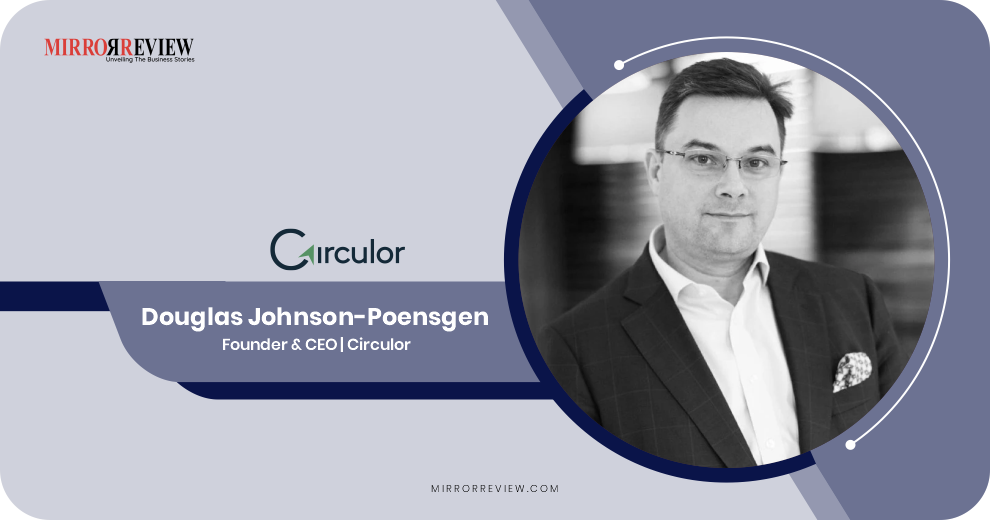
There are executives who manage companies, and then there are executives who build them from nothing, rebuild them under pressure, and pivot them when the world shifts beneath their feet. Douglas Johnson-Poensgen is firmly, unmistakably the second kind.
With more than three decades of operating leadership across climate and industrial technology, financial services, telecommunications, media, technology, defence, and government, Douglas has done the work that most business leaders only read about in case studies. He has built businesses from concept to global scale, led complex business model pivots under commercial and regulatory pressure, and delivered major operational turnarounds in environments that are regulated, politically sensitive, and unforgiving of hesitation.
The BT and Barclays Years
Before founding Circulor, Douglas held senior leadership roles at BT Global Services and Barclays. At BT, he was a senior member of the team that delivered a 450% EBITDA increase on an £8.5 billion business turnaround. The numbers are striking, but what they represent is even more so: an organization in distress, reshaped under pressure into something profitable and functional.
At Barclays, he resolved two significant historical regulatory issues through complex multi-party negotiations. The outcome was a direct saving of approximately £250 million to the bank. These were not small corrections. They were high-stakes negotiations with real institutional consequences, and Douglas navigated them successfully.
What those years ultimately gave him was not merely financial or operational expertise, but a deeper understanding of how global systems behave under pressure, how regulation reshapes markets, and how institutions respond when transparency becomes unavoidable. That understanding would later become foundational to Circulor itself.
Building Circulor
Douglas founded Circulor with a specific and urgent mission: to bring transparency to industrial supply chains. Over eight years at the helm, he scaled the company from inception to global market leadership in industrial supply chain traceability.
The partnerships Circulor built are a measure of the trust the market placed in it. Major automotive and energy companies, including Volvo, Jaguar Land Rover, Total, BHP, and Boeing, came on board. The company also contributed to the development of battery passport standards across Europe, work that sits at the intersection of regulatory compliance and climate accountability.
At a time when enterprises were under increasing pressure to prove the ethical sourcing, carbon footprint, and regulatory compliance of their supply chains, Circulor positioned itself not simply as a software platform but as a system of industrial accountability. Using traceability technologies, real-time supply-chain visibility, and emissions intelligence, the company helped transform ESG from a reporting exercise into an operational capability.
The World Economic Forum recognized the significance of what was being built, naming Circulor a Technology Pioneer in 2022 and Douglas a Global Innovator in 2024.
The Pivot That Defined a Tenure
What makes Douglas’s story at Circulor particularly instructive is not the growth. It is the pivot. Identifying structural shifts in the regulatory and political landscape, he repositioned Circulor from climate and ESG traceability to cross-border trade compliance, targeting obligations under the EU Battery Regulation (EUBR), the EU Deforestation Regulation (EUDR), the Carbon Border Adjustment Mechanism (CBAM), and the Basel Convention.
This is precisely the kind of move that is easy to describe and difficult to execute. The company had to maintain commercial momentum through the transition, all while managing the complexity of a business model that was fundamentally changing shape.
The shift reflected something larger happening across the global industry. Sustainability was no longer being treated as a voluntary corporate initiative. It was becoming embedded in international trade, procurement, manufacturing, and market access itself. Douglas recognized that transition early and positioned Circulor accordingly.
“The ability to read the landscape before the landscape reads you is where experienced operators earn their distinction.”
A Name on the Global Stage
In 2025, Douglas was named to the TIME100 Climate list, which recognizes global leaders making a meaningful impact on the climate crisis. It is a recognition that placed him alongside some of the most consequential climate figures of the moment, a signal not just of past achievement but of ongoing relevance.
Douglas is, at his core, a builder and a pivot artist in the most disciplined sense. He builds to scale, he pivots under pressure, and he does both with the kind of deliberate intelligence that comes from thirty-plus years of doing the hard thing in hard places.
What makes his work especially consequential is that it addresses one of the defining questions facing modern industry: how do global supply chains become simultaneously transparent, compliant, resilient, and sustainable? For Douglas Johnson-Poensgen, the answer has never been abstract. It is built through systems, standards, operational visibility, and the willingness to redesign industrial accountability from the ground up.
Read More: Sustainability Tech, ESG & Performance Innovation Leaders to Watch in 2026