
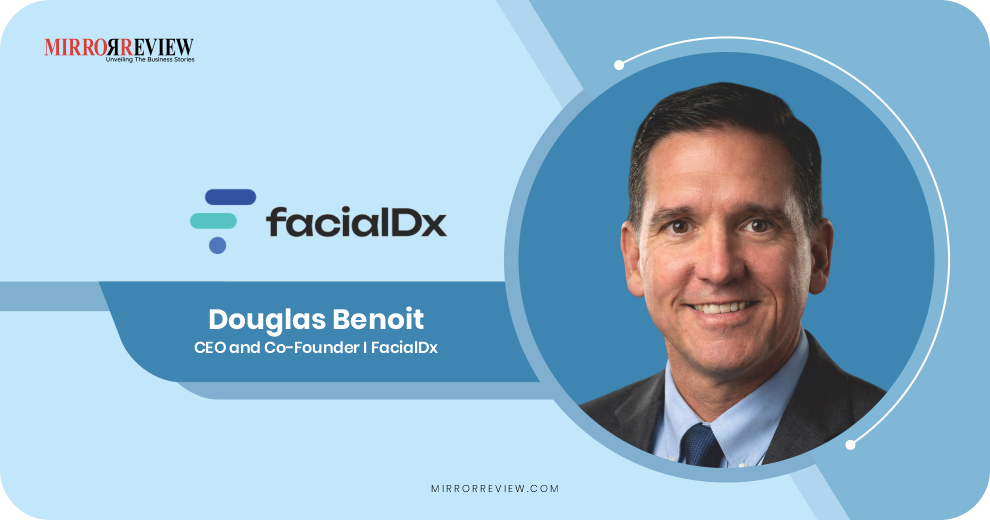
There is something almost poetic about the fact that a technology designed to read the human face was born, in part, from a moment when no one was truly paying attention.
It was the early days of the COVID-19 pandemic. Douglas Benoit, a decorated U.S. Military veteran and former intelligence officer, had been waiting nearly eight months for a VA appointment. When the call finally came, it lasted seven minutes. Seven minutes, after eight months of waiting. Most of that brief window was spent simply scheduling another appointment set for months further down the road. No real insights were exchanged. Nothing of consequence was accomplished.
For most people, an experience like that registers as a frustration and then quietly fades. For Douglas, it became the beginning of something far greater.
The Soldier Who Learned to Think Before He Could Vote
Douglas enlisted in the United States Marine Corps at the age of 17, fresh out of high school. He was eager to experience life, to serve something greater than himself, and to find out exactly what he was made of. The Marines, as they tend to do, answered all three questions at once.
“The Marines taught me to think decisively, take initiative, and develop the physical and mental resilience to accomplish what others couldn’t,” he reflects.
Small-team operations became his native language. The discipline of doing more with less, of achieving complex objectives under extreme pressure, would follow him for the rest of his career in ways he could not yet fully anticipate.
In 1998, he transitioned to college, earning a degree in Kinesiology while working full-time. The early 2000s brought opportunity. The dot-com era and a booming Southern California real estate market gave him his first clear view of a problem worth solving. He noticed that people had access to resources they didn’t fully understand, and that someone willing to bridge that gap could build something meaningful.
That insight produced International Cash Funding, a company that provided capital solutions in complex and distressed situations. By 2004, the company’s net worth had reached the lower seven figures. Douglas was, by any measure, succeeding. And then the world shifted.
September 11, 2001, had never truly left him. Watching close friends sustain serious injuries in the years that followed deepened a pull he could no longer ignore. In 2005, he commissioned as a U.S. Army officer in the intelligence community.
A Decade of Intelligence, Discipline, and Decisive Action
What followed was a decade of work that most people encounter only in policy briefings or classified reports. Douglas served as a platoon leader, communications and intelligence officer, foreign liaison, collection agent, and commanding officer. His career was defined by specialized roles and training in Surveillance and Target Acquisition, Coxswain, Airborne, and Army Rangers, with operational experience across multiple countries. He collaborated with foreign nationals, allied forces, and joint commands on high-stakes intelligence missions.
From 2012 to 2015, he served as Development and Integration Officer for a decisive action training program, coordinating live intelligence training across multiple military services, agencies, and international partners. This work, turning raw and often chaotic data into clear, actionable intelligence for real-world operations, would quietly become the conceptual backbone of everything he built next.
“It’s like learning to swim with your hands and feet tied together,” he says of his military experience. “Once you master that, very little in the civilian world feels impossible.”
A medical discharge in 2015 brought that chapter to a close. In the midst of the next few years of behavioral health and wellness treatment, He pursued a second Master’s degree in Real Estate Finance to work for the U.S. government and tried to identify where his skills belonged in civilian life. From 2019 to 2022, he worked alongside several early- and mid-stage technology companies, helping them advance their technology, hit key milestones, raise capital, and drive sales. He was circling something bigger than himself, though he couldn’t define it.
Twenty-Two Veterans and Three Months on the Road
The shape arrived, unexpectedly, during a pandemic.
When that seven-minute VA video call ended with nothing resolved, Douglas didn’t simply close his laptop and move on. He began listening more carefully to the people around him. His wife, Samantha, joined him as they spent three months traveling across the United States, meeting with 22 veteran friends who had served in combat zones and were now quietly struggling, years or even decades later, with TBI, PTSD, depression, and related challenges after more than 20 years of service.
Those conversations were clarifying in the most profound sense. The problem was not simply bureaucratic inefficiency, though that was certainly present. It was a systemic gap. Healthcare and wellness intake processes were too slow, too invasive, and too disconnected from the speed and clarity required for genuine decision-making.
Around the same time, a close friend and business partner introduced Douglas to an experienced clinician who had spent more than 40 years performing facial analysis, had trained hundreds of medical professionals, and had collectively treated more than 20,000 patients. The clinician’s concept offered something Douglas recognized immediately: a rich, proven, data-driven method for reading the body’s condition through the face.
“Their stories made it crystal clear: we had an opportunity to make a real difference.”
13 December 2021, FacialDx Inc, a visual biomarker intelligence company, was created with a bold mission: to revolutionize global health and wellness through non-invasive, AI-powered screening of physiological and psychological biomarkers, delivering faster, easier, and more actionable intelligence for better decisions in healthcare and beyond.
156 Biomarkers, 13,824 Patterns, and Five Photographs
The technology at the heart of FacialDx is, on its surface, disarmingly simple. Through a free demo, a user uploads five high-quality images of a person’s face into a secure cloud-based portal. What follows, however, is anything but simple.
FacialDx’s AI engine analyzes over 156 biomarkers from those images in a single session, drawing on principles from both Western and Eastern medicine to recognize more than 13,824 variable patterns associated with significant health conditions and personal characteristics. The analysis runs entirely in the cloud on Amazon Web Services (AWS), protected by Plerion HIPAA-compliant security protocols. A comprehensive, encrypted report is generated and returned immediately to the authorized user or healthcare professional.
It is worth being precise about what FacialDx is, and what it is not. It is not a diagnostic device. It does not tell a doctor that a patient has PTSD, a traumatic brain injury, or depression. What it does is serve as a decision-support tool: a way of delivering fast, non-invasive, actionable intelligence that supports clinical judgment rather than replacing it. All data remains fully encrypted and protected throughout the entire process, ensuring complete privacy and compliance with HIPAA standards, including all regulations governing Protected Health Information and Personally Identifiable Information.
That distinction is not merely a legal nicety. It is, Douglas insists, the entire philosophical point.
One Platform, Many Missions
What makes FacialDx particularly unusual is its range. Military and first responder units can receive reports weighted toward operational readiness and resilience. HR and enterprise wellness teams can focus on employee well-being and early risk indicators. Telehealth providers can use the insights to support faster triage and care planning. Corrections facilities can apply the technology during intake screening and support programs. The same underlying engine, configured with the right emphasis for each user.
It is the kind of design philosophy that reflects a military intelligence officer’s instinct: build the system robust enough to operate in any terrain, then calibrate for the mission at hand.
Ethics, privacy, and consent are not afterthoughts in this framework. Every individual whose images are analyzed is clearly informed that their photographs will be used solely to generate their personal report. The insights are delivered directly to them, or to the authorized professional they designate, and are never shared with third parties without explicit consent. When FacialDx is integrated as an API within enterprise or clinical settings, the partnering organization assumes full responsibility for obtaining proper consent and maintaining full regulatory compliance.
The platform’s core values, Service First, Innovation with Integrity, Speed and Efficiency, Actionable Intelligence, and Resilience and Excellence, are not corporate platitudes. They trace directly back to the experience that built the man behind the company.
Partners, Momentum, and a Clinical Trial in Australia
FacialDx did not arrive at its current position alone. Douglas is generous in acknowledging the network that helped bring the platform to life. Samantha Benoit, Don Heidrich, and a dedicated technology team transformed an original concept into a robust, web-based application. Early principals and investors believed in the technology before it had fully taken shape and enabled the company to move successfully through proof-of-concept, MVP development, and into the go-to-market phase.
A growing network of partners and affiliates continues to play a vital role, including Azzura Santo, Aaron Itzkowitz, Dan Porter, David Mannheim, Dr. Aaron Tabor, Dr. Claude Solitario, Dr. Joseph Pergolizzi, Dr. Todd Frisch, James Smith, Kathy Hebert, Mark Casper, and Tommy Richardson, along with several organizations including GENIEXO Aesthetic Research, Nuu Mobile, RaDoTech, and Tech for Troops.
The momentum has been building with notable speed. Two highly reputable international technology companies have proactively reached out to explore distribution partnerships with FacialDx, with one of those companies also having conducted the initial proof-of-concept for database and server management, validating the platform’s technical foundation from the ground up.
In October 2025, Synbio International Inc. formalized a strategic alliance with FacialDx through Share Purchase and Warrant Agreements, a development covered by NASDAQ, GlobeNewswire, Seeking Alpha, StockTitan, and TechFocus Asia, among others. In January 2026, Synbio signed an agreement for a proof-of-concept clinical trial to evaluate FacialDx’s AI-based facial analysis screening software for behavioral health disorders. By April 2026, an Australian clinical trial had been launched, aimed specifically at earlier detection of major medical depression and PTSD.
For a company still in its early growth phase, the combination of inbound partnership inquiries from established global players and a formally structured clinical trial represents a powerful and public validation of what Douglas set out to build in the fall of 2021.
A Vision as Large as a Smartphone Screen
Where Douglas ultimately wants to take FacialDx is a vision that is, in the best sense of the word, audacious. The immediate focus rests on three high-impact markets where the existing platform can deliver measurable value: Healthcare, Sports Performance, and Human Resources and Enterprise Wellness. Future expansion plans include sectors such as dating services and security screening.
But the larger vision reaches much further.
“Our bigger, long-term vision is bold and inclusive: to empower anyone in the world with a smartphone equipped with an HD camera to easily monitor their own health and wellness using FacialDx, anytime, anywhere.”
He envisions FacialDx becoming a seamless, expected API layer within standard screening processes across military, medical, sports, and employment contexts, accessible to millions of people every day, within five years, and quite possibly much sooner. The goal, at its core, is to shift the world from reactive care to truly proactive wellness on a global scale.
That is not a modest ambition. But then, Douglas has never been in the business of modest ambitions.
The Man Behind the Mission
There is a version of this story that focuses only on the technology, the biomarkers, the clinical trials, the strategic alliances. That version is incomplete.
Douglas is sustained by a framework as simple as it is demanding: God, Corps, Country. Three essential areas that he works, consciously and consistently, to keep full every day. God comes first, as the foundation of his thoughts and decisions. Corps represents his family and close friendships, the people who make the journey worth taking. Country stands for the community, the work, and the larger purpose it serves.
At the center of that Corps is a family of nine: his wife Samantha and their seven children, three daughters and four sons. Spending quality time with them and actively participating in their hobbies and interests is not something Douglas treats as a reward for finished work. It is part of the work itself.
“Family, faith, and purpose aren’t separate from work; they’re the fuel that makes everything else possible.”
One of the things that clearly delights him is watching his children grow into young entrepreneurs, each with a strong sense of purpose and a genuine desire to make the world a better place. FacialDx, he says, was built with that same spirit in mind.
His leadership philosophy, offered without fanfare, carries the quiet confidence of someone who has tested it repeatedly, in combat zones, boardrooms, and cross-country road trips with his wife to listen to the stories of struggling veterans:
“Lead with purpose, build with heart, and create tools that truly serve others.”
It sounds simple. Most true things do.
A Tool That Matters
There is a particular kind of builder, rarer than it should be, who approaches technology not as an end in itself but as a means of solving a problem that genuinely hurts people. Douglas Benoit is that kind of builder.
He started with a seven-minute phone call that accomplished nothing. He drove across a country, listening to 22 veterans describe what it felt like to fall through the gaps of a system that should have caught them. He found a clinician whose four decades of facial analysis work offered a different way of seeing. And he built a platform that now carries, embedded in its architecture, the weight of all of that listening.
“If we can help even one person catch a health concern earlier, support a veteran’s recovery, or strengthen a team’s well-being, then we’ve succeeded in our mission.”
FacialDx is still, as Douglas himself acknowledges, just getting started. But there is something in the trajectory of this company, in the speed and seriousness of the partnerships forming around it, in the clinical trials now underway in Australia, that suggests it is moving in a direction from which it will not easily be turned back.
The face, it turns out, has always had a great deal to say. It just needed someone with the right training to start listening.
Quotes
Read more : AI, Biometric Intelligence & Mission-Critical Wellness Leaders to Watch in 2026


