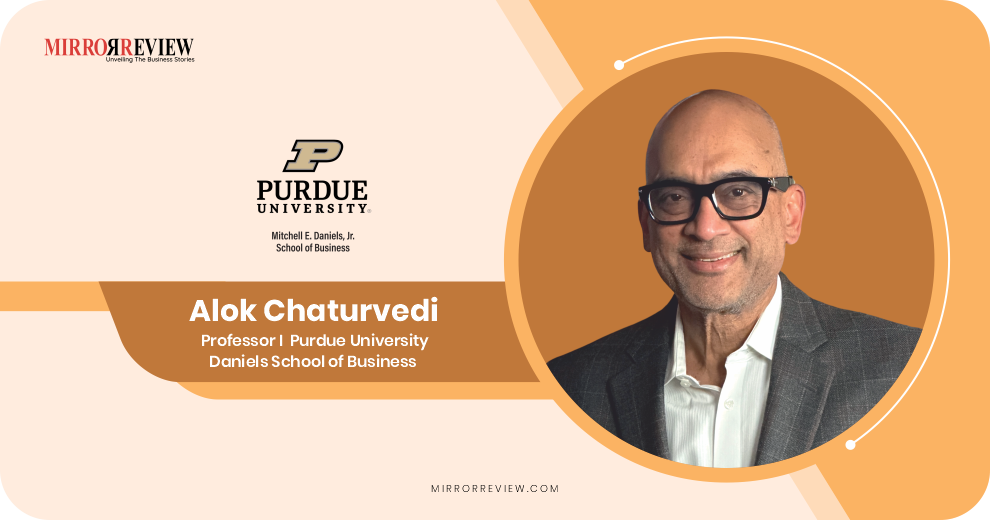
There is a specific kind of quiet that exists in the office of a man who spends his days thinking about the intractable. It is not the silence of emptiness, but the heavy, hum-filled silence of a server room or a library, where the air feels thick with data waiting to be turned into decisions. Dr. Alok Chaturvedi lives in this quiet place. He sits at the intersection of things that usually do not meet. He stands between the clean, cold logic of rigorous mathematics and the messy, desperate needs of the human condition. He bridges the gap between the subatomic weirdness of quantum mechanics and the dusty reality of a rural village in India.
For four decades, Dr. Chaturvedi has been asking a single, relentless question. It is a question that sounds simple until you try to answer it. How can we model complex systems well enough to make better real-world decisions?
Most people ask this question to sell more widgets or optimize a supply chain. Dr. Chaturvedi asks it because he believes that if you get the math right, you can save a life. Or ten million of them.
He is a Professor at Purdue University’s Daniels School of Business and the Director of the Institute for Social Empowerment through Entrepreneurship and Knowledge (ISEEK). But these titles feel like ill-fitting suits for a man whose work is essentially about cartography. He is mapping the future. He is drawing lines between the terrifying potential of Artificial Intelligence and the stabilizing force of ethical wisdom. He is not just a technologist. He is a philosopher who speaks in algorithms.
The Sentient World
To understand the scope of Dr. Chaturvedi’s mind, you have to go back to a time of crisis. During the conflicts in Iraq and Afghanistan, the U.S. military had a problem. They had plenty of firepower, but they lacked foresight. They could break things, but they struggled to predict the consequences of breaking them.
Dr. Chaturvedi and his team built something that sounds like science fiction. They called it the Sentient World Simulation (SWS). It was a synthetic mirror of the real world, a continuously running, agent-based model that digested data and spat out probabilities. It gave decision-makers a way to “rehearse” the future. It allowed them to see that if they pulled a lever here, a wall might fall down over there.
“That was not abstract research,” Dr. Chaturvedi says, his voice dropping to the register of someone who has seen the weight of his own equations. “It was computation meeting consequence.”
The system helped preserve lives. It proved that you could use silicon and code to understand the organic chaos of human conflict. But for Dr. Chaturvedi, this was just the proof of concept.
If you could use this power to navigate a war, surely you could use it to navigate the even more complex landscape of peace. If you could model a battlefield, could you model a pathway out of destitution?
The Quantum Bridge
Today, the frontier has moved. The buzzword in every boardroom is “Quantum.” CEOs are terrified of it, or they are throwing money at it, usually without understanding it. They see it as a faster horse. They think it is just a computer that computes more.
Dr. Chaturvedi shakes his head at this. “The critical insight for CEOs,” he says, “is that quantum computing isn’t just faster than classical computing. It is a fundamentally different way of processing information.”
He is currently pioneering what he calls the “Quantum Bridge.” It is a pragmatic, almost subversive approach to the hype. While the rest of the world waits for stable quantum hardware, machines that are still finicky, expensive, and rare, Dr. Chaturvedi is using quantum thinking on the computers we have today.
He uses quantum-mathematical structures to design algorithms that run on standard hardware. It turns out that the math of the quantum world, concepts like superposition and entanglement, are incredibly good at solving human problems.
“Think of it as ‘measurement theory’ for business decisions,” he explains.
In the classical world, and in traditional business strategy, you gather data, you analyze it, and then you commit. You collapse the wave function. You choose a path. But the world is uncertain. Dr. Chaturvedi’s quantum-inspired frameworks allow a system to maintain “strategic superposition.” This means holding multiple possibilities simultaneously, delaying the irreversible decision until the moment of optimal timing.
It is not a metaphor. It is rigorous mathematics. And when applied to business, it improves decision quality dramatically while cutting the cost of information. It is a way of being comfortable with uncertainty, of navigating the fog not by clearing it, but by seeing through it with a different kind of eye.
The Village and the Cloud
If the Quantum Bridge is the “how,” then ISEEK is the “who.”
It is easy to talk about “empowering the underprivileged” in the abstract language of a grant proposal. It is much harder to do it when the population you are serving has little literacy, no capital, and no access to the internet.
Dr. Chaturvedi founded ISEEK with a ten-year goal that is staggeringly ambitious: to “graduate” ten million people from at least ten countries out of destitution. He wants to turn them into entrepreneurs.
The standard model of economic development is brutal. It usually involves taking people from rural areas and shoving them into urban factories. It disrupts families, destroys communities, and creates urban slums. It creates efficiency at the cost of humanity.
Dr. Chaturvedi looked at this system and saw a bad algorithm. He saw a model that optimized for money but failed to optimize for “human flourishing.”
So he flipped the model. Instead of moving the people to the factory, he moved the factory to the people.
Through Project Saksham in India, ISEEK deployed the “Factories-on-Wheels” concept. They bring manufacturing capabilities to rural villages. They use a platform called Daksh, a gamified mobile app that teaches entrepreneurship to people who might not be able to read a textbook but can certainly understand a game.
“Innovation isn’t just technology,” Dr. Chaturvedi says. “It is maintaining optionality.”
There is that quantum thinking again. By bringing the work to the village, the women of Jharkhand can run sustainable micro-enterprises. They earn an income. But they do not lose their social support network. They stay in their community. They remain in superposition; mothers, community members, and business owners, all at once.
“This isn’t charity,” Dr. Chaturvedi insists. “It is a sophisticated systems design that achieves better outcomes by respecting human diversity.”
He talks about “cognitive diversity.” He recognizes that a woman in a village in India makes decisions differently from a stockbroker in New York. Traditional AI optimizes for the average, which means it optimizes for the stockbroker. Dr. Chaturvedi builds systems that design for “equity enhancement.” He builds AI that works for the edges of the bell curve, not just the center.
Digital Dharma
We live in an era of tech anxiety. We worry about algorithms radicalizing our children. We worry about AI taking our jobs. We worry about the surveillance state.
Dr. Chaturvedi offers a solution that is thousands of years old, repackaged for the silicon age. He calls it “Digital Dharma.”
Dharma is a Sanskrit concept that is difficult to translate. It means duty, law, righteousness, or the natural order of things. For Dr. Chaturvedi, Digital Dharma is “a practice for living well with technology.”
It is not a set of regulations imposed by a government. It is a personal discipline. At the core of this philosophy is the vratam: a small, keepable vow.
“Think of these as low-stakes rehearsals for high-stakes digital moments,” he says.
A vratam might be a promise to turn off your phone an hour before bed. It might be a commitment to verify a piece of news before sharing it. It might be a refusal to click on clickbait. These sound like small things. But Dr. Chaturvedi argues that they build “ethical muscles.”
When the crisis comes, when you are faced with a deepfake that confirms your worst biases, or when you are tempted to trade your privacy for convenience, you need those muscles. You need to have practiced the art of attention and choice.
“This journey is both personal and communal,” he says. As individuals adopt these small practices, the culture shifts. The demand for ethical technology grows. It scales from the user to the platform to the policy. It is a bottom-up revolution of conscience.
The Calculus of Inequality
What keeps Dr. Chaturvedi working this hard? He has achieved tenure, he has won the National Training and Simulation Association’s Lifetime Achievement Award, and he has successfully exited a commercial company, Simulex. He could retire to a cabin and read books.
“What keeps me at this is simple,” he says. “Technology can amplify inequality or reduce it. The difference is whether equity is designed in from the start.”
He sees a divergence coming. On one side, there is the “Quantum Bridge”: sophisticated, high-speed decision-making tools for the elite. On the other side, there are the billions of people left behind by the digital economy.
If we are not careful, AI will widen this canyon. It will make the rich hyper-efficient and the poor irrelevant. Dr. Chaturvedi’s work is an attempt to wire the bridge so that traffic flows both ways.
He points to his “Quantum Bridge” research again. “The same quantum structures that optimize business decisions also enhance healthcare equity for underserved populations,” he says.
This is the elegance of his worldview. The math that makes a corporation profitable is the same math that makes a healthcare network fair. It is all about optimization. It is just a matter of what you choose to optimize for.
The Unprepared Future
Dr. Chaturvedi manages his life with the same balance he seeks in his algorithms. He finds grounding in his partnership with his wife, Rashmi. He finds relief in the “multidisciplinary nature” of his work. Moving from high-level quantum theory to the practical logistics of a mobile app for rural India prevents burnout because it uses different parts of the brain.
But there is an urgency in his voice when he talks to leaders. He has a mantra, a warning that he delivers to CEOs and students alike.
“The future arrives unprepared.”
We have a habit, he says, of viewing things like AI or quantum computing as distant events. We think we have time. We wait for the technology to be perfect. We wait for the regulatory landscape to settle.
“But the future isn’t a single moment; it’s a process,” Dr. Chaturvedi says. “And that process is happening right now.”
The leaders who will succeed are not the ones who wait for the quantum computer to arrive in a box. They are the ones who are building “quantum literacy” right now. They are the ones building “ethical AI frameworks” right now. They are building “organizational muscle.”
He is a man who has spent a lifetime modeling the future, and his conclusion is that you cannot predict it perfectly, but you can prepare for it. You can build systems that are resilient. You can build technologies that are kind.
Dr. Alok Chaturvedi is looking at the screen. He sees the code. He sees the quantum states swirling in superposition. But through the data, he sees the village. He sees the face of a person who just needs a chance. And he goes back to work, calculating the precise mathematical formula for hope.
Quotes
Also Read: AI & Quantum Visionaries: The Most Influential Leaders to Watch in 2026