
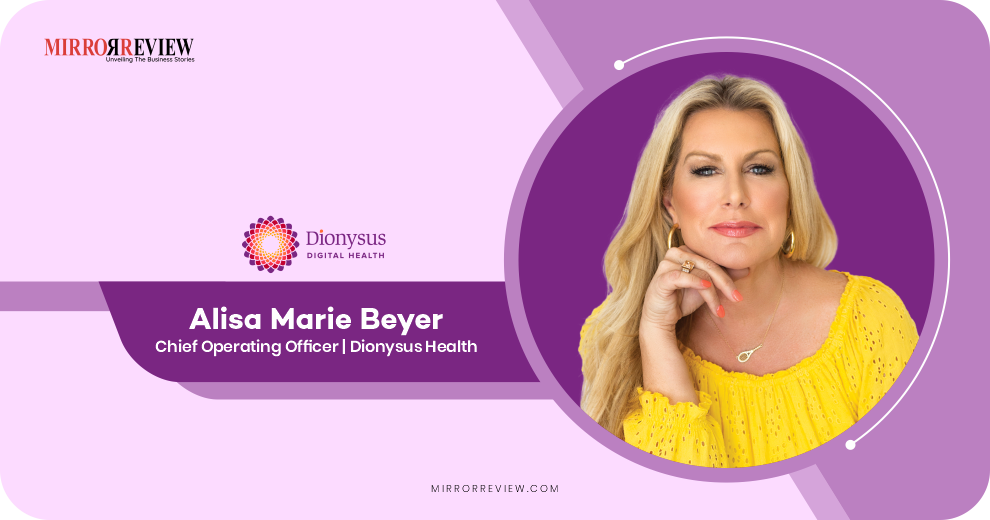
Alisa Marie Beyer has a way of holding two seemingly opposite worlds in perfect, productive tension. One moment, she’s talking about the intricate beauty of a birth plan, the sacred space of a delivery room, the quiet desperation of a new mother struggling in silence. The next, she’s dissecting commercial strategy, articulating the nuances of a go-to-market path, and extolling the virtues of a really great spreadsheet. She is a birth doula and a COO, a childbirth educator and a biotech executive, an amateur cattle rancher and a woman who has navigated multiple successful company exits.
In many people, these identities would clash, creating a discordant personality. In Alisa, they harmonize. She is the living embodiment of the bridge she is so determined to build—a bridge between the soft, intuitive world of birth and the hard, data-driven world of business. As the Chief Operating Officer of Dionysus Health, a pioneering San Diego-based molecular diagnostics company, she is channeling a lifetime of experience into bringing a single, transformative product to market: myLuma™, the first-ever prenatal test that can predict a woman’s risk for postpartum depression and anxiety.
To sit with Alisa is to understand her self-proclaimed title of “Professional Wingwoman.” She is fiercely focused, not on herself, but on the person next to her, whether that’s talking to a group of OBs about a life-changing new diagnostic or a first-time mother terrified of the unknown. Her energy is not a slow burn; it’s a bright, steady flame. It’s the kind of energy that gets things done, that builds companies and confidence in equal measure. For over two decades, she has been obsessed with birth and business, and now, in what she calls a later season of her own motherhood, those two passions have finally, powerfully, converged. This isn’t just a job. For Alisa, a “3X Mama” who lives between San Diego to Tahoe, this is a mission to solve the right problem, not just the obvious one. And for millions of mothers, that could make all the difference.
The 25-Year Pivot
Every story has a beginning, a single moment that lights a fuse. For a 16-year-old Alisa in Williamsport, Pennsylvania, that moment came while volunteering with WIC, the Women, Infants, and Children program. Surrounded by the raw, beautiful, and often challenging realities of motherhood, a fire was lit. She would become an OB. But life, as it often does, had other plans. As the first in her family to attend college, the long, arduous path to becoming a physician didn’t align with her circumstances. So, she pivoted. If she couldn’t be in the delivery room as a doctor, she would find another way to make an impact. She turned to business.
“Fast forward 25 hard-earned years,” Alisa says, a note of reflection in her voice, “and I’m fortunate to say that how I earn a living, how I serve others, and what I consider my life’s mission all finally align—motherhood.”
That alignment is now expressed through two distinct but complementary roles. As the COO of Dionysus Health, she is at the forefront of healthcare innovation. As the founder of Let’s Talk Birthy, a heart-centered organization educating first-time moms on pregnancy, childbirth, and postpartum to support safer, healthier hospital births.
She is on the front lines of maternal support. It’s a dual existence she has been preparing for her entire life. Her career has always been about building—building companies, building strategies. But it was becoming a mother herself, three times over, that provided the most crucial insight. She experienced firsthand the profound chasm between the childbirth education she received and the stark reality of postpartum mental health support—or rather, the lack of it.
That personal realization became Alisa’s professional turning point. It propelled her to dive deeper, to formally train and become a certified childbirth educator, a birth and postpartum doula, and a perinatal behavioral health coach. She has worked with hundreds of women, one-on-one in private practice, and as part of a bustling hospital team in San Diego, supporting the unique challenges faced by families in the U.S. Navy. This frontline experience isn’t just a footnote on her corporate resume; it is the very lens through which she views her work in biotech. It gives her a granular, human-centered understanding of what mothers truly need, an understanding that data alone can never provide.
The Crisis We Don’t See
The statistics surrounding postpartum depression (PPD) are staggering, almost too large to comprehend. It is the single most common complication of childbirth. More common than gestational diabetes, more common than preeclampsia. It contributes to nearly one in four maternal deaths in the United States, making it a leading driver of maternal mortality. The economic toll is a jaw-dropping $14.2 billion annually. Yet, the response from the healthcare system has been, as Alisa puts it, “shockingly inadequate.”
“Fifty percent of women with PPD receive no treatment,” she states. “They fall through the cracks—undiagnosed, untreated, and alone.”
This is the problem Dionysus Health was created to solve. While there is a simple, standard test for gestational diabetes with a 96% screening rate, the screening for PPD, hovers around a mere 40%. Diagnosis relies on a mother, often in the throes of crisis, to self-report her symptoms on a questionnaire, long after the baby has arrived. Dionysus Health’s mission is to shatter that paradigm. Their goal is to make a predictive, objective, and early diagnostic test the undisputed standard of care.
At the helm of this mission is an all-star team of female scientists and doctors, a fact that clearly energizes Alisa. The company was founded by Dr. Andrea Cubitt, a world-class scientist whose resume includes contributing to Nobel Prize-winning research under the legendary Dr. Roger Tsien and holding leadership roles at multiple successful biotech firms. Joining her as a co-founder is Dr. Vivienne Ming, a theoretical neuroscientist and AI pioneer whom Inc. magazine named one of the “10 Women to Watch in Tech.” Rounding out the leadership team is Chief Medical Officer Dr. Jennifer Payne, a nationally recognized psychiatrist who founded the Women’s Mood Disorders Center at Johns Hopkins and now directs the Reproductive Psychiatry Research Program at the University of Virginia, where she oversees Dionysus’s clinical studies.
For Alisa, joining this powerhouse team was more than a career move; it was a calling. “I joined Dionysus because it represents a rare and meaningful alignment of personal mission and professional purpose,” she says. “As a mother who silently endured postpartum depression and anxiety, I know how isolating that experience can be. I also know it doesn’t have to be this way. At Dionysus, I get to help rewrite that story—for millions of women.”
The Science of Seeing It Coming
For decades, the standard medical advice for a pregnant woman worried about her mental health has been to “wait and see.” myLuma™ is the scientific rebuttal to that passive, dangerous approach. It is a prenatal blood test that, as early as 28 weeks into pregnancy, can predict a woman’s risk of developing postpartum depression. It’s a fundamental shift from reactive crisis management to proactive, personalized care.
“This is critical,” Alisa explains, “since research suggests 50% of PPD cases begin during the third trimester but are dismissed as ‘normal’ pregnancy symptoms.” myLuma™ gives doctors and mothers a tool to validate those early feelings and connect the mother with support before her baby arrives.
The science at its heart is epigenetics; the study of how external factors like stress and hormonal shifts can change the way our genes work. Our DNA is not just a fixed blueprint; it’s more like a dynamic script, and experiences can add notes in the margins, telling certain genes to speak up or stay quiet. Dionysus’s scientists, leveraging a decade of preliminary data, have identified specific epigenetic biomarkers, molecular fingerprints, in a mother’s blood that act as a signal for elevated PPD risk.
Validated in over 600 patients with a predictive accuracy of up to 85%, myLuma™ offers an objective insight that has never before been possible. It’s a game-changer. It replaces a subjective, delayed questionnaire with a clear, consistent, and early scientific indicator. “For decades, women have been told to ‘wait and see,’” Alisa repeats with emphasis. “With myLuma™, science is finally saying: we can see it coming—and we can act early. This isn’t just a test. It’s a new standard for maternal mental health.”
From Breakthrough to Business
Having a groundbreaking technology is one thing; bringing it to market is another challenge entirely. This is where Alisa, the builder of strategies and companies, shines. Dionysus Health is currently in that pivotal, delicate stage of transitioning from a validated scientific concept to a full-fledged commercial company.
“It’s not an easy leap,” she admits, “but we’re gaining strong momentum.”
That momentum is quantifiable. The company has secured an impressive $15 million in non-dilutive funding, which includes a prestigious NIH award and a substantial $10 million grant from the Department of Defense. This funding is crucial for supporting the rigorous clinical validation required for their FDA approval pathway. They are currently running two major clinical trials in partnership with the esteemed UVA and INOVA health systems in Virginia, with a target of achieving FDA clearance by 2027.
On the commercial front, they recently announced a strategic partnership with Mammha, a leader in perinatal behavioral health. This collaboration will launch commercial pilots of myLuma™ with OB providers in key states like Florida, California, and Texas, getting the test into the hands of doctors and patients and gathering real-world data. It’s a clear, methodical march toward their goal. “We’re building something truly transformative,” Alisa says, her confidence palpable. “And we’re just getting started.”
The Empty Nest and a New Beginning
To understand what drives the COO, you have to understand what drives the woman. Alisa speaks candidly about two moments in her motherhood journey that stopped her in her tracks. The first was leaving the hospital with her firstborn, a moment of pure, terrifying, magical beginning. The second was watching her youngest head off to college. “One was the beginning. The other felt like an ending,” she confesses. “And if I’m honest—I hated that ending. I cried more during my first year as an empty nester than all the other years combined.”
Feeling lost, she didn’t retreat. She stepped forward, back into the world that had first called to her as a teenager. She stepped into birthwork. She began helping new moms bring their babies into the world, and then, crucially, supporting them in the quiet, often difficult weeks and months that followed. It was in helping mothers who were struggling, just as she once had, that she found a renewed sense of purpose. “It became one of the greatest gifts of my life,” Alisa reflects, “reminding new mothers they aren’t alone.”
This experience led Alisa to found Let’s Talk Birthy. After years of one-on-one work, she saw a persistent gap. First-time moms were drowning in information but starving for wisdom. They felt overwhelmed, underprepared, and disconnected from their own power in the birthing process. Let’s Talk Birthy was her answer, a heart-centered organization educating first-time moms on pregnancy, childbirth, and postpartum to support safer, healthier hospital births.
“When a mom walks into birth without support, she often abdicates control to circumstance,” Alisa explains. “But when she feels confident and supported, she’s far more likely to have the kind of birth she wants—and a stronger start to motherhood.” Our mission is simple: give first-time moms the education and support they need—because when they feel better, they birth better, and better births create stronger beginnings for both mother and baby.
It is this venture, this direct line to the lived experience of mothers, that keeps her work at Dionysus so sharply focused. It ensures that as they scale technology, they never lose sight of the human at the center of it all.
The Right Problem
When you ask Alisa for a guiding mantra, she gives you a strategic directive: “Solve the right problem—not just the obvious one.” It’s a philosophy that defines her entire approach. In healthcare, it’s easy to get stuck treating symptoms. Dionysus Health’s work, she says, is about going deeper, about fundamentally reimagining the standard of care.
She also offers a more grounded piece of advice, a glimpse into the practical, get-it-done side of her personality: “Also? Never underestimate the power of a great spreadsheet and a strong cup of coffee.”
And there it is again—the two worlds held in perfect balance. Alisa is the doula who understands the soul and the COO who understands the spreadsheet. She is the mother who has felt the depths of postpartum anxiety, and the executive capable of helping build a multi-million dollar company. Alisa Marie Beyer is not just building a company. She is building a new paradigm, one where no mother has to “wait and see,” where science and compassion walk hand in hand, and where every woman entering motherhood has a wingwoman to see her through.
Quotes

Also Read: The 10 Most Trailblazing Healthcare Leaders in 2025


