Ask most technologists how a project begins, and the answer tends to arrive in the form of a platform, a pattern, or a preferred vendor. The more revealing answer comes from someone who has learned to hold all of that back. Before a diagram is drawn or a tool is named, a certain kind of architect asks what the business is trying to achieve, what constraints and risks surround it, and what success will look like.
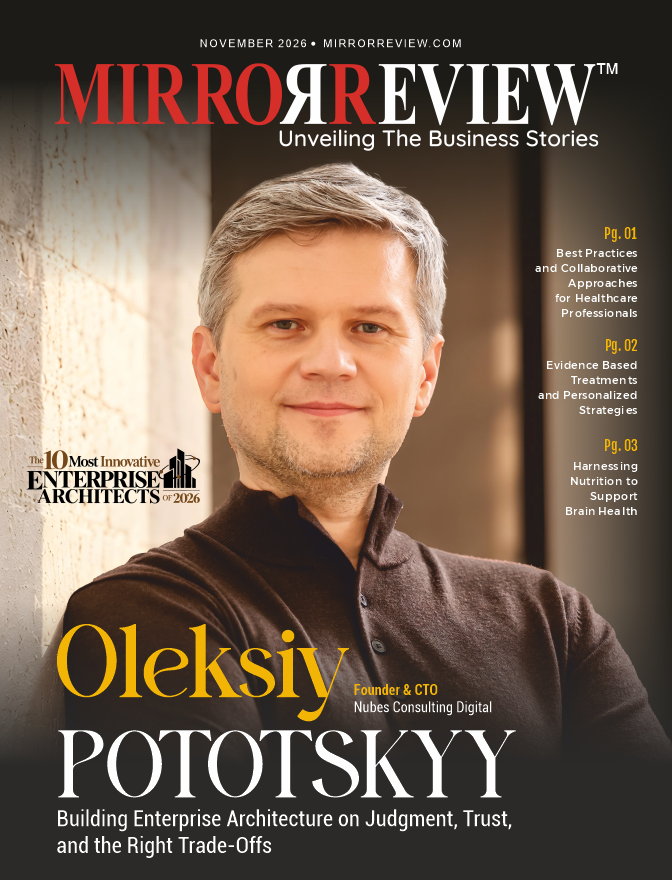
That is the habit of Oleksiy Pototskyy, Founder & CTO of Nubes Consulting Digital. For him, architecture begins with understanding the business need and only then determining which technology can support it.
A Career Built Layer by Layer
Oleksiy is candid that this was never the plan. His career was not originally aimed at enterprise architecture. Instead, it developed progressively through system administration, software development, infrastructure, cloud, technical leadership, and large-scale transformation work. Each stage broadened his understanding of how technology decisions affect the wider business.
Twenty years on, he describes enterprise architecture as the place where several pressures meet: business goals, technology choices, risk, cost, and execution. It is less a technical specialty than a point of convergence, and he has spent his career learning to work at that junction.
Solving the Right Problem
That philosophy sits at the center of Nubes Consulting Digital. Oleksiy does not begin with a predefined service or a favored technology. He begins with the client’s objectives, constraints, risks, and plans for growth, and then designs an architecture that fits that specific situation.
The principle shapes how the firm works with its clients, and it sometimes has a cost. He is also willing to recommend a simpler approach even when it may generate less revenue in the short term, because he sees client value and lasting trust as more important outcomes.
Lessons From Many Industries
Oleksiy’s work has taken him through banking, healthcare, retail, automotive, real estate, manufacturing, and cybersecurity. Rather than treating each sector as a separate world, he has drawn a wider lesson from the variety. He calls it a more universal mindset, one that looks at the problem itself from several perspectives and is not bound by the common patterns of a single industry.
Every sector, in his telling, teaches something different about risk, scale, regulation, resilience, cost, and speed. Bringing those lessons together often reveals options that would stay hidden inside one industry. The result is a proposal fitted to the client’s real situation rather than to an industry template.
Balancing Priorities Without Losing the Plot
Complex organizations pull an architect in many directions at once, and Oleksiy’s method for handling that is to start with the business outcome, because it sets the priorities. From there, he weighs the practical conditions that determine whether the architecture can succeed: risk appetite, compliance, budget, delivery time, resilience, team capability, and future growth.
He has seen the opposite approach at work. He has encountered projects where the technology was selected first, and the business was subsequently expected to adapt. In his experience, that approach can introduce unnecessary complexity and expense rather than meaningful business value. For Oleksiy, good architecture means choosing the level of technology and resilience the business actually needs, and making the trade-offs explicit.
Taming the Technology Zoo
The same discipline governs how he decides which emerging technologies deserve a place in an enterprise’s strategy. His expertise covers AI, machine learning, cloud architecture, and cybersecurity, yet he treats novelty with caution. Over the years, he has watched organizations accumulate what he calls a ‘technology zoo’, with overlapping tools and platforms that grow harder to maintain. The challenge, as he puts it, is to find the balance between real needs and the desire to follow the latest trends.
When assessing a potential solution, he looks for evidence that it addresses a genuine business need and can be supported effectively within the organization’s wider environment. He is honest that these questions do not add up to a formula. For Oleksiy, sound architectural judgment develops through a combination of technical expertise, business understanding, practical context, and experience.
When Legacy Meets Wartime
Modernizing legacy systems is where that judgment is tested hardest. Oleksiy does not believe in a single playbook, because the main challenge changes with the situation. He has worked with large enterprises where knowledge about applications, infrastructure, dependencies, and even ownership had been lost over time. In those cases, the first task was to understand what existed, how the systems depended on one another, and what could happen if something failed.
Other situations impose a different order of priorities. In banking during wartime, he explains, time and business continuity became more important than an ideal target architecture. His approach in every case is to assess criticality, dependencies, compliance, and risk first. Only then does he decide whether to migrate, modernize, replace, or, in some cases, leave a system unchanged.
Leading Without a Shared Room
Oleksiy has led cross-functional teams across the EU, the U.S., Latin America, and Asia. Since the COVID period, much of his work has been fully remote, often without meeting colleagues or clients in person. That experience taught him that distributed teams need more than processes and tools.
His practice has several parts. He adapts Agile practices to the team, keeps responsibilities and progress clear, and creates regular opportunities for people to talk beyond their daily tasks. Informal team meetings matter especially, he says, because people need to know each other as humans and not only as roles on a project.
His preferred measure of leadership is the willingness of people he has worked with before to choose to collaborate with him again.
Two Books From the Field
Oleksiy has turned his experience into two books. The first, on the Architecture of Payment Systems, grew out of a recent financial-services engagement in the UAE. After that work, he began writing in earnest, because he could not find one practical source he could confidently recommend to colleagues.
Modern payments, he explains, are complex ecosystems of banks, processors, wallets, local payment rails, digital assets, vendors, regulations, and operational dependencies. The central lesson is to design the whole system, not isolated components. That means starting with the business model and the flows of money and data, then balancing compliance, resilience, cost, vendor dependencies, technical constraints, and future growth.
His second book focuses on the Architecture of Cloud Migration and draws on many years of leading complex migrations. He is firm about where a migration should not begin. “Migration should never start with the question, ‘Which cloud should we use?’” The starting point is an understanding of workloads, dependencies, business criticality, compliance requirements, cost, operational capabilities, and acceptable risk. A clear migration and rollback strategy is part of that foundation.
He sees the industry moving toward a more hybrid world, where public cloud, private infrastructure, and sometimes several cloud providers coexist. Even so, he cautions that multi-cloud should not become a goal by itself. “The real goal is flexibility,” he says, meaning that each workload should sit where it offers the right balance of value, resilience, cost, and control.
The Architect in the Age of AI
Looking at the next few years, Oleksiy sees AI as an amplifier for architects and not a replacement. He already uses it to analyze information, compare options, and prepare initial reports several times faster. That speed frees time for the decisions that depend on context and judgment.
In his view, the architect’s value has never been in producing diagrams or documents. It lies in understanding business priorities, validating assumptions, making trade-offs visible, and connecting AI, cloud, cybersecurity, and other technologies into one workable system. Cybersecurity, he says, will remain fundamental, especially as AI changes the risk landscape and organizations prepare for post-quantum cryptography. The role, as he sees it, will increasingly center on judgment, integration, and governance.
Where Study Meets Practice
Oleksiy holds two Computer Science degrees, alongside specializations in technology and business disciplines. His studies span AI, cloud, cybersecurity, business, and finance, and together they have given him a broader lens for evaluating decisions: technical feasibility and business value, cost and risk, speed and long-term sustainability.
It matters especially in consulting, where organizations rarely need only a technical answer. They need to understand what should be built, why, and what value it will create.
Outcomes Over Titles
When asked for measurable achievements, Oleksiy prefers, where client confidentiality allows, to point to outcomes rather than titles. He has led complex projects with more than 800 people. His work has also supported organizations across Europe, the U.S., Latin America, and Asia, with programs spanning banking, retail, manufacturing, and other industries.
Earlier in his career, he built high-traffic platforms that processed tens of millions of requests per day and served tens of thousands of websites. More recently, he has led cloud and modernization initiatives for large enterprises, including the migration of critical banking infrastructure during wartime. In that work, business continuity, resilience, and risk reduction mattered more than conventional project metrics.
What Comes Next
Oleksiy expects enterprise architecture to become less about static models or enterprise frameworks, and more about continuous decision-making. As the environment changes more quickly, architects will need to connect technology choices with business strategy, risk, and organizational change on an ongoing basis.
His own plans follow that direction. He wants to combine industry work with research and teaching, particularly around digital transformation and IT change management. His aim is to turn practical lessons from real projects into methods that other architects can use, and to carry academic thinking back into real business problems. For a man who never set out to be an architect, it is a fitting next chapter.
Quotes
Read more: The 10 Most Innovative Enterprise Architects of 2026