Every profession keeps its standards somewhere. In property-casualty insurance and risk management, many of them live inside credentials, and behind each credential stands a body of knowledge that someone has to write, test, and keep current.
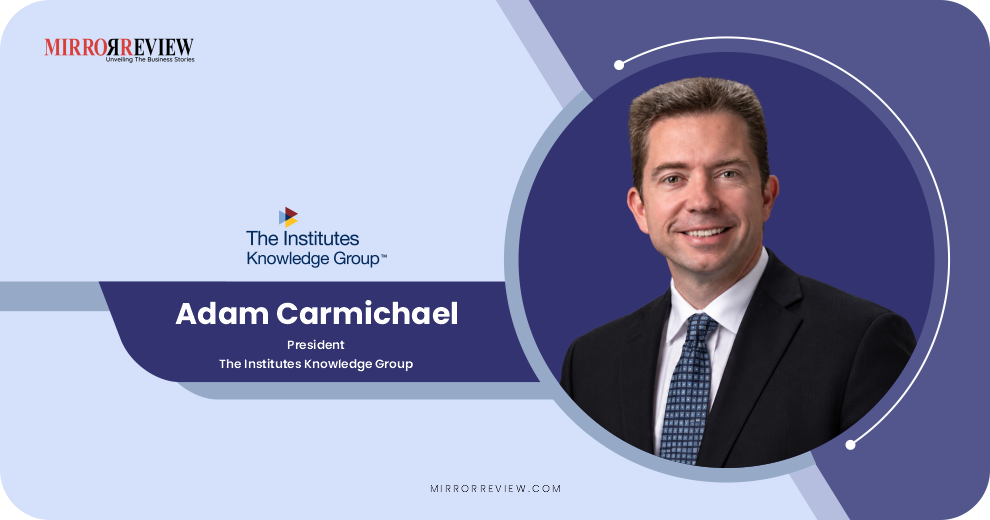
Since July 2020, that work at The Institutes, in Malvern, Pennsylvania, has been led by Adam Carmichael, now Group President of Education. He leads the strategic direction of The Institutes Knowledge Group, the Agent & Broker Group, CEU, and The Institutes CPCU Society.
Across its education portfolio, The Institutes offers more than 25 professional designations and over 100 courses, including CPCU and ARM. Adam oversees the business-unit plans and processes behind new course creation, including the development and delivery of digital education content and associated assessments. It is a portfolio built for scale, and it is led by someone whose career began with a simpler question: what are the numbers really saying?
The Institutes’ website, web.theinstitutes.org, presents these learning opportunities to professionals and organizations seeking to strengthen their insurance and risk management knowledge.
The Analyst Years
Adam’s history with The Institutes is a long one. His record there spans more than 26 years, and his career has moved through research, marketing strategy, and assessment leadership, all within the organization’s Malvern base.
It started in March 2000 at the Insurance Research Council, a division of The Institutes. He joined as an analyst and, after eight years, in February 2008, had risen to Director of Research.
The Council’s work was public policy research, and he led a range of projects. Some were public attitude surveys on topics affecting the insurance industry. Others were quantitative studies of large data sets, producing analysis and insights on public policy issues that bear on the industry.
The two methods answer different questions. A survey asks what people think. A large data set shows what has happened. His work called for both. That period gave him a thorough training in listening to an entire industry at once, before he moved to a different vantage point.
Listening to the Customer
In February 2008, Adam became Director of Marketing Research. He held the post for almost five years. The task was to generate insight about the customers, students and products of The Institutes, using both quantitative and qualitative methods.
The annual rhythm was demanding: more than 20 surveys every year. He wrote the survey questions, analyzed the resulting data, and communicated strategic recommendations. He also applied his analytical skills to customer data to uncover opportunities for improving the customer experience. Across that period, the pace produced more than 100 surveys, each one carried from question to recommendation.
In January 2013, a new title arrived: Senior Director of Marketing Strategy, held for one year, through December 2013. Here, he implemented strategic initiatives for the marketing department. He managed multiple projects at once, among them marketing for new product releases and market research initiatives aimed at market segment growth.
Adam was a leader on cross-departmental teams that produced data-driven, customer-focused results. He also managed project teams working in Agile sprints, ensuring members completed their assigned tasks on deadline.
Taken together, the two marketing chapters run from February 2008 to December 2013, nearly six years spent studying the people The Institutes serves.
Building the Assessments
In December 2013, Adam became Managing Director of Assessments, a post he held until February 2018, just over four years. The job was to oversee the creation of assessments for the credentialing programs that serve property-casualty insurance and risk management professionals. It called for analytical and creative problem-solving in a fast-paced, detail-oriented environment.
He managed a team of four Directors of Assessments and led cross-departmental teams on innovative projects, all with the goal of improving the customer experience.
In February 2018, he became Vice President of Assessments. He held that role until July 2020, for approximately two and a half years. The promotion placed him at a more senior level within the same function, continuing his leadership of assessment work and cross-departmental initiatives focused on improving the customer experience.
Across the two assessment roles, the work stretches from December 2013 to July 2020, six years and seven months devoted to the instruments that measure whether a professional has learned what a credential promises.
Translating Industry Insights Into Professional Education
The thread running through these roles is not hard to find. Adam has built his career as an analytics leader, translating quantitative and qualitative evidence into recommendations a business can act on.
He has also demonstrated the ability to lead cross-functional teams, applying analytical and creative problem-solving in a customer-focused environment. His use of customer data to identify and prioritize business growth opportunities matters as much as any title. It is the habit of a leader who treats a customer’s behavior as information, and information as the beginning of a plan.
Scalable development is reflected in the systems that support course creation and assessment across a broad portfolio. Business-aligned training shows in a career spent turning customer data into priorities. Industry knowledge is embedded in the technical standards and subject matter that underpin The Institutes’ professional credentials.
A credential is, in the end, a promise made to an employer on behalf of a person. Keeping that promise credible depends on assessments that are well built and content that is current. Adam has worked on both ends of that equation: first studying what customers and students need, then building the instruments that measure what they have learned.
Adam’s path, from research and marketing strategy to assessment leadership and now education leadership, has moved steadily closer to the point where evidence becomes education. The ultimate test is whether that education equips insurance professionals to make better decisions when the facts are incomplete, and the stakes are real.