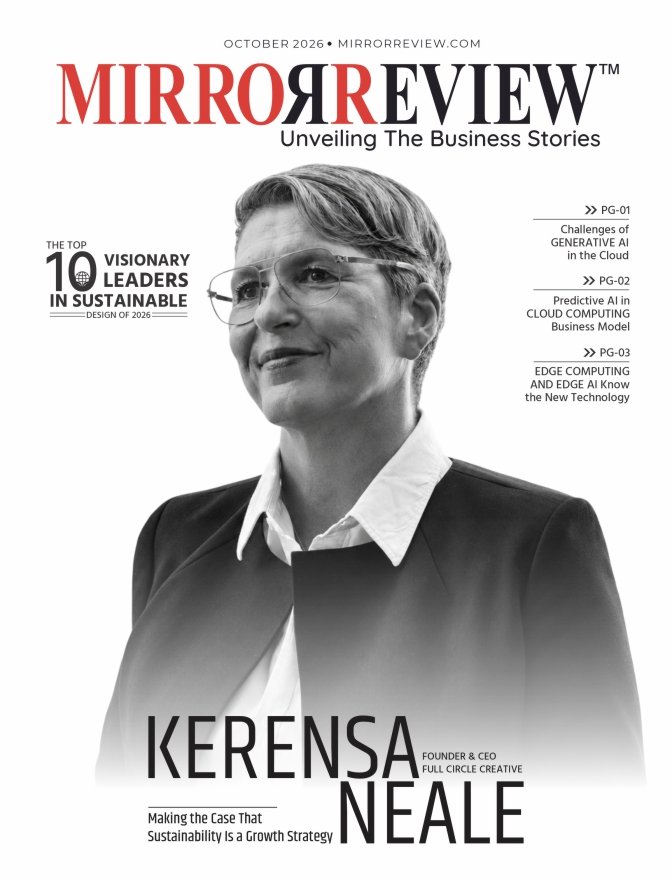
Every industry eventually reaches a point where the true cost of how it operates becomes impossible to ignore. Fashion reached that point some years ago, and Full Circle Creative was built on a simple, almost defiant premise: that helping the industry’s biggest challenges is not a burden to be managed but one of the greatest business opportunities available to it right now. Founded by Kerensa Neale, Founder and CEO of Full Circle Creative, the consultancy exists to prove that sustainability, creativity and commercial performance are not competing priorities. They are, in her view, the same project.
“Sustainability is at the core of everything we do. We look at the long game; our aim is to leave any business we work with in a better state than when we found it – more resilient, more agile, and built for a better future,” Kerensa says. It is a statement of intent rather than a slogan, and it shapes every engagement the company takes on, from a single-day workshop to a multi-year brand transformation.
Three Pillars, One Methodology
Full Circle Creative organises its work around three pillars: Sustainability, described internally as the driving purpose behind everything the consultancy does; Creativity, the power that finds new solutions to old constraints; and Transparency, which Kerensa calls “the only viable currency in a world of disinformation.” Together, these pillars underpin what the consultancy calls its Positive Accelerator model, built on the idea that transformative change can start anywhere within a business through Strategy, Brand, or Product – and that every improvement strengthens the next, creating momentum that compounds over time.
The clearest recent proof of that model in action is Full Circle Creative’s work with Jockey India, a client who began the relationship doubting they could afford to invest in sustainability at all.
Jockey India: From Doubt to Margin Opportunity
Kerensa spent time consulting with Jockey India, where Full Circle Creative helped identify ways key selling items could achieve better fabric efficiency through small, targeted design adjustments, cutting waste and improving margins. The engagement demonstrated how sustainability-led thinking could also create a commercial opportunity, showing that efficiency and sustainability can work as the same lever.
The consultancy also facilitated an Aligned Creative Process workshop with Jockey’s teams to streamline the product creation calendar, helping rebuild a shared creative direction across departments that had previously been working in silos. “We help build more agility and resilience into the way businesses operate – not just into a single product,” she says.
Penna: A Collection Built Sustainably From Zero
Where Jockey India shows what efficiency can do to an existing range, the Penna project shows what is possible when sustainability is the starting point rather than a retrofit. The consultancy was commissioned to develop the first fully sustainable medical scrubs collection of its kind, building it from the ground up using a sustainable blend of organic cotton and recycled polyester. Through the same principles of minimal waste design that run through all of Kerensa’s work, the collection will feature a first-of-its-kind, 100% natural, antiviral, and antibacterial finish.
It is, in miniature, the entire Full Circle Creative argument: that a genuinely regenerative product does not have to compromise on performance, and that healthcare-grade functionality and environmental responsibility can work in tandem rather than exist in tension.
Retraze and Repass: Telling the Story Behind the Material
The consultancy has also helped Retraze, a brand created by the Chinese company RecycTex, define and communicate its brand story in a way that makes sustainability tangible for both brands and consumers. Retraze collects waste plastic bottles recovered from mountains and islands and transforms them into fibres and yarns used in high-end materials, demonstrating how waste can become a valuable resource through thoughtful design, material innovation, and transparent storytelling. For Full Circle Creative, projects like Retraze are about more than materials; they help brands communicate purpose in ways that build credibility, differentiation, and long-term value.
That same commitment to transparency now extends beyond materials to the products themselves. The consultancy has recently signed a partnership with Repass, an Oslo-based company building digital product passports that are industry-agnostic and compatible with any PLM system. At the scan of a QR code, a customer can see complete transparency: where fibres were grown, how a product was made, and how to repair, resell or rent it. Rather than viewing the European Union’s January 2027 Digital Product Passport requirement as another compliance obligation, the consultancy sees it as an opportunity for brands to tell authentic stories about how their products are made and to build greater trust with customers.
For Kerensa, transparency is no longer simply a sustainability initiative; it is becoming a strategic business advantage. “I’ve come to believe transparency is becoming the only true currency in sustainable design,” she says.
Alongside these projects, the company is currently leading a confidential strategic repositioning programme for a major international brand. While details remain under wraps, the work reflects the consultancy’s broader approach: combining strategy, creativity, product innovation, and sustainability to help businesses build stronger, more resilient brands for the future.
How the Business Works
Clients typically enter Full Circle Creative’s process through one of three doors: Strategy, Brand, or Product, each designed to meet a business wherever its most urgent need actually sits.
The Strategy pillar begins with a custom audit, bringing an outside expert perspective to a business alongside market insights and a tailored strategic proposal designed to ignite a client’s journey toward positive change.
Brand engagements focus on clarifying a company’s brand purpose, producing a brand index report that measures brand heat, position, and trajectory, and developing a visual identity that aligns the business with its stated mission.
Product services include a product audit to assess how effectively a range translates a brand’s purpose into the market and how well it builds brand presence, resilience, and lasting customer relationships. This is supported by creative process and direction work to build alignment across departments, and product design and development support spanning the full life cycle, from concept to positive end of life.
The consultancy backs this work with a clear commercial rationale: coherent brand identity is associated with meaningfully higher revenue, roughly twenty-three percent according to Full Circle Creative’s internal analysis, while aligned touchpoints across a business can unlock a ten to fifteen percent revenue uplift while simultaneously reducing marketing and operational costs. Unified brands, in other words, do not simply look better. They outperform.
To put this commercial logic into practice, Full Circle Creative offers structured, fixed-scope engagements — including Product Range Audits, Minimal Waste Design Workshops, Positive Creative Process alignments, and Brand Purpose Workshops. These intentionally targeted offerings draw on the consultancy’s network of creative experts and team members, bringing multidisciplinary expertise to each project while maintaining a focused, practical approach to delivery. Further details on the services and their scope are available through the company’s website.
The Expertise Behind the Model
None of this methodology exists in the abstract. It is built on three decades inside some of the industry’s largest and most consequential organisations, decades that the consultancy treats not as biography but as evidence.
At Nike, Kerensa led the transformation of the brand’s Asia women’s cotton fleece range from regular cotton to one hundred percent organic, working closely with then-Product Director Carol Lim. The redesign, achieved entirely through the principles of minimal waste design, offset the additional cost of organic cotton through greater material efficiency, maintained the same commercial margins, and demonstrated that sustainability could strengthen profitability without increasing costs. It remains, in Kerensa’s own words, “the example I still use today.”
Earlier in her career, at Adidas, she identified an opportunity where the company’s legal team saw only a threat: rather than suing the fashion houses using its three-stripe motif on the catwalks of Paris, Milan and London, she pitched collaboration instead, identifying Japan as the right creative partner. That proposal became the foundation for Y-3, still running today as one of the fashion industry’s longest-standing collaborations between luxury fashion and sportswear, demonstrating that collaboration can create greater long-term value than litigation.
At Decathlon, as Global Artistic Director, Kerensa grew the central design team from six people to around fifty and helped establish a shared creative direction across the retailer’s roughly eighty-five in-house sub-brands. This brand repositioning and the broader shift toward a more circular model took place under the leadership of CEO Barbara Martin Coppola. Within this broader direction, Decathlon maintained a hard constraint: no product could launch unless it cut its carbon footprint by at least thirty percent against its predecessor. Circular business models including repair, rental and resale grew at roughly twenty-five percent year on year under the new direction. She concluded her time at Decathlon after successfully co-leading the company’s global rebrand and helping create its new visual identity in partnership with the London-based Wolff Olins team, with the launch aligning with the Paris 2024 Olympic Games.
These experiences are not presented as career milestones for their own sake. They form the evidence base behind Full Circle Creative’s approach today, showing repeatedly that better design decisions, stronger creative alignment, and more efficient systems can improve both commercial performance and environmental outcomes simultaneously.
It is this trajectory, from a fashion education in Madrid during the Movida Madrileña years of the late 1980s, through Adidas, Nike, and Decathlon, that gives Full Circle Creative’s methodology its authority. Every stage reinforced the same lesson: sustainability is most effective when it is embedded into business strategy from the outset rather than added as an afterthought.
Why Now
Kerensa founded Full Circle Creative in 2024 alongside her son and Co-Founder, Euan Neale, after reflecting on how decades of industry experience could be redirected toward building a more resilient, regenerative future for fashion and consumer brands. Rather than dwelling on the industry’s environmental impact alone, the consultancy was created to help businesses transform those challenges into competitive advantages through better strategy, stronger creativity, smarter product development and more regenerative business models.
That same year, at the Copenhagen Global Fashion Summit’s fifteenth anniversary, she met a community of people already working to rebuild the industry from within, including Amanda Johnston, curator of the Future Fabrics Expo. Those conversations reinforced what her own client work had already demonstrated: the future belongs to businesses that embrace sustainability as a driver of innovation, resilience, agility, and long-term commercial growth rather than treating it as a compliance exercise.
For Kerensa, the industry’s greatest opportunity lies not simply in reducing environmental impact, but in redesigning business models, creative processes, and products so they become more agile, more regenerative, and ultimately more valuable for both companies and customers. That philosophy now defines every engagement Full Circle Creative undertakes.
For Full Circle Creative, sustainability is no longer a specialist discipline or a compliance requirement. It is a strategic business tool that helps organisations innovate faster, reduce waste, strengthen their brands, improve operational efficiency, and build long-term resilience.
Quotes
Read more : The Top 10 Visionary Leaders in Sustainable Design of 2026