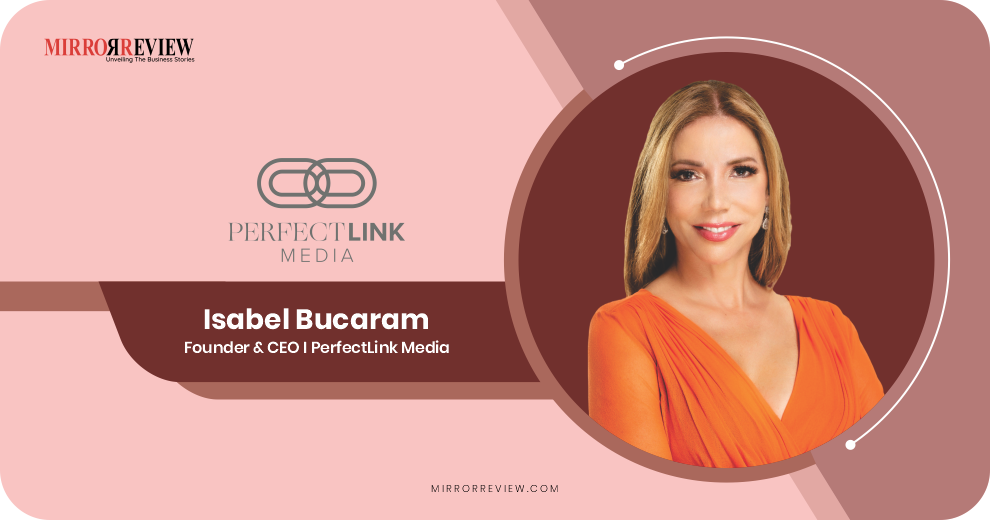
For most of her professional life, Isabel Bucaram has understood that opportunity rarely happens by accident. She prefers to think of it as being prepared when the right opportunity presents itself.
Her instinct for building relationships began long before she entered the corporate world. From the age of eleven, Isabel was immersed in an international environment through her father, a race-car champion and the owner of the Autódromo Internacional de Salinas in Ecuador, which attracted some of the most prominent drivers, athletes and personalities from across Latin America. Without even calling it networking at the time, she was already learning how to connect naturally with people from different countries, cultures and backgrounds.
Sports would continue to open the world to her. Years later, marriage brought her into the international professional tennis circuit, where she traveled among top-ranked players, business leaders and prominent international figures. Golf, another sport she loved, expanded that world even further. On one memorable occasion, she was invited to Morocco as part of a group of golfers hosted by members of the Moroccan royal family, an experience that placed her among an international circle of influential personalities and the global jet set.
Rather than treating these experiences as networking exercises, Isabel absorbed them as lessons in connecting authentically across cultures, industries and social worlds.
Her entrance into media was not simply a stroke of luck. An opportunity emerged after a communications plan she developed caught the attention of the CEO of Spanish Broadcasting System (SBS), ultimately leading to an offer to become Marketing Director. Years later, CNN en Español recognized the same potential. The position she would eventually hold there was created in significant part around the experience, relationships, and networking expertise she already brought with her.
She would go on to spend fifteen years leading VIP Relations, Public Relations, and Marketing at CNN en Español, within a broader career spanning more than two decades in international media. Along the way, she earned an Emmy Award and a series of international recognitions.
By the time Isabel entered CNN, she was not beginning to build a network. She had been building one for most of her life, and learned that some of the most powerful opportunities emerge when preparation, relationships, and timing come together.
“Communication alone does not transform organizations; relationships do,” she says, and it is the kind of sentence that could sound like a slogan if she had not spent more than two decades proving it in newsrooms, boardrooms, and international arenas.
Today, as Founder and CEO of PerfectLink Media, she has turned that philosophy into a business dedicated to helping organizations build credibility, strategic alliances, and long-term growth. The company was never an exit from media, but an expansion of its purpose.
The Origins of a Perfect Link Media
Every founder has an origin story, and Isabel’s is less about a lightning-bolt moment than the accumulation of decades of experience and conviction.
She had spent years watching presidents, CEOs, entrepreneurs, athletes, media personalities, and global leaders move through rooms, and she noticed a pattern that many people overlooked. The companies and individuals that mattered most were not always the ones with the biggest balance sheets. They were often the ones whose credibility and reputations preceded them into every negotiation.
“Today’s most valuable companies compete through intellectual property, reputation, and trusted relationships just as much as they compete through financial performance,” she says.
That philosophy did not stay abstract for long. She channeled it into her book, NetworkQueen: A Journey of Connections (NetworkQueen: Un viaje de Conexiones), and into a proprietary framework she calls the Connect. Impact. Leads. methodology, a system designed to reinforce PerfectLink Media’s intellectual property while generating sustainable, long-term enterprise value for its clients.
A New Definition of Leadership
Ask Isabel what she learned from more than two decades inside global media, and she will not begin with ratings or headlines. She will talk about the human connections that make trust possible.
“Leadership today is no longer defined by hierarchy,” she says. “It is defined by the ability to build trust, inspire collaboration, and create opportunities for others.”
She has a name for this approach: Relational Leadership.
But Isabel, who trained as an economist before becoming a communications executive, was not content to leave the idea there. She wanted to articulate the value behind something that traditional balance sheets rarely capture.
“For decades, we have measured financial, human, and social capital,” she explains. “I believe the next strategic asset leaders must intentionally cultivate is Relational Capital.”
For Bucaram, Relational Capital is the value created through trusted relationships that can accelerate innovation, partnerships, sales and sustainable growth. In her framework, these connections are not simply a soft skill; they can become a strategic asset for individuals and organizations.
Inside the PerfectLink Media Model
PerfectLink Media’s services reflect its philosophy of aligning strategic communications with business development and demonstrating how trust intersects with commerce. Isabel’s team works across Public Relations, Global Networking, Executive Positioning, Personal Branding, Corporate Reputation, Government Relations, International Expansion, Crisis Communications, strategic advisory for business growth, and Content Planning and Production.
What ties it all together is a refusal to allow technology to replace the human element that built her career in the first place.
“We believe technology should enhance human connections, never replace them,” she says. “At PerfectLink Media, we believe every meaningful business result begins with a genuine human relationship.”
Where the Personal Becomes the Strategic
Isabel has spent enough time correcting a common misconception that she can recite the correction almost like a reflex. Networking, to many people, means collecting business cards at an event. To her, it means something closer to architecture.
“Networking is the intentional process of creating relationships that generate value for individuals, organizations and society,” she says. “It is where human connection meets business opportunity.”
She draws a direct line between that idea and the discipline of personal branding, arguing that “people connect with people before they connect with companies.” Credibility, in her framework, is the first domino; it builds trust, trust creates opportunity, and lastly, opportunity can drive sustainable growth. The idea that “your network is your net worth” has circulated in business thinking for years. In NetworkQueen, however, Bucaram gives the concept her own interpretation.
For her, NET Worth is not simply the financial value that can result from knowing the right people; it is the value of the network itself.
That value can take many forms: trust earned, credibility built, knowledge exchanged, doors opened for others, and connections cultivated over a lifetime. Rather than reducing those relationships to financial transactions, Bucaram sees their broader value in what they make possible.
But Bucaram is equally careful to make an important distinction: not every relationship is meant to be monetized. Some relationships are there to accompany us through life, to offer friendship, mentorship, coaching, perspective, support, or simply human connection. Their value cannot, and should not, always be measured in financial terms.
“Relationships are not transactions,” she says. “You cannot monetize every person who enters your life.”
The real value lies in the trust that is built over time, and when that trust is genuine, the day may come when one person knocks on the other’s door, not necessarily for money, but for advice, an introduction, an opportunity, a collaboration, or support. When that happens, both may be willing to open the door and create value together.
That, for Bucaram, is Relational Capital: not what you can extract from a relationship, but what two people are capable of creating because trust already exists between them.
Teaching Algorithms to Respect People
For someone whose career began long before artificial intelligence reshaped communications, Isabel talks about technology with the ease of someone who sees its potential without losing sight of its limits. At PerfectLink Media, AI is used to analyze audience behavior, identify emerging trends, refine messaging, and sharpen the speed of strategic decision-making.
“AI allows us to better understand audiences, anticipate market opportunities and continuously improve the effectiveness of our strategies,” she says.
But she is equally quick to draw a boundary around what technology cannot do. “While AI can accelerate efficiency and enhance decision-making, it cannot replace empathy, credibility or emotional intelligence.”
She also emphasizes something discussed less frequently in conversations about technology: emotional resilience, which she considers an essential leadership competency, particularly for entrepreneurs navigating uncertainty.
A Career Without Borders
As a young and growing company, PerfectLink Media is gradually building a diverse portfolio of clients and projects across different industries and markets.
For Isabel, that evolution is one of the most fascinating parts of entrepreneurship. Each new client introduces a different world and a different set of challenges, allowing her to reconnect with the curiosity that first drew her to journalism while applying decades of experience in communications.
“In many ways, I feel I am practicing journalism again,” she says. “Every client requires me to listen, investigate, ask questions, understand an industry and discover the story that truly needs to be told.”
That diversity has reinforced one of her core beliefs: “Effective communication begins with understanding people before understanding markets.”
Rather than simply translating a message from one language to another, her team works to understand the culture, context, and audience behind it, adapting the narrative while protecting the client’s identity and authenticity.
“In today’s interconnected world, success is no longer about reaching the largest audience,” she explains. “It is about earning the confidence of the right audience and creating meaningful connections that can transcend industries, cultures, languages, and geography.”
The Leap That Tested Everything
It would be easy to assume that a communications veteran’s biggest professional trial involved a scandal, a press crisis or some late-night phone call about a client gone sideways. Isabel’s answer is far more personal.
“The greatest leadership challenge of my career was not managing a communications crisis,” she says. “It was leaving a successful corporate career and building my own company.”
Corporate life, she notes, came with structure and certainty. Entrepreneurship demanded something else entirely.
“That experience strengthened my emotional resilience and confirmed that vision must always be greater than fear,” she says.
It is a lesson she still leans on: every meaningful achievement begins with the courage to embrace change.
Measuring What Cannot Be Counted
PerfectLink Media is still a young company, and Isabel is intentionally building it differently. Rather than creating a traditional organizational chart, she works through what she calls Links: a global network of highly specialized professionals who can come together around the particular needs of each project and client.
“This collaborative model allows us to remain agile while bringing together senior expertise across multiple disciplines,” she says.
The model allows the company to expand its capabilities without sacrificing the agility that defines it. And when asked what success ultimately looks like, Isabel does not begin with the size of a client list or a revenue figure.
“Our greatest measure of success is not the number of campaigns we deliver,” she says, “but the long-term relationships, strategic alliances and business opportunities we help create for our clients.”
The Weight of the Trophies
Isabel’s shelf of honors reads like a career retrospective in itself: an Emmy Award, recognition among the 100 Women to KNOW in America, and selection as one of the 100 Latinos whose portrait now hangs permanently at Miami International Airport as part of the A Journey of Success gallery.
She has also received professional recognition across the United States and internationally. But ask her which achievement carries a particularly personal meaning today, and she points to her book.
NetworkQueen: A Journey of Connections brings together decades of professional and personal experience, transforming those lessons into a leadership philosophy and practical framework that other people can apply to their own lives, careers, and businesses. The book is scheduled for official release on September 23, 2026, on Amazon, in both English and Spanish, bringing those ideas to a wider international audience.
What Comes Next
Isabel is already looking beyond the current moment toward what she believes will increasingly define business: intangible assets, intellectual property, reputation, proprietary methodologies, trusted relationships and brand credibility.
“Artificial Intelligence will continue transforming marketing and communications,” she says, “but technology alone will never differentiate organizations because it is increasingly accessible to everyone.”
The differentiator, in her view, will increasingly be Relational Capital, cultivated deliberately among clients, employees, investors, governments and communities.
“In the years ahead,” she says, “relationships will no longer support business strategy. They will become business strategy itself.”
A Closing Argument for Trust
Looking beyond strategy, Isabel’s advice to the next generation of communications leaders is remarkably simple.
“Invest in relationships with the same discipline that you invest in your education, your career and your business,” she says.
Titles change, markets evolve, technology advances, but trust, she insists, remains one of the few assets capable of appreciating over time. She wants networking understood not simply as a task to complete, but as a philosophy to inhabit.
“I don’t believe networking is about building a larger network,” she says. “I believe it is about building a better one, one relationship at a time.”
Perhaps that is the clearest expression of the philosophy behind Isabel Bucaram’s work: not simply to know more people, but to create the conditions in which trust, credibility and shared purpose can turn connections into lasting value.
Quotes