Energy storage is often judged by how quickly it can release electricity. Form Energy approaches the challenge from a different angle: how long can stored power remain available when the grid needs it most?
Form Energy’s first commercial offering is an iron-air battery designed to store electricity and deliver it back over a period of up to 100 hours. That extended duration could help electricity networks maintain supply through prolonged periods when other sources of generation fall short.
The battery’s chemistry relies on a reversible reaction between iron and oxygen. As the system discharges, oxygen from the surrounding air reacts with the iron, forming rust and releasing electrical energy. When electricity flows back into the battery during charging, the reaction reverses, restoring the iron and releasing oxygen.
The system relies on three readily available ingredients: iron, water, and air. Their relative simplicity is central to Form Energy’s effort to make long-duration storage more affordable. While lithium-ion batteries are widely used for shorter-duration storage, Form’s iron-air chemistry is designed to keep electricity available over several days, addressing a different need on the grid. The company points instead to weather that is increasingly extreme and unpredictable, from severe winter storms to intense heat waves to historic floods, and to a grid that needs stored energy it can lean on for days.
Anatomy of a Module
Inside each battery module sits a stack of smaller cells, each filled with iron and air electrodes and a water-based, non-flammable electrolyte, much like the one found in AA batteries. Each battery module is housed within a weather-protected enclosure roughly comparable in size to a shipping container. Multiple enclosures are assembled into power blocks capable of operating at the megawatt scale, while larger installations combine numerous blocks to supply electricity to the grid.
For scale, a one-megawatt system in its least dense configuration occupies half an acre, while higher-density configurations would achieve more than 3 megawatts per acre. Form says its systems can be deployed in a range of settings, including urban areas, and that the design has no mechanism for thermal runaway and uses no heavy metals. In December 2024, the company reported that its iron-air battery technology had completed UL 9540A safety testing without flame or thermal-runaway propagation.
Five Veterans and a Lab Bench
The story begins in 2017, when five energy storage veterans founded the company: Mateo Jaramillo, Ted Wiley, Billy Woodford, Yet-Ming Chiang, and Marco Ferrara. They began with seed funding and lab space from MIT’s The Engine. In 2018, Form opened its first research and development facility in Somerville, Massachusetts, built its first prototypes, and chose the 100-hour iron-air battery as its first product after extensive techno-economic analysis. That year it closed a $9 million Series A.
The financing ladder since then is steep. A $40 million Series B in 2019 brought the total past $50 million. A $76 million Series C followed in 2020, alongside a first pilot agreement, a 1.5-megawatt project with Great River Energy in Minnesota. Then came $240 million in 2021, $450 million in 2022, and $405 million in 2024, which pushed total funding past $1.2 billion. As of 2026, Mateo Jaramillo serves as Chief Executive Officer, while co-founder Ted Wiley serves as President.
The Factory on Steel’s Old Ground
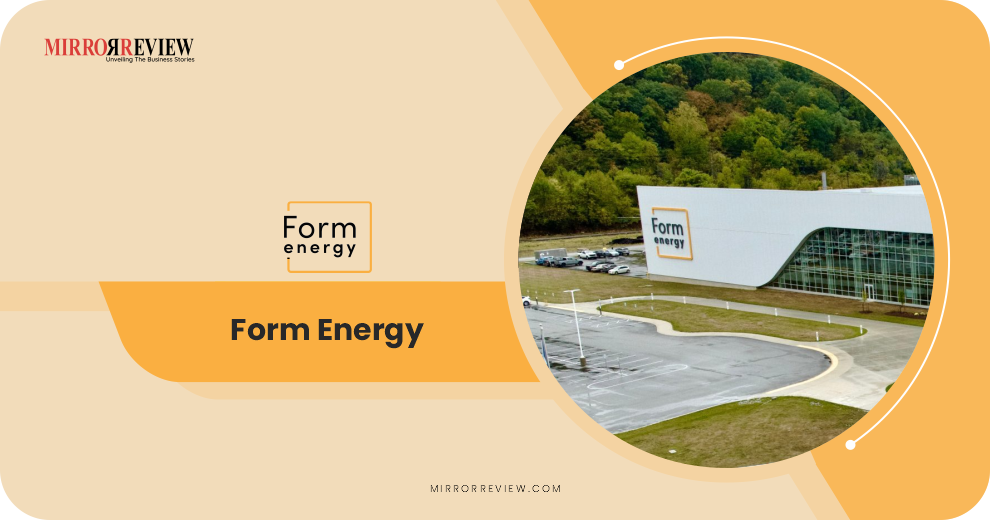
In 2022, after reviewing more than 500 potential sites across the United States, Form announced plans for its first high-volume manufacturing facility in Weirton, West Virginia. Building work started in 2023, and the facility was completed the following year, when initial trial manufacturing also began. Named Form Factory 1, the plant occupies the former Weirton Steel mill site, giving a historic industrial location a new role in the development of energy storage technology.
Form’s address is a small piece of poetry in itself: 26 Iron Way. Across West Virginia, Massachusetts, and California, the company now employs over 1,000 people. On September 9, 2026, Form Energy began a targeted recruitment drive for technicians at its Weirton facility. The initiative reflects a practical requirement of the energy transition: scaling advanced manufacturing depends not only on new equipment but also on skilled people capable of operating it.
Proof, Then Backlog
Before the orders came the testing. By 2026, Form Energy’s testing program had encompassed more than 34,700 subscale cells and 6,200 full-scale cells, alongside 170 modules and more than ten grid-connected battery packs. This progression from individual cells to grid-connected systems has helped the company evaluate 100-hour operating capability and other performance requirements for long-duration energy storage. Its first grid-connected system was deployed in California’s Sacramento Valley in 2023, and its first commercial demonstration system, with Great River Energy, followed in 2025.
Commercial milestones have piled up. In 2022, Georgia Power signed an agreement with Form for a 15-megawatt project. In 2023, Form Energy expanded its commercial relationships through agreements involving Xcel Energy, Dominion Energy, the California Energy Commission, and the New York State Energy Research and Development Authority (NYSERDA). In 2024, the U.S. Department of Energy selected Form for an 85-megawatt, 8,500-megawatt-hour project in Maine.
In 2026, the company announced three more landmarks. One is a planned 300-megawatt, 30-gigawatt-hour iron-air battery project with Xcel Energy to support a new Google data center in Minnesota. Another is an agreement for its first international project, a 10-megawatt, 1,000-megawatt-hour system with FuturEnergy Ireland, which is expected to come online in 2029. The third is a 12-gigawatt-hour supply agreement with Crusoe to support AI data centers, with deliveries planned to begin in 2027. Its backlog rose from approximately 20 gigawatt-hours to 80 gigawatt-hours of projects under agreement, equivalent to roughly 800 megawatts at a 100-hour duration.
The Series G and the Road Ahead
On August 12, 2026, Form announced a $750 million Series G led by T. Rowe Price, which also led the Series F. The round brings total equity raised to over $2 billion. New investors include Sequoia Capital, Janus Henderson, Franklin Templeton, and PEAK6 Investments, joined by continuing backers such as Prelude Ventures, Breakthrough Energy Ventures, Coatue, Energy Impact Partners, NGP, and GE Vernova. Proceeds will accelerate manufacturing in Weirton and advance commercial deployments.
Leadership has grown with the company. Form Energy brought Navneet Govil on board as Chief Financial Officer, drawing on his more than 30 years of experience in finance and investment management. Before joining the company, he held a senior role at SoftBank Investment Advisers. Wes Sloan joined as Chief Operating Officer, with more than 25 years across aerospace, automotive, and energy, including time at Panasonic Energy North America and Rolls-Royce. On September 21, Form also announced the closing of a separate $270 million credit facility to support manufacturing expansion and working capital.
Form’s own grid planning studies, performed with utility partners, suggest that meeting its cost and performance targets could unlock multiple gigawatts of demand for multi-day storage in the United States over the next decade.
Form Energy is a study in patience rewarded. It began in 2017 with five veterans and a lab bench, and it arrives in 2026 with a factory on old steel ground, an 80-gigawatt-hour backlog, and a battery that rusts and un-rusts on purpose.
Read more : Leading Companies to Watch in 2026