
Most workplace problems do not announce themselves. They do not arrive as headlines or resignation letters on the first day. They arrive quietly, as a lingering thought someone carries into a meeting, replays on the commute home, and mentions to no one. It might be a difficult conversation someone has been avoiding, a team dynamic that has grown tense, or a decision that feels heavier than it should. Left alone, that quiet thought does not usually disappear. It tends to grow, and by the time it becomes visible to an organization, it has often already cost something: an absence, a resignation, a breakdown in trust.
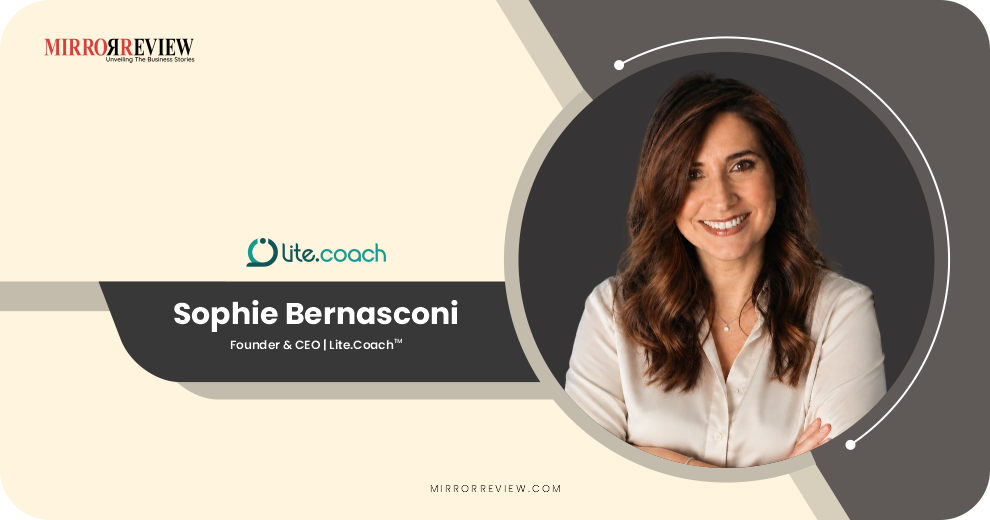
This is the problem that occupies Sophie Bernasconi, Founder and CEO of Lite.Coach™, a workplace coaching service built on a simple but underused premise: that creating space for reflection at work can help people address challenges before they become bigger problems.
From HR Business Partner to Founder
Sophie was raised in the Italian-speaking part of Switzerland and studied Economic and Social Sciences before entering Human Resources, a field she would remain in for more than seventeen years. Her career included senior HR business partnering roles in complex international organizations, alongside a broad range of responsibilities spanning talent and learning, leadership development, organizational change, recruiting, diversity and inclusion, and employer branding.
It is a résumé that reads less like a single job title and more like a long apprenticeship in human behavior at scale. She later added several coaching training programs to that foundation, with a particular emphasis on business and resilience coaching. “These experiences shaped my approach,” she says, describing a practice built on “listening, observing, understanding people and organizational dynamics, and responding pragmatically.”
That perspective became the foundation for the way she approaches both leadership and coaching: attentive to people, grounded in organizational realities, and focused on practical responses.
The Origin of Lite.Coach
Sophie did not set out to build a wellness brand or a leadership buzzword. Lite.Coach grew out of something she witnessed repeatedly during her years in HR: people carrying workplace concerns internally rather than voicing them, becoming frustrated or demotivated as a result, until the strain eventually touched their relationships, their well-being, and their performance.
“Sometimes the first visible sign for the organization is an absence, burnout, conflict, or resignation,” she explains.
‘Not every workplace concern requires therapy, but some are too important to ignore.’ Lite.Coach was designed to provide a space in between: a confidential place where someone could talk through what was occupying their thoughts, gain some distance from it, find the right words, and walk away with practical next steps instead of allowing the concern to remain unresolved.
Not Just for the Corner Office
It would be easy to assume, given how executive coaching has traditionally worked, that a service like this exists primarily to support the people at the top of an organization. Sophie is careful to correct that assumption, and it is arguably the most important distinction in her entire model.
Lite.Coach does support managers and executives directly. It offers them focused coaching conversations built around specific workplace situations, along with structured development programs designed to strengthen how they lead and manage their teams. But that support is deliberately not where Lite.Coach stops.
“Lite.Coach aims to make personalized coaching accessible to employees at every level,” she says, “through focused, confidential online sessions of 30 or 40 minutes.”
Each organization decides for itself how widely to extend that access, whether to managers and executives, to selected employee groups, or to the entire workforce, and whether to offer it on an ongoing basis or during specific periods of change or heightened pressure. That flexibility is central to what makes the model different. Coaching, in her framing, does not have to be reserved for a small number of executives or delivered through lengthy programs. It can be short, focused, and available to far more people than traditional models typically provide.
The Mechanics of a Confidential Conversation
The model rests on six defining characteristics, and together they offer an alternative to the more exclusive, long-term coaching engagements many companies are used to. Sessions are accessible at every level of an organization. They are practical and solution-oriented, built around specific situations rather than open-ended discussion. They are preventive, meant to address concerns before they become more complex or costly. They are neutral and confidential, offering an independent space separate from a person’s direct manager or HR department. They are short and focused, lasting thirty or forty minutes and centered on a single issue, and they exist to support managers and HR, functioning as an external resource that complements, rather than replaces, the guidance those roles already provide.
For managers pursuing deeper development, Lite.Coach also offers something more structured: a program that can begin with a validated psychometric assessment, followed by sessions that help the manager understand their own personality, motivation, and natural behavior, and how those patterns ripple outward toward team members, stakeholders, and their own manager in turn.
A Question Worth Asking Every Team
Long before Lite.Coach existed, Sophie had already developed a habit that reveals a great deal about how she leads. As a manager, she regularly asked each member of her team a simple question: “On a scale from one to ten, how happy are you at work?” After hearing their answer, she would follow up with a second question: “What can I do to help increase that number?”
It sounds almost too plain to be a leadership strategy, and that is precisely the point. It allowed her to work with direct information rather than assumptions and identify concrete actions that could improve someone’s experience at work. When people saw that their input was taken seriously and that action actually followed, even in small ways, trust tended to grow, along with collaboration and a sense of shared investment in the team’s success.
The Weight Senior Leaders Carry
Sophie has spent enough time around senior executives to recognize a particular kind of strain that rarely gets discussed openly. Leaders are navigating continuous change and rising complexity, often with fewer resources than they need, while also feeling pressure to project confidence downward to their teams and optimism upward to their own leadership, even in moments when they privately have doubts or lack the answer.
“They are expected to provide clarity while navigating uncertainty themselves, support their teams while meeting demands from above, and deliver results over time,” she says. Over time, that tension can make leadership feel isolating, and it can quietly erode motivation, judgment, energy, and effectiveness. Notably, Sophie does not frame this as a challenge unique to women in leadership. She sees it, in her words, ‘across senior leadership’ broadly, a pressure that does not discriminate by gender even as it shapes each person’s experience differently.
Four Dimensions of Sustainable Performance
If there is a single framework that captures how Sophie thinks about organizational health, it is this: sustainable performance rests on four dimensions, competence, clarity, resilience, and connection. What makes the framework useful, rather than merely tidy, is her insistence that each of these dimensions is experienced individually. What feels perfectly clear to one employee may remain genuinely ambiguous to another, and the resource that strengthens one person’s resilience may do nothing for someone else. A uniform approach, she argues, does not work for people.
This is where Lite.Coach’s model is designed to add value. By giving employees across every level access to individual, confidential conversations, the service helps them clarify expectations, prepare for difficult conversations, address tension before it calcifies, and take ownership of their next steps. When people return to their teams better able to express what they need and navigate difficult situations, this can contribute to stronger collaboration, accountability, trust, and working relationships across the wider organization.
When Her Own Leadership Was Tested
Sophie’s convictions were not formed in the abstract. She points to a specific period, a large-scale organizational transformation within the financial industry, as the moment her leadership was most seriously tested.
“Leadership means being transparent about uncertainty while providing as much direction, stability, and human presence as possible,” she says of what that experience taught her. She came away believing that communication from the top matters enormously, and that for most employees, not knowing can be more difficult than receiving a challenging message delivered clearly and honestly. Leaders will not always have every answer, but they can be honest about what is known, what remains uncertain, and what people can reasonably expect next. That period reinforced something she now treats as a guiding principle: during periods of change, people need both clarity and the space to process what that change means for them personally.
Building Lite.Coach’s Reach
Lite.Coach launched in March 2026 and currently offers coaching in English, German, French, and Italian, with additional languages and specialized professional backgrounds available through its external coach network as needed.
Initial feedback on the coaching sessions themselves has been, in her words, very positive, and that response has been echoed by the HR professionals to whom Lite.Coach has been presented, who tend to immediately recognize a real, underserved need.
Employees do not always want to bring every workplace concern to their manager or HR department, and when those concerns go unaddressed, the consequences eventually surface anyway, through conflict, disengagement, absenteeism, or turnover that might, in some cases, have been addressed earlier.
Just as significant to her is the network of experienced external coaches who have chosen to collaborate with Lite.Coach, drawn by the same conviction she holds: that workplace coaching needs to become more accessible and practical. As the company grows, Sophie intends to measure impact through utilization, reported progress, and repeat organizational engagement, while protecting the confidentiality at the heart of the model. Companies receive aggregated information about how the service is used and how valuable it is perceived to be, but never details about individual conversations.
Looking Ahead: The Future of Leadership
Sophie is watching two forces move in tandem, and she believes they will define the next chapter of leadership. The first is technology and artificial intelligence, reshaping how work gets done and forcing leaders to help their people navigate rising complexity and constant change. The second is more troubling: Gallup’s 2026 State of the Global Workplace report found that global employee engagement fell to 20% in 2025, while manager engagement fell to 22%, down nine points since 2022.
Against that backdrop, she believes distinctly human capabilities – judgment, empathy, communication, resilience, and connection – will only become more important, not less. “Leadership will be less about having all the answers,” she says, “and more about creating the conditions in which people can grow, adapt, and contribute.” She also sees a sharper edge to the conversation around retention. As technology lowers the barriers to alternative professional paths, including entrepreneurship, organizations will increasingly have to ask themselves what they actually offer that makes people choose to stay.
A Closing Case for Reflection
Sophie’s parting message to readers is less a call to action than an invitation to a habit. “Normalize reflection as part of everyday working life,” she says. Taking time to pause, gain clarity, and think through how best to respond, she believes, leads to better decisions and more thoughtful action, not less productivity.
When reflection and constructive dialogue are encouraged at every level of an organization, people are able to address concerns earlier, learn from difficult situations, and move forward better equipped for whatever comes next, building both individual and collective resilience along the way. Change and obstacles, she notes, will always be part of working life. The organizations that build in space to process them, rather than absorb them silently, are the ones that stand to benefit: healthier working relationships, stronger collaboration, better decisions, and, ultimately, more sustainable performance.
Quotes
Email: contact@lite.coach


