Over twenty-seven years, a young engineer in Dublin sat in front of a web browser and started asking it questions it had never been asked before. How much could it actually do? Where were its limits, and could they be pushed? It was not a glamorous question, and nobody was watching, but it turned out to be the question that would shape an entire career, one built less on chasing the next big platform and more on a stubborn, almost old-fashioned belief that technology should remove real pain from real people’s days.
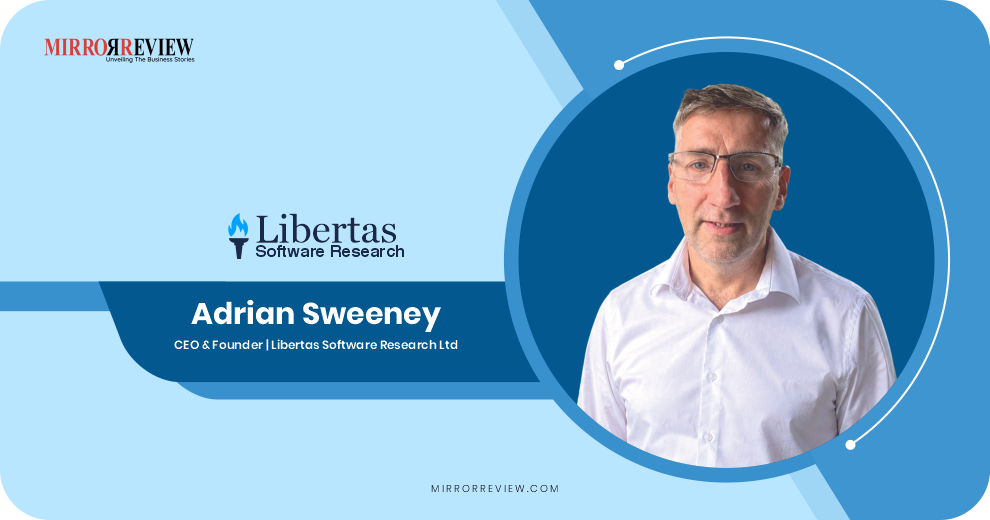
That engineer is Adrian Sweeney, now CEO and Founder of Libertas Software Research Ltd, a company headquartered in Portadown, Northern Ireland, to do precisely what smaller organizations so often cannot do for themselves: build, secure, and maintain software with the discipline of an in-house team they do not have. Across 27 years in enterprise technology, working with the European Space Agency, NASA, AXA Insurance, the Department of the Taoiseach, and eventually his own flagship platforms, Adrian has held onto one conviction with unusual consistency. Software problems are rarely technical. They are structural. And structural problems demand someone willing to sit in the room, ask the uncomfortable question, and stay there until the real issue surfaces.
The Research Phase That Never Really Ended
Adrian’s career began at Parallel Internet, where he rose to Director of IT, delivering bespoke enterprise content management systems for the Department of the Taoiseach, the Department of Transport, AXA Insurance, and Jones Lang LaSalle. It was, in his own telling, a research phase disguised as a job, and it is the part of his career he still describes as the most enjoyable.
Buried inside that research was a detail that would end up defining much of what came after. Part of the CMS work involved making the builds WAI compliant, adhering to the Web Accessibility Initiative’s standards for people using assistive technology. That single accessibility thread pulled hard enough that he eventually left to found Libertas Solutions with a group of partners, building a CMS engine that produced both WAI and Section 508-compliant websites, ones clients could maintain themselves without calling a developer every time something needed to change.
It was, as Adrian puts it, digital transformation before the term existed, a manual, developer-dependent process handed back into the client’s own hands. That instinct toward self-sufficiency, toward building something once and building it properly, would echo through every company he touched afterward.
Vessels, Space Stations, and a Decade in the Trenches
His engineering leadership work took Adrian somewhere most engineers never get near. As Team Lead at SkyTek, he led delivery of an insurance risk product tracking 700,000 vessels worldwide through satellite data, built a Command and Control tool for an EU project sponsored by the European Space Agency, and worked on improving the prototype of NASA’s web-based document management system, the one used aboard the International Space Station to manage the procedures astronauts rely on in orbit.
From there, he moved into Engineering Team Lead at Hostelworld, overseeing three development teams split across Dublin and Porto. It is a career arc that, laid flat, reads like a list of institutions most companies only dream of working alongside. But what connects an insurance vessel tracker to a space station document system, in his account, is not prestige. It is the same recurring pull toward embedding directly within teams to solve operational problems, not abstract ones, and increasingly, toward AI and automation as tools that could do that work faster and more reliably, never as an end in themselves.
That instinct is exactly what led him, in 2025, to found Libertas Software Research Ltd full-time.
Closing the Gap Between the Boardroom and the Desk
Ask Adrian what problem he actually set out to solve, and the answer is disarmingly practical. Many smaller businesses simply do not have an in-house IT department capable of building software for them, and with AI now in the picture, he can take on projects that would never have been commercially viable to build from scratch before.
But the deeper pattern he noticed across two decades of leading engineering teams is one of drift. Projects often get sidetracked chasing new features and lose sight of the basics. His approach has always been to keep a project anchored to what it is actually supposed to deliver, even as new features get added, because a small architectural decision made early can save months of rewriting later, once a business finally sees the full potential of a feature it once treated as an afterthought.
He offers a construction consultancy client as an example. The client described their pain point as needing higher cadence reporting. The real problem, once Adrian sat with the person doing the work, was manually reading through 160 documents just to extract and track the status of every workstream below a certain threshold. Closing that particular gap, between how a business frames its own problem and what is actually happening at a desk somewhere inside it, is the reason Libertas Software Research Ltd exists.
Leading From Inside the Work
Adrian’s leadership philosophy is built on staying close, not managing from a distance, because transformation projects tend to fail exactly when leadership drifts too far from what is actually being built. That is how he approaches ORDU Studio too, pairing deep domain expertise, through Peter Daly, former Chief Emergency Management Officer at HSE Ireland, now acting as Strategic Subject Matter Expert, with hands-on technical leadership.
He is equally direct about trust. You can’t do it all yourself, so trust your team. Build a team that is not afraid to say “I don’t know,” because that admission, made early, is what keeps a transformation project moving instead of stalling quietly behind closed doors. Build teams that support each other rather than compete. And if a company is fortunate enough to have a Subject Matter Expert on staff, actually listen to them, rather than keeping them around purely for credibility.
Two Flagships, One Underlying Principle
Libertas Software Research’s two core products, PrimeCRM and ORDU Studio, look, on the surface, like they belong to entirely different worlds. One is a content and customer relationship platform. The other manages emergency incidents across multiple agencies. But Adrian built both around the same conviction: risk reduction belongs in the architecture, not bolted on afterward.
PrimeCRM is an AI-native CMS and CRM engineered for speed, with sub-5ms p50 response times and support for more than 30 languages. Threat detection and mitigation are built into its core and deployed automatically to every customer, holding a P90 page-retrieval score under 20ms even under stress. There have been 174 upgrades to PrimeCRM’s core so far, each pushed out automatically to every client site, security and performance improvements arriving without anyone having to ask.
Its origin story is almost accidental. He needed a website for ORDU Studio, and since that application was being built in 31 languages, the website needed to match. He had never liked WordPress, and the early Libertas Software Research site ran on it regardless, while the early ORDU Studio site sat on Zoho Pages. Nothing on the market at the time could easily deliver a 31-language site that also captured demo requests, so, drawing on his years building CMS platforms, Adrian built one himself.
ORDU Studio, meanwhile, is a modular multi-agency incident and event management platform, or MAIMS. Early in its development, he recognized it could easily calcify into an unwieldy monolith, so he rearchitected it into what he calls a Studio of solutions: Ordu|Console, for managing an incident from anywhere in the world; Ordu|Planner, which maps emergency plans to actionable steps; and Ordu|Connect, which allows Verified Third Parties to securely share information into open incidents without compromising the privacy of incident logs.
The platform’s first Verified Third Party is a Greek university modeling earthquakes and their local impact. Through Ordu|Connect, their model results feed directly into an active incident, and an incident commander can navigate straight to that dashboard before making a decision, real data reaching the exact moment a judgment call is being made.
The Fire, the Student, and Where AI Actually Belongs
Adrian is wary of AI for AI’s sake, and he reaches back two decades to explain why. He draws a parallel to the year 2000, when XML was the keyword every organization rushed to attach to their systems, whether it was needed or not. At Libertas Solutions, he built the CMS around XML deliberately, to genuinely improve accessibility, not to have the word in a slide deck. Today, he sees AI occupying that same overexposed position.
He describes AI as a force multiplier, not a replacement for staff, and has written on the subject directly, in a piece titled “The Companies Cutting Headcount for AI Will Lose to the Ones Who Didn’t.” Ford, he notes, is a real-world example, rehiring staff shortly after cutting headcount in favor of AI.
Nowhere is his caution clearer than in ORDU Studio’s interface, which deliberately does not use AI to make incident decisions. When commanders are working from the Recognised Current Situation and the Priorities and Aims of an incident, that judgment stays entirely human. Adrian offers a fire response as an example. Twenty trucks might arrive at a blaze, and an AI would likely recommend putting it out immediately. The correct call might instead be to let it burn, because the chemicals being thrown into the atmosphere are buying responders the time they need to evacuate elderly residents nearby. That’s not a decision I’d want a model making.
His broader analogy for AI is memorable precisely because it refuses to flatter the technology. It’s like a talented but inexperienced student. It’ll write fantastic-looking software, but does it have strong foundations? Strong governance, in his view, means asking that question before AI goes anywhere near a decision, never after. That same philosophy runs through Libertas Software Research’s maintenance work, where long-term, the company plans to use AI to continuously review maintained client projects for vulnerabilities, flagging issues early so a human can decide what to do about them. Adrian points to a complete review of ORDU Studio run through Claude Fable, from Anthropic, where every issue it surfaced was reviewed, documented, and mitigated promptly.
The Test That Actually Mattered
Not every leadership test looks like a boardroom decision. Adrian’s came early in his career, as the newly appointed IT Manager at Cruise.co.uk, then the UK’s largest cruise travel agency. The company’s main website was run by an external development team, and it was regularly going offline for a full day at a stretch, with fixes crawling through an FTP upload to a test environment before anyone would even consider a release. The software could not be run locally at all.
He made the case to bring development entirely in-house, taking ownership of a mission-critical system he had not built himself, under real commercial pressure, with the business losing bookings whenever the site went down. Once he had access to the source code, the team found and fixed the root causes of the instability and got the site back onto stable ground.
The leadership test wasn’t really the technical fix; it was making the call to take that risk on, own the outcome, and rebuild trust in a system that had been failing the business for a long time. The unexpected reward was a team that came back to life once the frustration of waiting on an external company disappeared. Senior developers wanted to rewrite the architecture to allow the site to scale, and true to his instinct to trust his people, Adrian let them apply the new architecture piece by piece, improving stability step by step rather than gambling on a single disruptive rewrite.
From Days to Minutes
At Mills & Reeve, a solicitors’ firm in Birmingham, the Finance team asked Adrian to speed up client bill generation. The turnaround from requesting a bill to posting it was measured in days. Bills were printed, physically handed to lawyers, marked up by hand, and sometimes sent back a second or third time for clarification.
Before writing a line of code, Adrian asked the Head of Finance a single question: who in the company would be against a new system? The answer was a lawyer resistant to change, someone who did not want to learn a new way of working. He made that person the required sign-off for the entire project.
Sitting with that user revealed the actual blocker, a comfort with an old Word document workflow rather than any objection to change itself. So Adrian built the new system to look like a Word document inside the browser, one that was quietly intelligent underneath, handling every calculation automatically and 100% correctly every time. That same skeptic went on to champion the rollout across the firm’s multiple offices, cutting turnaround from days to minutes.
It is the same philosophy: sit with the actual user, find the real blocker, design around it, that he says is baked into how Libertas Software Research Ltd operates today. On the product side, a recent PrimeCRM case study recorded a tenfold increase in page-serving speed for one client, response times moving from seconds down to milliseconds.
What Thirty Years of Scrutiny Teaches You
Across AXA, NASA, the European Space Agency, the Department of the Taoiseach, and the Department of Transport, Adrian identifies a single thread connecting projects that otherwise share almost nothing in common: software that holds up under real operational and regulatory scrutiny.
Before starting any project, he insists on a one-to-one with the main stakeholder, because those conversations consistently surface something that exists nowhere in the documentation, something so assumed inside the organization that nobody thinks to mention it. One client had a legal requirement for a specific piece of functionality that was never written down anywhere. Every time the system got replaced, whoever built the new one missed it, and because it was a legal requirement, that gap kept landing the client in trouble. Adrian’s solution was to build that exact piece first, get early sign-off from the client, and only then build out the rest. When the full system launched, it worked perfectly first time.
What Comes After the Bubble Bursts
Asked where enterprise technology heads next, Adrian reaches for an analogy from the smartphone industry. There was a point, he says, where each year’s camera upgrade stopped being a large enough leap to justify a new phone. The operating system was good enough, the camera took great photos, and that was simply enough.
He expects AI to hit that same meeting point of hardware and model quality, and he believes it will be the genuinely interesting moment in the industry. Once developer machines are powerful enough to run the models they need day to day, the number of tokens companies buy externally will fall, and costs will fall with it. He anticipates something of a bubble-bursting moment, where companies stop paying for a license per employee and shift most of their work to run locally within their own networks.
Outliers will remain, he says, mostly large industry, research organizations, and entertainment companies rendering things like two – or three-minute movie scenes with full frame-to-frame and storyline continuity, workloads that genuinely require the fastest cloud models available. For everyone else, the sensible architecture is an abstraction layer that calls a local model most of the time and falls back to the cloud only when a workload truly demands it. Organizations, in his view, should stop treating AI as a subscription line item and start treating it as infrastructure they own and run themselves.
A Closing Word on Resilience
For Adrian, a resilient, future-ready organization is never the one with the flashiest AI stack. It is the one that still works properly once the hype cycle has moved on, because the fundamentals were solid from the start. He urges leaders not to fear AI, to treat it instead as a force multiplier, while never letting it run unchecked long enough to damage a company’s reputation.
His final piece of advice reaches beyond AI entirely: build a fallback for every third-party service a company depends on, in case a supplier goes under, gets acquired, or quietly rebrands under a new domain. That kind of continuity planning, he suggests, is what separates a resilient organization from one that is one bad vendor decision away from a crisis.
Quotes
Also Read: Enterprise Software, Digital Transformation & AI Innovation Leaders to Watch in 2026