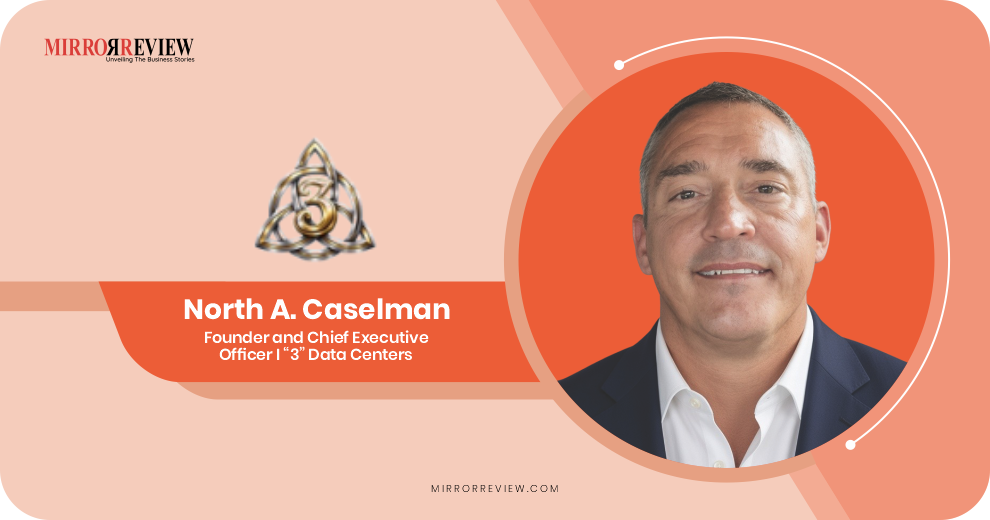
There is a particular kind of quiet that settles over a data center floor, a hum so constant it stops registering as sound at all, more like a pulse. It is the sound of thousands of machines thinking, and somewhere behind that hum is a supply chain of power lines, transformers, chillers, and permits that most people never think about until the lights, or the internet, or the artificial intelligence they have come to depend on, simply stop working. Few people have spent as much of their working life inside that infrastructure as North A. Caselman, Founder and Chief Executive Officer of “3” Data Centers.
Caselman did not arrive at this vantage point by accident. His path began at Quantico, Virginia, where he served in the United States Marine Corps as a small computer systems specialist and cybersecurity networking engineer. He has since built a 30-year career in the data center industry, including 15 years in Silicon Valley, and holds the Certified Data Center Design Professional (CDCDP) designation.
From Quantico to Global Crossing
When Caselman left the Marine Corps, his first civilian position was with Global Crossing, where he gained experience with global networks and the power of connectivity. “I learned about global networks and the power of connectivity,” he recalls of those early years.
His career subsequently included roles with TelX, Digital Realty, Global Crossing, Lumen, XO, FishNet Security, and Sprint/T-Mobile/Cogent. He has also advised and consulted on both the buy and sell sides of data center transactions, serving as a catalyst in deals worth billions of dollars.
That early exposure set the trajectory for what would become a thirty-year career in the data center industry, culminating in his leadership of “3” LLC and “3” Data Centers. The progression from military technology and global connectivity to data center development gives his career a clear through line: understanding the systems behind connectivity, then finding ways to make those systems work under increasingly demanding conditions.
The Idea That Became “3”
Every founder has an origin story, and Caselman’s begins with frustration, a feeling shared by nearly everyone who has tried to build something during a period of scarcity. “After experiencing the hardship of getting access to developmental power and watching the vacancy rates dwindle across the globe, I wanted to find a solution that would take best advantage of the current market and solve some of the data center constraints,” he explains. That search led to the creation of “3” LLC, and from it, “3” Data Centers, which he describes as a tactical data center company built to solve tomorrow’s problems by getting compute infrastructure online today.
The opportunity became more urgent as AI accelerated demand for data center capacity. Caselman points to three decades of watching the industry evolve, layered on top of low vacancy rates both nationally and globally, and an AI boom that has produced what he describes as the largest data center demand in the industry’s history. His time selling GPU servers exposed him to a problem that does not get discussed often enough outside the industry: the compliance difficulties surrounding the deployment of AI hardware. Scarcity, he notes, is easy enough to identify. The real difficulty is compounding. Finding the most sought-after Blackwell accelerator means little if a buyer cannot procure it or deploy it. That gap, between obtaining the hardware and actually putting it into service, is what pushed him to work backward from the source. “It has created the need to reverse engineer from the power on the pole, all the way to the server, rack, and PDU level,” he says. “This is where we can help.”
A Philosophy Built on People
Ask Caselman what guides his leadership, and the answer does not begin with technology. It begins with people. “It all starts with finding and working with good people,” he says. “Once you have assembled a team, it’s about speed to market, technical thoroughness, scale, and having a contingency plan for each of your critical path objectives.”
There is a certain restlessness in how he talks about staying current, an unwillingness to simply repeat what has worked before. “We aren’t building the same old mousetrap because we aren’t hunting the same old mouse,” he says, a line that captures something essential about how he sees the industry: not as a fixed set of problems, but as a moving target that requires constant recalibration.
Full Stack, From GPUs to Generators
What separates “3” Data Centers from other providers, according to Caselman, begins with its focus on data centers purpose-built for AI workloads. Its facilities use both air and liquid cooling technologies, while the company emphasizes flexibility, uptime, fungibility, and value.
That focus is part of a broader full-stack approach that spans site selection, land development, power acquisition and delivery, and the procurement of critical infrastructure. The company also works across real-estate acquisition, marketing, sales, and leasing, with deal structures that can include cold shell, hot shell, joint ventures, and mezzanine debt financing.
On the power side, “3” works with public utility, behind-the-meter, and cogeneration arrangements, as well as clean-energy alternatives including wind, solar, nuclear, and hydro. It also addresses power-purchase agreements, large-load letter addendums, will-serve power, power studies, and long-lead equipment such as transformers, generators, and ATS switchgear.
“We are incredibly nimble and have found many resources to ensure our customers enjoy uptime, fungibility, and real value,” he says. “Gained from thirty years of industry experience, we are best suited to be deployed in tactical mission-critical predicaments.”
The model extends beyond infrastructure itself. Caselman also advises private-equity firms entering the data center capital markets and helps bundle data center and GPU purchases in support of attestation and compliance requirements.
The Bottleneck Nobody Can Avoid
If there is one word Caselman returns to when discussing the industry’s biggest obstacle, it is supply chain. Somewhere, and sometimes everywhere, along a project’s critical path, a vendor’s lead time can quietly kill a deal. His answer to that risk is diversification, maintaining relationships with multiple vendors so that his team is never left without options. “Having a diverse supply chain and multiple vendors provides the peace of mind that we can always find that ‘I got a guy’ mentality,” he says. “At the end of the day, we are problem solvers.”
That problem solving extends into how the company tracks the pace of change in AI hardware itself. He notes that “3” stays closely aligned with NVIDIA certifications and release nomenclature, ensuring its facilities can support the infrastructure those technologies require. He frames the shift in almost architectural terms. “Long gone are the days you put a megawatt of power in twenty thousand square feet,” he says. “Welcome to the days where you can spend your megawatt in a few racks.”
Building for the Complexity Customers Now Expect
Reliability, security, scalability, and operational efficiency are central considerations in the infrastructure solutions “3” Data Centers develops and supports. Caselman explains that the company has a variety of infrastructure configurations it can deploy and support, with solutions built from the ground up so that data centers can securely and effectively support customers’ growing needs.
The flexibility matters because AI infrastructure is changing faster than the conventional assumptions on which many data centers were designed. “3” therefore approaches each deployment as a problem to be solved rather than a template to be repeated.
Lessons From the Hard Years
No founder’s story is without friction, and Caselman is candid about the challenges that came with building “3” Data Centers in an industry that has attracted a growing number of participants. “They always say if it were easy everyone would do it,” he reflects. “The process of sifting through the Good, the Bad, and the Ugly that have swarmed to the data center industry is a process that can both take time and cost money.” If there is a lesson in that experience, it is one that reinforces everything else he says about leadership. “This resolidifies the capstone,” he says. “People are our greatest resources.”
Milestones on the Horizon
For a company still in its earlier chapters, Caselman is measured rather than boastful about what comes next. “3” Data Centers is on pace to reach 20 megawatts of commissioned capacity by the end of 2027, a figure he describes as modest by today’s standards, but deliberate and achievable as a first step.
Alongside that buildout, Caselman points to a different kind of achievement, one rooted less in capacity and more in access. By blending infrastructure sales and AI hardware sales into a single revenue stream, “3” allows non-IG customers to participate in a market he describes as historically stingy. “This allows non-IG customers to get a chance to operate in a market that has been very stingy,” he says, before adding, with the kind of clarity that avoids any ambiguity, “Just to be clear, we do work with IG customers however.”
Watching the Thermal Threshold Approach
Ask Caselman what is coming next for the industry, and his attention moves immediately toward hardware, specifically NVIDIA’s Vera Rubin GPU, which he views as a genuine turning point. He describes it as an inflection point in the data center landscape, driven by a thermodynamic threshold that will fundamentally shape future designs. “The NVIDIA Vera Rubin GPU release will mark the inflection point in the historical data center landscape,” he says. “That thermodynamic threshold will forever shape tomorrow’s data center designs.”
A Closing Word to the Industry
For organizations building or investing in the infrastructure that will carry the next phase of artificial intelligence, Caselman’s closing thought is less a victory lap than a call to attention. He points out that few current solutions offer the kind of elastic thermal relief the industry will soon require at scale. As the race toward what he calls artificial intelligence supremacy accelerates, he believes the real obstacles are the scarcity and constraints surrounding power generation, power delivery, and thermal capacity.
For someone who began his professional journey working with computer systems and cybersecurity at Quantico, the challenge has evolved dramatically, but the underlying task remains familiar: understanding where a system can fail and building the infrastructure needed to keep it moving.
Caselman believes the next stage will require new technologies and broader adoption to address those constraints, particularly as AI pushes power and thermal requirements into territory the industry has not previously encountered.
It is, in its way, a fitting note for a man who began his career working with computer systems and networks at Quantico and has spent three decades since helping address the infrastructure challenges behind an increasingly compute-intensive world.
Quotes
Read more : Data Center Infrastructure, AI & Digital Infrastructure Leaders to Watch in 2026