
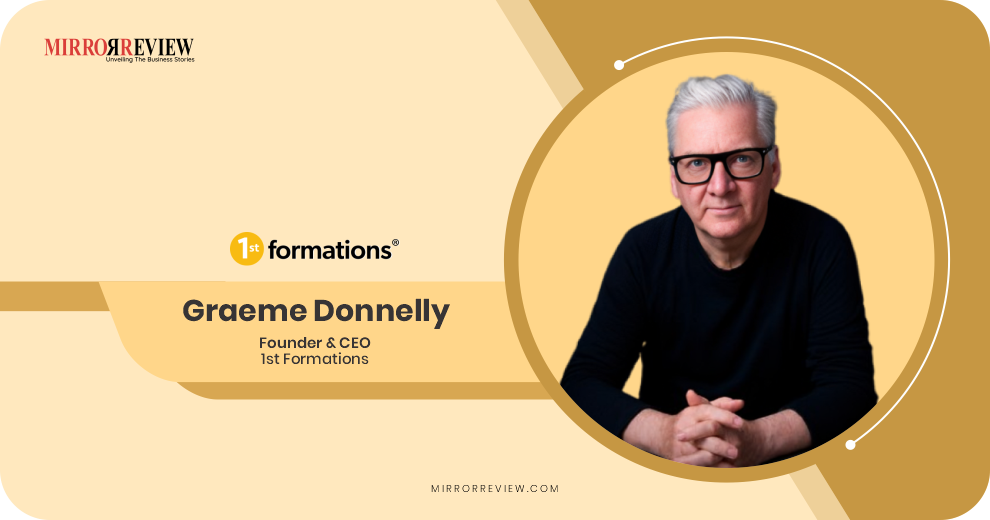
In a Covent Garden office building, with seven charities housed rent-free, the maths does not quite add up the way most business owners would expect it to. Square footage that could be leased for profit instead costs money. Profit that could stay private instead funds initiatives at the London School of Economics and Imperial College London. This is the world Graeme Donnelly has spent more than three decades building, and it is a world where the numbers only make sense once you understand the man behind them.
Graeme Donnelly is the Founder and CEO of 1st Formations, the company formation business now sitting at the centre of BSQ Group, alongside Rapid Formations and Quality Company Formations. Together, these companies have formed over one million businesses in the UK, employ over 120 people, and have built a reputation as the only B Corp-certified company formation agent in the country. But the story of how he got here begins nowhere near a boardroom.
From Measuring Buildings to Measuring Opportunity
Before he was forming companies, Graeme was measuring them, quite literally. He trained as a Quantity Surveyor and spent years working for a large firm in Glasgow, the kind of steady, technical job that teaches a person how to read costs before they read people. Eventually, he struck out on his own as an Independent Surveyor, but the work never sat right with him. “I didn’t enjoy Quantity Surveying,” he says, plainly, without any of the polish that usually accompanies a founder’s origin story.
So, he did something else instead. He bought a boutique business centre in central Glasgow in 2000, selling virtual offices and serviced offices to companies that wanted a prestigious address without the overhead of an actual lease. He overspent on renovations and misjudged demand. The bills piled up faster than he could pay them. Suppliers grew anxious. Sleep became a luxury.
What matters, in Graeme’s telling, is not the failure itself but what came after. After several years of struggle, he noticed something about his customers: the ones most eager to take a virtual office were the ones in the middle of forming a limited company. If he wanted volume, he needed to be where the companies were born, not just where they rented an address afterwards.
The Overnight Discovery
The turning point arrived almost by accident. A company formation agent began using Graeme’s Glasgow address for mail forwarding, and almost overnight, his address services grew exponentially. Rather than simply enjoying the windfall, he investigated it. He looked up the agent, understood exactly what they were doing, and realised that the real opportunity was not convincing established companies to use his address or rent desks. It was in forming the companies themselves.
He acted immediately. “I looked them up, realised that the route to selling high volumes of address services was through company formation, and went into company formation the next day,” he recalls. He sold his house in Glasgow, moved to Covent Garden in London, and began forming limited companies in England for the very first time with 1st Formations. The business grew from there, but Graeme was not simply chasing profit. He wanted to fix something that had frustrated him personally for years: the fragmented, confusing process of starting a company in the UK, where a new director had to cobble together an address, a business bank account, and an understanding of their legal responsibilities all on their own.
One Roof, Everything a Founder Needs
Today, BSQ Group has formed over a million companies, and the pitch to founders is simple: everything they need, in one place. Company formation, address services at a prestigious location, a Hassle-Free Compliance Service that manages statutory filings, and a full accounting service including year-end accounts, Corporation Tax returns and Self Assessment filings, enabling founders to grow their business with all of their statutory responsibilities taken care of. It is, in Graeme’s words, a response to an industry problem he understands intimately: the maze of obligations that comes with running a limited company.
“The Companies Act 2006 is not taught in schools,” he points out, “but the second someone forms a company, they become a director with legal responsibilities underpinned by this Act.” Most first-time founders are unaware that these obligations even exist, and even accountants, who are not company law experts, often struggle with statutory filings. BSQ Group’s answer is to strip away that complexity entirely, folding formation, compliance, accounting, and banking into a single, navigable service. As an Authorised Corporate Service Provider, the company now also completes Companies House identity verification checks for every founder it works with, a reform he sees as part of a much larger shift toward transparency across the entire Companies House public register.
Purpose as a Business Fundamental
Ask Graeme why sustainability and ethics matter to a company formation business, and he does not treat the two as separate tracks from the business itself. “Innovation and social responsibility aren’t parallel tracks; they reinforce each other,” he says. His roots in virtual offices taught him that digital-first services could lower barriers for entrepreneurs while shrinking environmental footprints at the same time, and that principle still guides him.
Under his leadership, BSQ Group became the first firm in its space to launch virtual office services which could be bought online, the first to become a Certified B Corporation, and the first to achieve carbon-neutral status, held consistently since 2022 and measured through Carbon Neutral Britain. Formation packages have been redesigned to remove printed documents altogether, supporting a zero-to-landfill approach to operations. The ambitions ahead are specific and measurable: a 10 per cent increase in the company’s B Impact score by 2028, and a halving of total emissions by 2050, backed by a formal Carbon Reduction Plan.
The same philosophy extends to people. BSQ Group was one of the earliest UK employers to commit to the Real Living Wage and was the 9th in London to receive a Living Hours accreditation from the Living Wage Foundation. “We innovate with impact,” he says of the company’s guiding value, explaining that innovation makes responsibility scalable, while responsibility gives innovation its purpose.
Giving Back, By Design
Perhaps the clearest expression of that philosophy sits inside BSQ Group’s own Covent Garden headquarters, 71-75 Shelton Street, where over 3,000 square feet of space, powered renewably, is donated free of charge to seven charities. It is an unusual choice for prime London real estate, but Graeme treats it as simply part of doing business properly.
The company’s first charity partnership, with the WONDER Foundation, has grown into one of its most significant commitments, including a £150,000 donation made in the past year, as well as over 100 volunteering days provided by BSQ staff. BSQ Group has also partnered with two of the country’s leading universities. At the London School of Economics, funding supports the race equality and neurodiversity founder clusters. At Imperial College London, funding backs the Entrepreneurship master’s degree, including its startup competition and advice to new founders. Founders emerging from both institutions receive free company formation, address, and compliance services from BSQ Group, a quiet extension of the same mission that drives the rest of the business.
Two Principles, Thirty-Five Years in the Making
When Graeme talks about leadership, he returns again and again to two ideas: a customer-first mindset and resilience. The first is almost mathematical in its logic. “Recurring revenue is much easier to obtain than new revenue,” he explains, “so if you can provide something genuinely useful, you can lower your marketing costs and make the business viable.” Build something people need repeatedly, and the business tends to take care of itself.
Resilience is the harder principle, and the one he speaks about with more feeling. Entrepreneurship, in his description, is a string of long hours and unexpected blows – staff departures, legislative changes, aggressive competitors, and countless other challenges beyond one’s control. “It’s how you get up again after these knocks and show up the next day that matters,” he says, “to your staff, your customers, and ultimately, your bottom line.” It is a philosophy forged, quite visibly, in the wreckage of that failed office venture back in 2000.
Culture That Scales With the Business
With more than 120 people now under the BSQ Group umbrella, Graeme has had to think carefully about how culture survives growth. His approach to recruitment is candid to the point of being unusual. He tells candidates plainly what to expect and is upfront that some workplaces are less high-octane and less ambitious than BSQ’s. To reward the people who help drive that growth, the company runs an Enterprise Management Incentive Scheme, offering share options to employees, creating what he describes as a natural, long-term alignment between staff and the company’s future.
What 2026 Looks Like From Here
Looking ahead, Graeme sees trust becoming a structural feature of the industry rather than a marketing slogan. Companies House identity verification checks, now completed for every founder BSQ Group works with, are part of a broader move toward a cleaner, more transparent business register, one where purpose-driven firms are positioned to thrive. Alongside that shift, he sees people-first culture becoming a genuine competitive necessity, reinforced by the Real Living Wage and Living Hours accreditations the company already holds.
Most tellingly, he believes purpose is migrating out of annual reports and into the products themselves. Paperless formation packages, compliance services that keep founders trading responsibly, education and scholarship partnerships, a headquarters shared freely with seven charities, all of it, in his view, is evidence of a coming standard. “The businesses that win in 2026 and beyond will be those where doing the right thing is built into the operating model, not bolted on,” he says.
Advice Worth Keeping
Asked what he would tell an aspiring entrepreneur, Graeme offers two pieces of advice, both drawn directly from his own record of failure and recovery. The first is a plain insistence on resilience: founders will fail repeatedly, and will feel insecure and vulnerable more often than they expect, and the only way through is to keep believing in the work and pushing forward regardless.
The second is a lesson in salvage. “Never throw anything away,” he says. “If a product or service fails, you should carefully analyse what was good about the product or service and see if you can specialise in that instead.” He points to Slack as the example that says it best, a company that began as a failed video game, whose developers looked through the wreckage and found that the game’s internal communication system was the one thing worth keeping. They rebuilt a business around it, and Slack is now worth $25 billion.
It is, in many ways, the same story Graeme tells about himself. A failed office venture. A pivot no one saw coming. And a business, built from the leftover pieces, that has now helped more than a million founders start something of their own.
Quotes
Read more : Purpose-Driven Business & Entrepreneurial Innovation Leaders to Watch in 2026


