
Adam Caller did not set out to spend his life inside classrooms, matching gifted teachers to families who needed them most. He began, of all things, with a degree in Civil Engineering, the kind of qualification that suggests bridges and blueprints, not report cards and reading lists. But something pulled him toward teaching instead, and he trained as a secondary school teacher, eventually spending seven years in the classroom, guiding students between the ages of eleven and eighteen through the ordinary chaos of adolescence and algebra alike.
Then came a pivot that would define the rest of his career. He left the classroom, not because he had become tired of teaching, but because he no longer wanted to work inside the structure of a school. He became a full-time, residential private tutor, moving into the lives of families rather than standing in front of a room of thirty students. It was in that role, quietly observing how the agencies operated, that he noticed something was missing. The agencies were not paying close attention to what families, and especially the children, truly needed. Nor were they paying much attention to what he, as a tutor, could actually offer. So in 1999, Adam did what dissatisfied professionals rarely have the nerve to do: he built Tutors International to do the job properly, eventually growing into his role as Founder and CEO of the company.
Not an Agency, an Employer
Ask Adam what separates his company from the dozens of other tutoring services in the world, and he will correct you before you finish the question. Tutors International is not an agency. It is an employer. His tutors work for the company, sometimes as contractors, sometimes as employees, but always under its guidance and support. This distinction is not a matter of semantics for him. Where agencies tend to introduce a tutor and step back, Adam’s company maintains a continuous contract with both the client family and the tutor, staying involved throughout the placement.
That involvement, he explains, is what allows small problems to be addressed before they become larger ones. It also explains why the company insists on meeting every family in person, spending time with the children themselves, before a single candidate is considered. Only after a detailed job description has been agreed upon does the recruitment process begin, and even then, every candidate under consideration is interviewed in person. There is no scrolling through a database of pre-approved names. Each search, he says, starts fresh. “We literally headhunt for each circumstance afresh.”
No Formula, Only Instinct
For a company built on precision, Adam is remarkably candid about the limits of process. When asked how he matches tutors to a family’s particular learning style or personality, he does not describe an algorithm or a checklist. He describes something closer to intuition, sharpened over decades. “There is no formula to this,” he admits, adding that he sometimes wishes there were, if only to make the work easier. But he is quick to note that a formula would strip away the very individuality the company is built to protect.
That instinct is guided, he says, by one constant above all else: what is genuinely best for the child. It is the single principle he returns to repeatedly, the filter through which every other decision passes.
Defending the Homeschooled and the Supported
Adam has heard the criticisms of private tutoring more times than he can count, and he does not flinch from them. The most common concern, particularly around homeschooling, is that a child will miss out on socialisation. He considers this one of the least significant criticisms directed at his industry. In his experience, a child taught well by a dedicated educator often has more time, not less, to pursue sports, music, faith, drama, debate, or community service, and he sees it as part of the tutor’s responsibility to actively seek out those opportunities.
The second criticism, aimed more at tutors supporting children still enrolled in school, is that the tutor becomes a crutch, something the child leans on instead of learning to stand independently. He rejects this framing entirely. The purpose of a tutor, in his view, is rarely to create dependency. Good tutors, he says, often make themselves redundant because their real task is teaching a child to eventually succeed without them.
What Makes a Tutor Worth Hiring
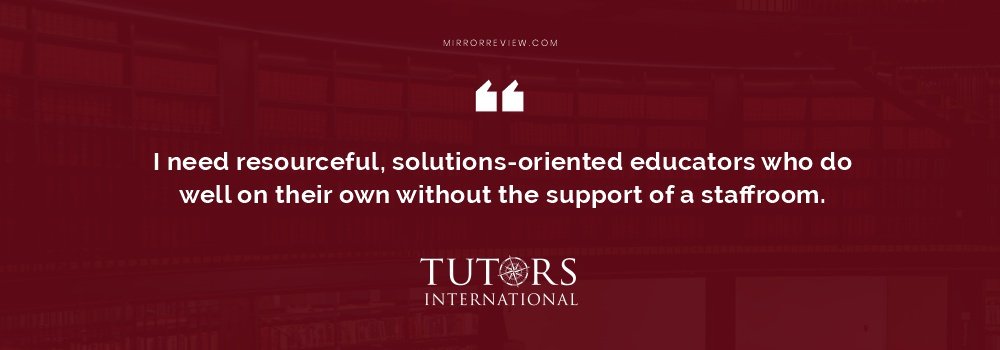
Adam is unusually selective about who gets to represent Tutors International, and he is transparent about why. He is not interested in candidates who have only dabbled in after-school tutoring without full course responsibility. Subject specialists who can teach only one discipline are unlikely to make the cut, and neither are candidates who lack international experience or additional language skills. What he wants instead are seasoned professionals, people with a genuine teaching degree and years of demonstrable classroom experience, capable of thriving independently without the built-in support structure of a traditional school environment.
It is a deliberately high bar because the people he places are often the only educators a child will have.
Leading Through Twenty-Six Years
Adam’s account of leadership is refreshingly unromantic. He does not describe crisis management or dramatic turnarounds. Instead, he describes surrounding himself with people he believes are better than him, empowering them, and backing their ideas once they have earned his trust. He credits the company’s stability, now spanning twenty-six years, to being consistently clear about its ethos and purpose, which he says helps resolve disagreements quickly whenever they arise. Many members of his leadership team, he notes, have been with the company for most of that history, a detail he offers not as a boast but as evidence of something durable.
Measuring an Impact That Resists Numbers
When asked to name Tutors International’s greatest achievements, Adam hesitates, not out of modesty, but because he genuinely finds the question difficult to answer in measurable terms. The company is often brought in precisely because a problem has resisted every previous educator or consultant who attempted to solve it. When that intervention succeeds, the child at the centre of it may one day inherit a significant company or carry responsibility for the livelihoods of thousands of families connected to that business. Knowing his company played a role in supporting that kind of generational continuity was, in his words, deeply gratifying, even if it cannot be reduced to a statistic.
Looking Toward 2026 and the Question of AI
Adam is candid about where he thinks private education is heading. The company, he says, continues to experience significant growth. But the driving force behind that growth is not simply demand for tutoring itself. There is a growing unease among his clients that traditional school and university systems have not kept pace with the speed of technological change, particularly artificial intelligence. Some families, he observes, worry that AI could eventually replace classroom teachers altogether, and it is precisely that anxiety that is pushing them toward something more personal, something they hope will prepare their children to lead the next generation rather than simply keep up with it.
A Life That Does Not Feel Like Work
For someone running a global operation, Adam describes his relationship with balance in strikingly simple terms. He does not see his work as a burden. He meets fascinating families and some of the finest educators in the world, and he struggles to see what there is not to love about that. He acknowledges that demands sometimes arrive all at once, but he credits his company’s efficiency and the capability of his employees with allowing responsibilities to be shared when needed. “I am not struggling for balance,” he says, without a trace of performance in the statement.
A Final Word to Families
Adam closes with something closer to a plea than advice. If a family reading his story believes a full-time private tutor might suit their circumstances, he urges them to reach out as early as possible. The one limitation his careful, unhurried process cannot easily accommodate, he says, is being asked to find the perfect tutor in a hurry.
Quotes
Read more : https://www.mirrorreview.com/the-most-prominent-leaders-2026/