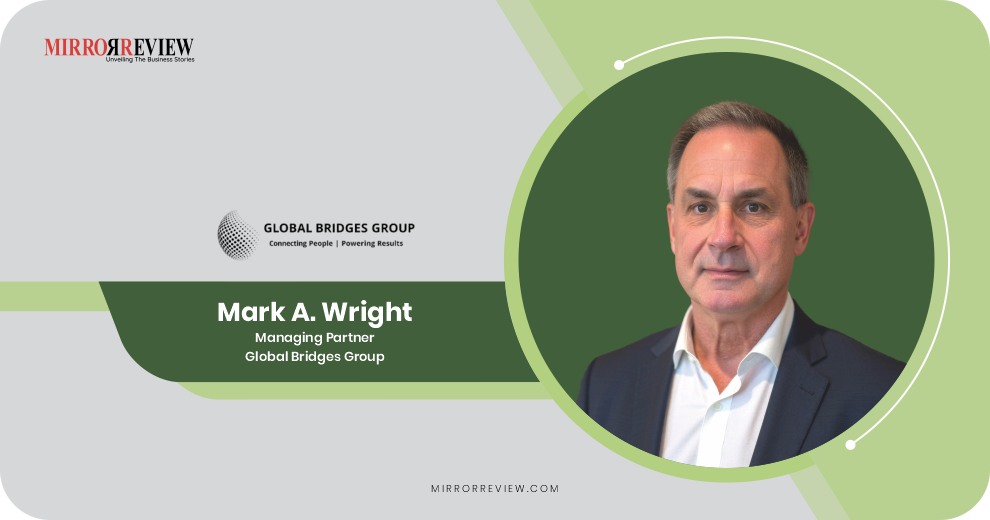
There is something almost counterintuitive about how Mark A. Wright speaks about home. After nearly four decades of construction sites, government corridors, boardrooms spread across multiple continents, and long-haul flights that blur into one another after enough years, he talks about the 15 miles of natural trails near his house in Greenville, South Carolina, with a kind of quiet, earned reverence. Not nostalgia. Something more precise. He knows what it costs to get there, and he protects it accordingly.
That deliberateness, as it turns out, runs through everything he has ever built.
From the Ground Up
Mark’s professional story begins not in a boardroom but on a construction site. In 1986, fresh out of the University of Iowa, he joined General Electric as a Field Engineer in Power Systems. The entry point was unglamorous by design. He was managing installation teams of up to 200 people on cogeneration projects, learning the mechanics of power generation not from manuals but from the ground beneath his boots.
He moved into management at GE over time, then took on roles at Westinghouse Plasma, steadily expanding a career that resisted easy categorization and comfortable specialization. The arc was long, and it was intentional.
It was his extensive international travel during the 2000s that produced the shift that would redefine everything that followed. Where most energy professionals read waste-to-energy through the lens of electricity output, Mark looked at the same projects and saw something the industry had largely looked past.
“I realized waste-to-energy’s true value lay not in electricity generation but in the syngas produced from waste, a feedstock for higher-margin products such as hydrogen and fuels,” he says. “That conviction became my mission and continues to drive Global Bridges Group today.”
That realization did not arrive in a single moment. It was the accumulation of years, fieldwork, and the kind of close listening that only sustained cross-cultural experience makes possible.
Connecting People, Powering Results
In 2018, drawing on over 40 years of industry experience, Mark founded Global Bridges Group (GBG) in Greenville, South Carolina, and has served as its Managing Partner for 8 years since inception. The company’s founding promise was stated simply and meant seriously: “Connecting People, Powering Results.”
The problem he was solving was specific and consequential. Across the global green technology landscape, innovative companies with strong solutions were getting stuck, unable to commercialize because of financing gaps, limited government relationships, and the complex cross-border execution that emerging markets demand. Most consulting structures were neither equipped nor sufficiently motivated to resolve this. GBG was built precisely to fill that gap.
The organization’s mission is to help green technology companies navigate the barriers of government policy, business climate, and cultural differences to succeed in global markets. Its vision is a global circular energy economy, developed, financed, and operational asset by asset. The core values guiding that vision are integrity, transparency, and a genuine commitment to partners’ long-term growth. These are not phrases borrowed from a slide deck. They are the architecture of every relationship the firm constructs.
The Work Itself
GBG’s operational range is deliberately wide. The firm works across renewable energy, waste-to-energy, dairy-to-biogas, biofuels, alternative fuels, waste-to-water, water purification, desalination, power generation, battery storage, technology IP, manufacturing, government contracts, and environmental sustainability. Its services span business and project development origination, strategic partnerships, capital alignment, market entry, capital structuring, financial engineering, regulatory strategy, stakeholder management, and execution oversight.
What separates GBG from a conventional advisory firm, however, is not the breadth of its expertise but the depth of its involvement. The team has built, scaled, and led multinational organizations across continents. They know the barriers that quietly kill green tech projects abroad because they have navigated them firsthand: complex permitting, country-specific financing norms, government relationships that take years to cultivate, EPC supervision, and the multi-year timelines these markets require.
Mark’s team does not develop a strategy and step back. They translate a foreign developer’s playbook into a format that local governments, lenders, and EPC contractors will actually accept. They sit at the negotiating table for the years it takes to close and remain through construction and operational ramp-up.
The business model reflects that level of commitment. Traditional consulting firms, as Mark notes, often profit from long engagements and cautious recommendations. GBG changed that. The firm operates on a monthly retainer with performance-based incentives, not traditional consulting fees. If a client needs expertise GBG does not carry in-house, the firm sources, vets, and provides it under the existing retainer, with no surprise invoices and no conflicts of interest. “That alignment changes the conversation from the very first meeting,” he says. GBG succeeds only when its clients do, and both parties understand that from day one.
A World of Opportunity
GBG operates across five continents, and its team carries over a century of combined global C-Suite experience in energy, waste management, renewables, environmental services, and financial services. The firm’s ecosystem spans technology providers, project developers, EPCs, equity investors, project finance lenders, multilateral institutions, and government partners. It has collaborated with US developers, advised UK and European technology firms on global expansion, and partnered with municipal authorities and private companies in India, the Middle East, and Africa.
That network was not assembled quickly. It was built over decades of trust, and it opens doors that new entrants to these markets simply cannot access on their own. When asked where the most significant opportunities lie heading into 2026, Mark is precise and geographic.
India stands out above the rest. The country is advancing rapidly in waste-to-energy, hydrogen, and data center construction, outpacing most markets where GBG currently has active projects. To anchor its presence there, the firm is forming a 50/50 joint venture with an India-based company, creating a structured gateway for US firms entering the Indian market. An Indian company named Saivek is also poised to become one of GBG’s closest partners.
The MENA region is investing heavily in waste-to-energy and circular infrastructure. Africa holds substantial long-term potential in distributed energy and waste solutions, though Mark is direct about the fact that patience is a genuine prerequisite there. Southeast Asia is opening up with growing momentum. In the United States, opportunity zones now offer unprecedented tax savings on capital gains, while the expanding data center sector is generating new demand for clean baseload power.
“The greatest opportunity is capital,” Mark says. “Institutional investment is finally flowing into credible green tech projects at scale, and emerging markets are now far more accessible than they were a decade ago.”
The obstacle, however, is equally real. Execution capacity remains the industry’s most persistent bottleneck. Permitting, local financing, EPC supervision, and commissioning are where projects fail. “Companies pairing strong technology with experienced execution partners will define the next decade. Those that don’t will burn capital learning lessons others have already faced,” he adds.
Real Numbers, Real Assets
For Mark, impact is not a metric that lives on paper. It lives in operating assets.
A 25 TPD plasma gasification-to-hydrogen plant in India, valued at $7.8 million, is entering construction following GBG’s management of its detailed design. In Europe, the firm completed a FEL 3 design package for a 150 TPD plasma-to-hydrogen plant. GBG conducted due diligence on a 1,000 TPD waste-to-energy acquisition and is currently co-developing a 100 TPD waste-to-energy project. Three anaerobic digestion plants that the team supported moved from under 50% availability to over 95%.
Each number represents years of invisible work: regulatory navigation, local relationship-building, financial structuring, and the kind of patient, sustained presence in complex markets that most organizations are neither structured nor prepared to maintain.
“Impact for us shows up in operating assets, not press releases,” Mark says.
The Next Horizon
GBG’s path forward runs through deeper engagement in India, an expanding US opportunity-zone pipeline, and a growing body of circular-economy work that is pushing into bold new territory.
One initiative captures the firm’s ambitions with particular clarity. GBG has recently joined Blue Horizon, a coalition formed to address one of the Atlantic coastline’s most stubborn environmental problems: 38 million metric tons of sargassum washing up on Atlantic beaches every year. The coalition’s work centers on converting that biomass into biofuels, transforming a large-scale environmental burden into a scalable energy resource.
“It is exactly the kind of cross-border, large-scale problem we were built to take on,” Mark says. For GBG, this kind of initiative is not a departure. It is a natural extension of a firm that has always defined growth as turning the waste streams the world is struggling to manage into circular solutions that scale across continents and sectors.
The Quieter Life of a Global Operator
It would be easy to assume that someone who has spent over 40 years building across five continents would find it difficult to slow down. Mark Wright has made a different choice, and it was clearly a deliberate one.
He is at the gym four or five days a week. He walks the trails near his Greenville home with a regularity that suggests those walks are doing more than exercise. Faith and family are not peripheral to how he operates. They are central. “I have learned to protect that time the way I protect a project schedule,” he says.
“After years of constant international travel, the quieter rhythm of Greenville is something I deeply value and need.”
There is quite a lot in that sentence for anyone paying close attention.
A Philosophy Built in the Field, Not the Boardroom
When Mark speaks about what the energy transition will actually require, the language is not aspirational in the performative sense. It is honest in the useful sense.
“The energy transition will not be achieved by the loudest advocates or the most polished presentations. Instead, it will be driven by those willing to engage in unglamorous work for years before recognition arrives,” he says.
He presses further: “If you have impactful technology, seek partners with practical project-building experience, respect the markets you enter, and remain involved even when uncomfortable.”
That patient, hands-on commitment, sustained over decades, is what “Connecting People, Powering Results” truly means. For Mark Wright, it was never a tagline. It has been a way of working, proven across continents, projects, and years, in the unglamorous places where energy transitions are actually decided.
Quotes
Read more: Energy Transition, Green Tech & Global Strategy Leaders to Watch in 2026