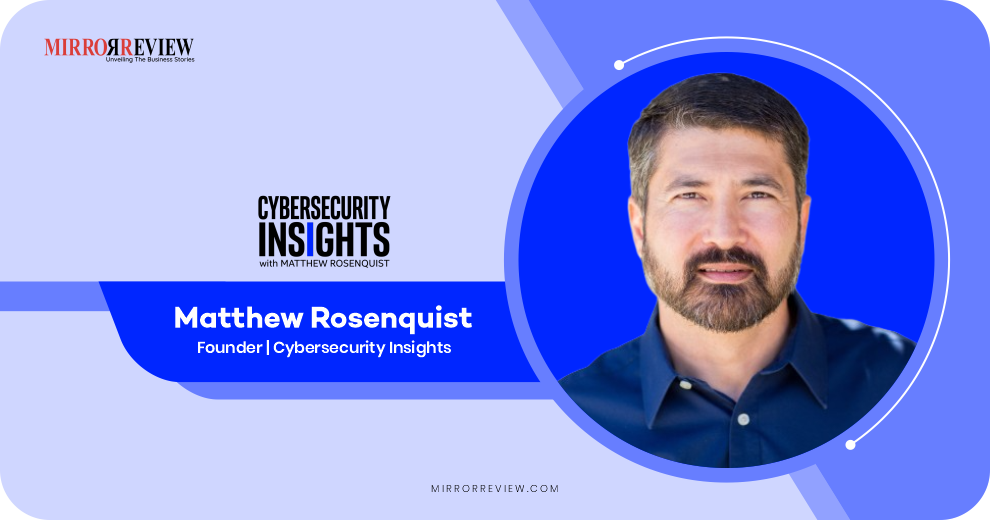
There is a conversation that many organizations still struggle to have effectively. It is the conversation between the cybersecurity professional who understands the threat landscape in precise technical detail and the executive responsible for business strategy, investment decisions, and organizational direction. One speaks in the language of vulnerabilities, attack surfaces, and threat actors. The other speaks in the language of growth, operational resilience, and risk management.
The gap between those worlds has become one of the defining challenges of modern cybersecurity. Matthew Rosenquist has spent his career helping close it.
As the Founder of Cybersecurity Insights and CISO at Mercury Risk, with a career that includes foundational years at Intel Corporation, Matthew occupies a rare position in the industry: a technical expert with the strategic fluency and communication skills to translate cybersecurity’s most important challenges into terms that boardrooms, governments, and academic institutions can actually act upon.
“Cybersecurity is no longer just a technical function; it is a critical enabler of business performance,” he has stated, a perspective that reflects the broader evolution of cybersecurity itself from a back-office technical discipline into a core component of organizational strategy.
Building Strategic Perspective at Scale
Matthew’s professional foundation was shaped during his years at Intel Corporation, where he operated inside one of the world’s most influential technology ecosystems. The experience exposed him to cybersecurity at enterprise scale, where security considerations intersect not only with infrastructure, but also with product development, supply chains, global operations, innovation cycles, and long-term business strategy.
That environment helped shape a professional approach grounded in both technical rigor and strategic fluency. Over the course of his career, he has contributed to cybersecurity research, publications, training initiatives, patents, advisory work, and industry discussions, building a body of work that reflects both deep expertise and a sustained commitment to advancing the broader cybersecurity conversation.
Today, his work focuses heavily on helping organizations improve cyber risk governance, executive communication, strategic resilience, and decision-making in increasingly volatile digital environments.
Redefining the Role of Cybersecurity Leadership
The role of the modern cybersecurity leader has changed dramatically over the past two decades. What was once viewed primarily as a technical or compliance-focused function has evolved into a leadership discipline requiring business acumen, boardroom communication, organizational alignment, and strategic foresight.
Matthew has consistently operated at the forefront of that shift. His expertise spans cybersecurity strategy, executive risk advisory, organizational governance, emerging technologies, digital trust, and stakeholder communication. But what distinguishes his work is not simply the range of subjects he addresses. It is his ability to frame cybersecurity as a business issue rather than an isolated technical concern. That framing changes the quality of organizational decision-making itself.
He frequently emphasizes the importance of elevating cyber risk conversations beyond fear-based or purely technical discussions and toward actionable strategic dialogue. In practice, that means helping executives understand cybersecurity not as a cost center or operational burden, but as a critical factor in resilience, trust, and long-term business performance.
Building Influence Through Clarity
One of the most distinctive dimensions of Matthew’s influence is the professional community he has built through thought leadership and public engagement. Across LinkedIn, keynote presentations, webinars, podcasts, research discussions, and media appearances, he has developed a global audience of cybersecurity professionals, executives, policymakers, and technology leaders.
His influence stems not from sensationalism, but from clarity. In a field often crowded with technical jargon and alarm-driven messaging, he has established himself as a communicator capable of explaining cybersecurity challenges in ways that remain sophisticated without becoming inaccessible. His work consistently bridges the space between technical expertise and executive understanding, helping organizations navigate increasingly complex conversations around risk, resilience, disruptive innovation, and digital transformation.
He also serves on advisory boards and collaborates across industry ecosystems, contributing to broader conversations surrounding cybersecurity leadership, governance, and emerging technology trends.
Expanding the Conversation Around Digital Ethics
An especially notable aspect of Matthew’s work is his sustained focus on digital ethics and responsible technology leadership.
As artificial intelligence, automation, and connected systems become more deeply embedded in business and society, cybersecurity discussions increasingly intersect with questions of trust, accountability, privacy, and organizational responsibility. He has been a consistent advocate for expanding cybersecurity conversations beyond technical defense and toward the ethical implications of how digital systems are designed, governed, and protected.
It is an area of growing importance, particularly as organizations face rising expectations around transparency, resilience, and responsible innovation.
The Translator the Industry Needed
Matthew Rosenquist is not disruptive in the performative sense. His impact comes from something more durable: changing how organizations think about cybersecurity itself. About the relationship between risk and leadership. About the connection between technical capability and business strategy. About the responsibility organizations carry in an increasingly digital world.
At a time when cybersecurity challenges continue to grow in scale and complexity, his ability to translate technical realities into strategic understanding has become increasingly valuable. And in 2026, that kind of leadership is no longer optional. It is essential.
Read More: Cybersecurity Marketing & Communications Disruptors to Watch in 2026