There is something quietly remarkable about the waste and recycling industry. It is, in many ways, the backbone of modern civilization, touching every city, every supply chain, every business operation on the planet. And yet, for decades, it has been among the last sectors invited to the table when digital transformation was being discussed. While financial services ran predictive algorithms and healthcare deployed machine learning, the trucks were dispatched by phone call. The emissions data were estimated, at best. The paperwork was thick and manual and perpetually late.
Evan J Schwartz noticed this gap a long time ago. And for more than 35 years, he has been thinking carefully and working systematically about how to close it.
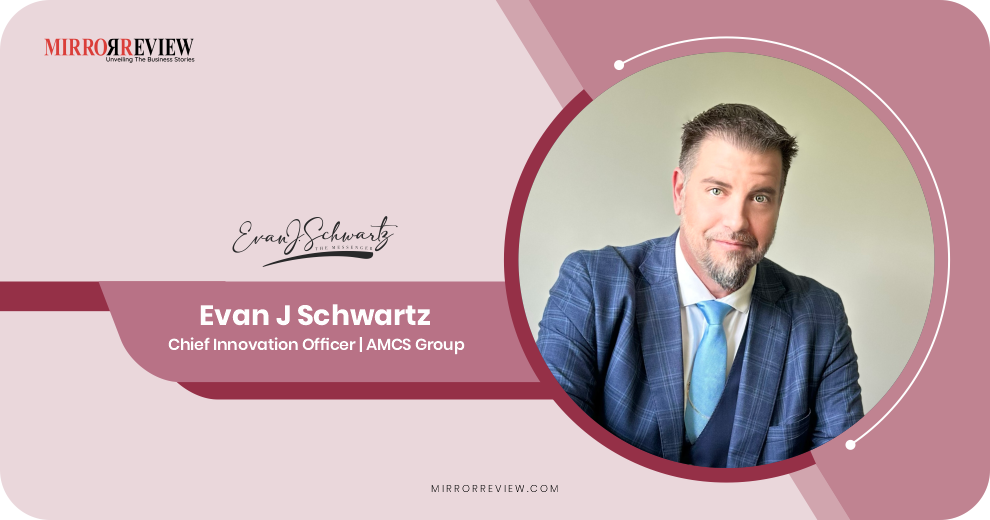
He is the Chief Innovation Officer at AMCS Group, a global technology company co-founded in 2003 by Jimmy Martin and headquartered in Limerick, Ireland. The company has grown to operate globally, and Schwartz now stands at the center of its most ambitious chapter yet: embedding artificial intelligence into the daily operations of the world’s resource-intensive industries and proving, in concrete financial terms, that sustainability and profitability are not opposing forces but, in fact, the very same force.
Over the course of a career that has taken him through roles as Chief Information Officer, Chief Operating Officer, Chief Technology Officer, and Chief Enterprise Architect, he has accumulated something considerably rarer than technical expertise. He has accumulated perspective. And in a moment when most organizations are still figuring out what to do with AI, perspective is, arguably, everything.
A Career Spent Seeing Around Corners
Evan did not arrive at sustainability technology by accident. He arrived there by following a particular kind of instinct: a sensitivity to the places where the need is greatest and the tools are fewest.
“My focus on sustainability and resource-intensive industries emerged from recognizing a critical imbalance,” he says. “These sectors have an outsized impact on the environment yet have historically lacked the digital maturity of other industries. That gap represents both a challenge and an opportunity.”
Each executive role in his career gave him a different vantage point on the same fundamental question: how does a complex organization actually change? As CIO, he focused on systems and data. As COO, he was accountable for operational performance. As CTO and architect, he emphasized scalability and design. This progression is not the resume of someone who collected titles. It is the record of someone who deliberately wanted to understand transformation from every possible angle, because he believed, correctly, that the full picture mattered.
The synthesis of those four roles now defines his entire approach at AMCS. Technology, he insists, cannot exist in isolation. It must be deeply aligned with business outcomes and operational realities, and it must be compassionate toward the people who have to actually do the work of adopting it.
This belief runs through his public writing, including his blog at EvanJSchwartz.com, his contributions to Forbes Technology Council, and the speaking engagements he takes on. He offers his speaking deck on the Stewardship Model and his time, at no charge, to any organization willing to engage seriously with these questions. “This is my passion,” he has said, with a directness that is worth pausing on. “And I fear we only get one chance to do it right.”
The Company at the Center of It All
AMCS Group was built on a straightforward but deeply ambitious premise: that the waste, recycling, and resource-intensive industries deserved the same quality of digital infrastructure that other sectors had long taken for granted.
Founded in 2003 and rooted in Ireland, the company has spent two decades building what Evan describes as the “foundational context system” that runs resource-intensive businesses. Its platform spans enterprise resource planning for waste, recycling, field services, pulp and paper, scrap recycling, fleet maintenance, transport and logistics optimization, ESG and EHS solutions, and advanced analytics. These are capabilities that, in most organizations, have historically lived in isolated silos, each generating its own disconnected data, each limiting the visibility of the whole.
“Organizations have struggled with fragmented systems, manual ESG reporting, and disconnected operational data,” Evan explains. “Our approach is to unify these capabilities into a single platform, enabling end-to-end visibility and control.”
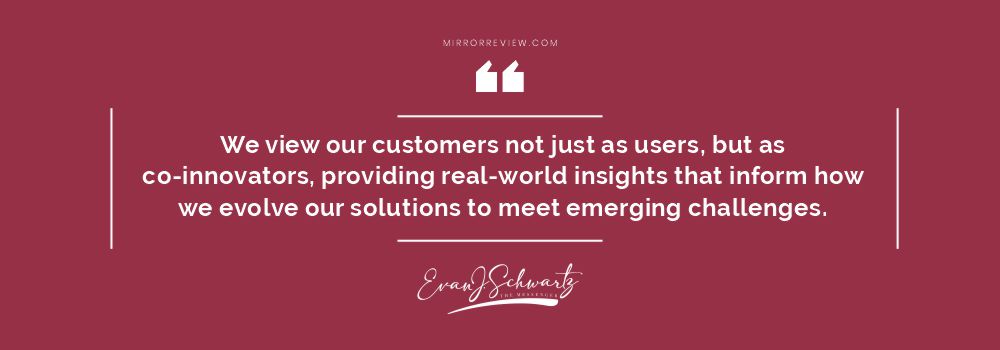
The core values guiding AMCS are clear and consistently applied: customer-centric innovation, measurable sustainability outcomes, and continuous improvement at scale. Notably, customers are not simply users in the AMCS model. They are co-innovators, providing real-world insights that shape how the platform evolves to meet emerging challenges. This relationship, between software provider and operational partner, is one Evan returns to often, because it is part of what makes the AMCS approach distinct from generic enterprise software.
The AMCS Performance Sustainability Suite earned the Top Product of the Year award from Environment+Energy Leader, recognition that reflects the company’s commitment to turning sustainability from a reporting requirement into an embedded operational reality. Waste Advantage Magazine featured AMCS prominently in its January 2026 issue, affirming the company’s expanding role as a strategic partner for resource-intensive industries navigating an increasingly complex regulatory landscape. The breadth of that recognition speaks to something more than good software. It speaks to a genuinely different way of thinking about what enterprise technology is for.
From Systems of Record to Systems of Action
If there is one idea at the heart of Evan’s current work, it is the recognition that enterprise technology is undergoing a shift unlike anything that has come before, and that most organizations are not yet equipped to meet it.
He frames it as a three-part progression. First came systems of record: databases and ERP platforms designed to capture and store transactions. Then came systems of intelligence: platforms that could analyze data and surface insights for human decision-makers. Now, he says, we are moving into something altogether different.
“We are moving from systems of record to systems of intelligence, and now toward systems of action.”
This is the era of agentic AI. Not AI that recommends a course of action and waits for a human to confirm it, but AI that can act within defined parameters: dynamically optimizing routes in real time, adjusting schedules based on asset performance, automatically identifying and responding to ESG anomalies. These are not theoretical possibilities. They are becoming embedded in the daily operations of AMCS customers across the globe.
But Evan is precise, even exacting, about what makes this possible. And it is a distinction that separates AMCS from the broader field of AI providers claiming transformative impact. “AI knows everything about business and maybe even your industry,” he says. “But it knows nothing about your business and how you operate. We fill that gap.”
AMCS has spent two decades building the foundational operational context that makes AI genuinely meaningful in specific enterprise settings. That accumulated institutional knowledge, woven into the platform, is what allows agentic AI to function as a calibrated instrument rather than a blunt, generic tool.
AMCS Group is the only provider offering what Evan calls a ‘Person Plus AI’ strategy: a framework that does not simply hand a company software, but can diagnose and provide guidance on how AI can benefit that specific company, and then supply the customer journey necessary to take genuine advantage of it, in ways that produce real, measurable results.
The Human at the Core of the Machine
What makes Evan’s voice unusual in a field often dominated by technical evangelism is his insistence on keeping people at the center of every decision, at every stage.
As Chief Innovation Officer, his job is not simply to deploy AI across AMCS customers. It is to help those customers navigate the organizational change management that adoption requires. And that, he argues, is where most AI initiatives quietly collapse.
“It’s no longer a tech challenge,” he says plainly. “It’s a digital workforce challenge.”
His April 2026 article in Forbes Technology Council, titled “Why AI, Why Now, and Why Your Company Can’t Afford to Wait,” makes this case with characteristic directness. The organizations hesitating on AI adoption, he argues, are not being thoughtfully cautious. They are falling behind. The urgency he expresses is not rooted in hype. It is rooted in watching the gap between AI-ready organizations and the rest of the market widen, in real time, month by month.
He is also deliberate about the intellectual habits required to lead well in this environment. He describes himself as highly sensitive to echo chambers and the single-user narrative, and as someone who actively seeks out opposing ideas to test his own thinking. It is the kind of intellectual honesty that is easy to profess and harder to practice.
And Evan does not subscribe to the apocalyptic view of artificial intelligence that tends to dominate popular coverage. He finds it, frankly, inaccurate and counterproductive.
“The future isn’t happening to us,” he says. “It happens because of us, and it is a choice. We can absolutely choose a better future, and my hope is to present a viable, positive option.”
This is not rhetorical optimism. It is a considered position from someone who believes the decisions being made right now, in boardrooms and technology departments and academic institutions, will have consequences that outlast all of us.
The Book That Said What Everyone Knew but Nobody Had Written
Before Evan became a widely recognized voice on AI adoption, he was quietly becoming the authority on a problem that has confounded enterprises for decades: the ERP implementation that costs twice as much as planned, takes three times as long, and still does not do what it was supposed to do.
His book, People, Places, and Things: A Framework for a Pain-Free ERP Implementation, published through Forbes and an Amazon Best Seller, is built around an argument that sounds obvious once you hear it but is almost universally ignored in practice. Successful ERP implementations are not primarily technology challenges. They are organizational ones.
The framework he developed maps a 10-step customer journey across three critical dimensions: people, places, and things. Organizations, he argues, consistently over-customize their systems, underestimate the importance of change management, and fail to align technology with the actual processes of the business. These are not new mistakes. They are the same mistakes, made again and again, despite decades of expensive, well-documented evidence.
“Despite technological advancements, these challenges persist because the underlying issues remain the same,” he writes. “The lessons from ERP are highly relevant today as organizations adopt AI: success depends on alignment, adoption, and execution, not just capability.”
The book has proven to be more than a practitioner’s guide. It has become a framework for understanding why technology, in isolation, is never sufficient, a lesson Evan applies in every conversation he has about AI adoption today. The parallels between ERP transformation and AI adoption are not superficial. They are, at their core, the same human problem with a different coat of paint.
Building the Stewards Business Will Need
Among the ideas Evan returns to most frequently is one that sits at the intersection of technology, education, and organizational design: the concept of the AI Steward.
An AI Steward, as he defines it, is a leader who is responsible for guiding the ethical, strategic, and operational use of artificial intelligence within an enterprise. Not a data scientist, not a software engineer, but someone who understands both the technology and the human systems it operates within, and can navigate between them.
Through his work as Adjunct Professor and Chair of the Board of Advisors for Computer Science and Cybersecurity at Jacksonville University’s Davis College of Business and Technology, Evan has been actively working to shape the curriculum that will eventually produce these leaders. The faculty there, he says, is doing remarkable work. But he is candid about the timeline.
“Businesses need to take the lead here,” he says, “and need to do it now.”
It will be between two and eight years before higher education reliably produces AI Stewards at the scale that business requires. That gap is not something organizations can afford to wait out. The companies that build internal AI capability today, that invest in AI literacy across the enterprise, establish governance frameworks early, and pursue use-case-driven adoption, will define the competitive landscape of the next decade.
AI is changing business needs, he observes, from a human-centric, repetitive delivery of excellence to a human-driven, iterative problem-solving that is capable of delivering orders-of-magnitude multipliers in output. This is, in his view, not a threat to human relevance but an invitation to a richer kind of work. The repetitive tasks are delegated to machines. The consequential decisions, the creative leaps, the empathetic judgments, those remain human.
For leaders navigating this transformation, AI is not just a tool. It is a foundational capability that will define how organizations operate and compete in the future. The organizations that treat it as such and build the internal structures to support it will be the ones that lead.
When Sustainability Becomes a Source of Margin
Perhaps nowhere is Evan’s thinking more practically consequential than in the area of ESG. For most enterprises, environmental, social, and governance reporting remains an obligation: a compliance exercise managed by a small team, filed annually, and largely disconnected from the business decisions that actually shape environmental outcomes.
Evan argues this is precisely the wrong way to look at it, and AMCS has spent three years building the evidence to prove it.
At AMCS, ESG is integrated directly into operational workflows, enabling real-time visibility and decision-making across the enterprise. This transforms ESG from a retrospective reporting exercise into proactive, embedded management. And it connects, in concrete financial terms, to the performance of the business.
The platform has enabled organizations to reduce fuel consumption through optimized routing, improve recycling efficiency, and streamline ESG reporting processes that were previously manual, fragmented, and unreliable. These are not abstract improvements. They are measurable outcomes that show up on a balance sheet.
“We haven’t forgotten the fiduciary responsibility our customers have to their shareholders and to the planet’s stakeholders,” Evan says. “Our focus on ‘Sustainable AND Profitable’ is unique.”
Over the past three years, AMCS has been building and proving a specific and powerful thesis: wherever you see spikes in CO2 emissions across a company’s ESG profile, you will find opportunities for operational efficiency and bottom-line free cash flow impact. Sustainability, understood correctly, is not a cost center. It is a source of margin.
Evan calls this framework Performance Sustainability. It may be the single most important idea AMCS has brought to market, and the most direct answer to the question that every executive with an ESG mandate eventually asks: what does this actually do for the business?
The full scope of this philosophy, and the tools that make it operational, is documented across the AMCS resources available at amcsgroup.com and through Evan’s ongoing writing and public engagement at EvanJSchwartz.com.
The Choice That Defines This Moment
There is a quality to Evan J Schwartz’s thinking that is difficult to capture fully in a single profile. He is precise without being cold. He is urgent without being alarmist. He holds complexity with patience and still manages to speak in sentences that anyone can follow. After 35 years at the intersection of enterprise architecture, operations, and transformation, he has the rare quality of someone who has earned his certainty but has not let it harden into rigidity.
He envisions a future in which AI manages the repetitive and the transactional, freeing people to focus on the iterative problem-solving and consequential decision-making that actually require a human mind. It is a more fulfilling future, he believes, for everyone involved. But it will only arrive if organizations build it deliberately, starting now, with governance and literacy and a composable architecture that can evolve as the technology does.
Education must adapt, from elementary school through graduate programs. Organizations must build internal AI capabilities rather than waiting for the market to deliver them ready-made. And leaders must understand, before anything else, that this is a workforce challenge long before it is a technology challenge.
“We’re driving global change in how people perceive themselves, their identity, and the value they provide to society,” he says. “I do not subscribe to the apocalyptic view of AI. The future isn’t happening to us. It happens because of us.”
For Evan J Schwartz, after 35 years of building systems, leading transformations, and watching resource-intensive industries slowly wake up to what technology can do for them, the work is as urgent as it has ever been. The tools are better. The platform is proven. The case, between sustainability and profitability, has been made.
The choice, he keeps reminding anyone who will listen, is ours to make.
Quotes
Read More: Sustainability Tech, ESG & Performance Innovation Leaders to Watch in 2026