If you spend enough time standing in the middle of a logistics depot in London, or a shipping yard in Hong Kong, the first thing you notice isn’t the technology. It is the friction. It is the anxiety of a fleet manager staring at a roster of drivers that is never quite full enough. It is the sound of a van scraping against a loading bay wall because the driver is tired, rushing to meet a same-day delivery window that has tightened from a goal into a demand. The global supply chain does not run on magic; it runs on margins that are razor-thin and human endurance that is currently being stretched to its breaking point.
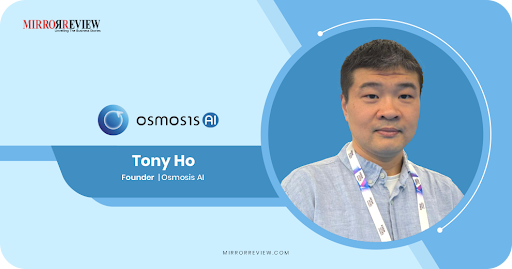
This is the world Tony Ho occupies. He is not standing on a stage making breathless promises about a sci-fi future where steering wheels disappear tomorrow. He is standing in the yard, looking at a battered Ford Transit van, and asking a very practical question: How do we make this vehicle smarter without bankrupting the person who owns it?
Tony is the Founder of Osmosis AI, a London-based company that is approaching the problem of autonomous transport with a philosophy that feels radically grounded. In an industry obsessed with building entirely new, bespoke, and prohibitively expensive robotaxis, Tony is taking the path of least resistance and highest utility. He is retrofitting. His company takes the commercial vehicles that are already on the road; the vans and trucks that keep our economy moving, and installs a “Robotic Driver” system in under two hours.
He is not trying to delete the human driver from existence; he is trying to solve the math problem of modern logistics. The demand for delivery is vertical, but the supply of drivers is flatlining. Tony is building the bridge between those two lines, not by demanding a revolution, but by facilitating an evolution – one that happens, as his company name suggests, through osmosis.
From Hong Kong Density to London Depots
To understand why Tony looks at a logistics problem differently than a Silicon Valley software engineer, you have to look at where he started. He grew up in Hong Kong, a place where infrastructure is not an abstract concept but a physical pressure. It is a city defined by density, where the flow of people and goods is a non-stop, high-stakes ballet.
“I grew up in Hong Kong, surrounded by dense infrastructure, busy transport and nonstop logistics,” Tony says. He didn’t start his career trying to build robots. He started by trying to stop waste. His early professional life was dedicated to energy efficiency in buildings and industry, using data and control algorithms to shave percentage points off consumption. It was unglamorous, technical work, but it taught him the value of optimizing what already exists rather than tearing it down to start over.
He became a serial builder of businesses in Hong Kong and China, creating companies that ran with high degrees of automation. These ventures generated the cash flow that would eventually fund his real ambition. “For me, autonomous commercial vehicles are the first, most natural application of that long-term robotics vision,” Tony explains. But when he looked at the autonomous landscape, he saw a disconnect. The industry was pitching science projects, dazzling technology that required fleet operators to scrap their assets and buy entirely new systems.
Tony saw the flaw in the logic. The people who actually move our goods; the depot managers, the logistics firms, are managing mixed fleets financed over years. They cannot afford to throw away a three-year-old truck just to get a smart one. They needed a solution that respected their reality.
The Philosophy of the Retrofit
In 2022, Tony founded Osmosis AI in London with a thesis that prioritized the user over novelty. The gap he saw was specific: practical autonomy that could be retrofitted onto existing commercial vehicles.
“We chose the retrofit model to make autonomous adoption affordable, fast, and sustainable,” Tony says. “Retrofitting avoids the high costs and emissions of building new trucks, letting fleet operators keep using their current vehicles.”
This is where the “Why” of his strategy becomes clear. He isn’t building technology for technology’s sake; he is building it to serve the operational continuity of his clients. The Osmosis solution installs sensors, compute power, and drive-by-wire hardware into a standard vehicle. It turns a dumb asset into an intelligent one.
The genius of this approach is in its accessibility. By avoiding the capital shock of buying new vehicles, Tony allows logistics companies to pilot autonomy without restructuring their entire operation. It is a servant leadership approach to innovation: meeting the customer where they are, rather than demanding they come to where the technology wants them to be.
The RaaS Model: Economics that Make Sense
The barrier to entry for advanced robotics has always been cost. Tony addresses this by structuring Osmosis AI around a Robotics-as-a-Service (RaaS) model. Instead of a massive upfront invoice, fleet operators pay a monthly fee, currently starting at just £199 for Level 2+ autonomy.
“Fleet operators pay a monthly fee per vehicle instead of buying expensive autonomy hardware upfront,” Tony explains. “This fee covers installation, maintenance, upgrades and health monitoring, so customers only pay while the robot is delivering value.”
This is coupled with a Software-as-a-Service (SaaS) subscription for the “DriverAgent” platform, which handles perception, planning, and fleet analytics. It is a business model built for scale and recurring revenue, but more importantly, it is built for trust. By linking revenue to active usage, Tony aligns his company’s success with the client’s success. If the robot isn’t working, the client isn’t paying.
Starting in the Yard
While the media loves the idea of autonomous trucks barrelling down the highway, Tony knows that the immediate ROI lies in a much quieter, more controlled environment: the depot yard.
“Depots are where a lot of stress, damage and inefficiency live – tight spaces, low-speed maneuvers, constant pressure on turnaround times,” Tony notes. Skilled drivers, who are already in short supply, waste valuable hours shunting trailers and moving vans a few hundred feet at a time. It is repetitive, boring, and prone to minor accidents.
Through his Co-Pilot Program, Tony works with logistics partners to automate these yard operations first. It is the ideal “sandbox” – private land, controlled speeds, and high repetition. “Once we’ve proven value in the yard… we extend out to hub-to-hub delivery,” he says. It is a methodical expansion from the middle mile outward, rather than trying to solve the chaos of last-mile city driving on day one.
The Architect and the Team
At the helm of this deep-tech enterprise, Tony balances the triad of technology, customers, and capital. “I guide architecture and safety so our stack remains modular, testable, and compliant,” he says. But he is not coding in a vacuum. He connects with fleet operators weekly, ensuring the roadmap is grounded in user needs.
He has assembled a lean, focused team to execute this vision. His partner, Leo, handles the electronics and PCB design, ensuring the hardware is robust enough to survive the vibration and temperature shifts of a working vehicle. Mouneesh leads the mechanical design, creating the actuators and mounts that allow the robot to physically control the vehicle. Tony leads the algorithm design and simulator testing.
They have already retrofitted a Citroën AMI as a road-going testbed and clocked over 20,000 miles of driving in simulation. They are moving toward Vision-Language-Action (VLA) models, next-generation AI that helps the system handle the “long tail” of rare, unpredictable events on the road.
The Pivot to Focus
Leadership, for Tony, has been about learning when to say no. Early on, the vision was broad, autonomous vans, yard robots, humanoids. Investors pushed back. It was too much, too soon.
“Facing tough advice, we streamlined our focus to middle-mile and depot operations,” Tony admits. It was a test of leadership to shelve the experimental robotics projects and focus entirely on the immediate commercial need. “Communicating this shift wasn’t easy, but it brought the team and stakeholders together around a clear path to product-market fit.”
This decision reflects a humility that is often missing in the tech world. It is the realization that a focused solution that works today is infinitely more valuable than a perfect solution that might work in ten years.
The Long Game
Tony is raising £1M to expand operations and accelerate regulatory clearance under the UK’s Automated Vehicles Act. But his vision extends far beyond the next funding round. He sees the “robot driver” as just the first job in a larger economy of robotic labor.
“For me, Osmosis AI is not ultimately about ‘solving self-driving cars’,” Tony reflects. “Driving is just one job – an important one – in a much larger world of work that robots will eventually help us with.”
His long-term vision is an adaptable “driver brain” that can orchestrate logistics across regions, eventually evolving into general-purpose robotics. But he is in no rush to skip steps. He manages his own endurance through swimming, finding clarity in the physical repetition of the water. “It reminds me that progress is made one pedal stroke at a time,” he says.
Tony Ho is not trying to be the loudest voice in the room. He is trying to be the most useful. He is building a company that acts like osmosis itself; a natural, inevitable force that moves quietly through the barriers of the old world to hydrate the new. He is serving the industry as it is, while gently guiding it toward what it must become. And he is doing it one retrofitted van, one depot, and one mile at a time.
Quote

Read More: Transformation & Leadership Innovators: Top Visionary Leaders To Watch in 2026